Sunday, 13 September 2009

Product placement on the way


In the US, product placement is a common technique used to promote brands within broadcast and cable programmes. American Idol's deal with Coke is only one example. The benefit, for brands, is being associated with popular programmes and seen by millions of viewers.

In the UK, however, product placement has not been allowed in TV programmes, because of concerns about 'editorial independence' and quality. Now that ban is expected to be removed for independent programming (kept for BBC programming and all kids' shows on all channels), which could lead to lots of new placement deals in UK entertainment.

Some consumer advocates on both sides of the Atlantic worry that product placement may interfere with programme integrity...or viewers may misunderstand the promotional aspects. The creator of the reality show Big Brother says that product placement should be done in a transparent way, adding:
"But you have to trust the consumer. If it's overdone or tasteless, viewers will switch off."

Thursday, 10 September 2009

Links to Marketing and Business News

Looking for online links to daily news and analysis of key marketing and business events? To see current editions of newspapers from around the world, try the Newseum site, click on the map, and browse for newspapers nation by nation, region by region. Click to see the website of a particular newspaper, locate the business section and read about what's happening in that area.

Here's a brief listing of some key sites for marketing, media and business news.

Wednesday, 9 September 2009

Cadbury + Kraft = Oreo Super Goo?


If Kraft and Cadbury wind up under the same corporate umbrella, will we start to see new products that reflect each company's strengths? So far, Cadbury is refusing Kraft's offer, but a sweetened deal may happen after all as Kraft seeks global expansion through mergers.

Kraft owns Oreo, which may well be the most popular biscuit brand in America. This sandwich with creme between two chocolate wafers is advertised on both sides of the Atlantic as the 'twist, lick, dunk' biscuit. Oreos have been sold at Sainsbury for some time, but last year Kraft widened its UK distribution and began a campaign to explain the 'twist, lick, dunk' eating ritual to UK consumers. However, Kraft didn't alter the Oreo recipe for UK consumers...and it's already begun launching brand extensions.

When Kraft introduced Oreos to China, it reduced the sugar content to suit local tastes and has been rewarded with Oreo becoming China's top biscuit brand. Will Oreos become UK favourites? It's too soon to tell.

Meanwhile, Cadbury chocolates are available in the US, but a tie-up with Kraft could open new possibilities for co-branding. Of course Cadbury may eventually be acquired by another corporate parent, but just in case, here are a few ideas I want to offer if Cadbury and Kraft should happen to join together.
  • Oreo Quick-Dunk Creme Eggs--Like Cadbury's famous eggs but with Oreo wafers outside or crushed on the inside, ready to dissolve with a quick dunking.
  • Oreo Double Stuf Caramilk--Oreo wafers with a thick layer of Caramilk creme filling.
  • Oreo Super Goo--Choco wafers with an extra dollop of Twisted Creme filling.

Friday, 4 September 2009

Happy birthday to the Mini

Now owned by BMW, the Mini has 50 years of heritage behind it; yet the new models are not being marketed by nostalgia alone, as noted in today's Times Online.

The Mini's marketing plays up its unique, distinctive styling. Buyers also enjoy configuring their Minis for individual tastes and preferences--including colours and accessories that express personality.

Brand fans can buy other products that offer a special 'Mini' feeling, such as a USB drive shaped like a Mini car.

In Tasmania, as in the UK and around the world, people are marking the Mini's half-century this month. Happy birthday, Mini.

Monday, 31 August 2009

McD's targets students

McDonald's UK knows that students often need to research companies for class projects--why shouldn't it be a McD project? The company has special web pages for students and instructors, with downloadable information packs about customer service, marketing, financials, franchising and entrepreneurship, stock control, recruitment and work experience.

The info packs have a surprising amount of detail. In the 'Finance at McDonald's' info pack, for example, is an illustration of how to calculate ROI. The pack also mentions McD's long-term ROI targets for new restaurants and restaurant renovations.

The 'Marketing at McDonald's' info pack is a mini-tutorial on marketing, including a brief glossary defining benefits, brand, market research, marketing mix and other terms. I was particularly interested in the mini-SWOT analysis (see below). I'd say that providing good material for school projects is an example of how McD's keeps its brand strong and relevant.
  • Strengths: The brand, and detailed market research to create the right marketing mix.
  • Weaknesses: McDonald's has been around for a long time (therefore important to keep innovating).
  • Opportunities: Increasing numbers of customers looking for food that is served in a quick and friendly way.
  • Threats: New competitors. Changing customer lifestyles.

Wednesday, 26 August 2009

Times 100 case studies

If you haven't seen the Times 100 case studies, click on over to take a look. Each shows how an interesting company approached an important business challenge or opportunity. Consumer and B2B companies are both represented (Tesco, Kellogg, Siemens, Nivea, Vodafone and many more).

One of the reasons these cases are so valuable is because they're classified by organisation name as well as by type of business issue, so you can browse and find exactly the kind of case you need, when you need it. Plus the Times provides links to company websites as well as instructors' materials and quizzes. Thank you, Times.

Monday, 24 August 2009

Checking in: Hotel Chocolat

Careful segmentation + multichannel marketing + ethics + customer feedback = Hotel Chocolat's recipe for marketing success.

Visit the company's home page and you'll see how it segments the market for luxury chocolates by occasion (such as birthday or wedding), by person (such as male, female, child, business associate), by product attribute (such as milk or dark chocolate), by product (such as hampers or special packaging), and by pricing (choose your pricing level).

Customers can click to order online or order a printed catalogue or visit one of Hotel Chocolat's UK stores or buy when at an airport World Duty Free shop. One of the most distinctive points of differentiation is the Engaged Ethics programme. The company imports cocoa grown in eco-friendly conditions from its own Rabot Estate in St. Lucia and from Ghana, paying above-market prices and participating in local community improvement efforts.

Hotel Chocolat is constantly testing new chocolates. It sends samples of new treats to the 100,000 members of its Tasting Club and decides, based on their feedback, which to include in its full product range. Sweet research for a company that likes to hear directly from its customers.

Friday, 21 August 2009

Belu's green marketing

Belu (pronounced like the colour blue) uses deep-green marketing to sell its carbon-neutral water in biodegradable bottles made from corn.

The website's .org domain reflects the underlying motive of putting profits toward a social goal--in this case, to provide clean drinking water to areas that need it.

More than 1,000 UK stores already carry Belu, despite intense competition from Nestle, Coca-Cola and other corporate giants that market bottled water as well.

In an interview with the Telegraph, Belu's founder says: 'We started the business with the view that we are going to use our profits for different purposes', meaning the development of clean-water sources for villages India and Africa. Can Belu's green marketing attract sufficient customers to build significant profits for its green causes?

Friday, 14 August 2009

The New Face of Burberry

Emma Watson is the new face of Burberry, a signal that the company is targeting younger buyers with an affinity for the upmarket brand's iconic chic. The Harry Potter star is working her magic in Burberry's latest ad campaigns, which the company has also posted on its website.

Burberry has moved into a stylish new London headquarters building, adding to its green credentials. It's also switched its New York base of operations, part of a push to increase US turnover.

Although most luxury brands are suffering during the global economic downturn, Burberry's broad appeal has served as a cushion and helped keep its momentum going. What's next for the BB check?

Monday, 3 August 2009

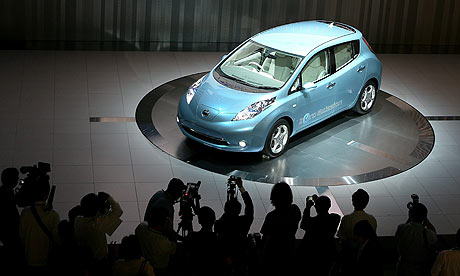
Nissan's new Leaf

Nissan have just introduced the new Leaf hatchback, an all-electric car that will require no petrol and have no gear shift. The fully-charged Leaf will be able to go for 100 miles, a range that Nissan's experts say will meet the daily travel needs of 70% of drivers.

By 2012, Nissan's plan is to be manufacturing 2oo,000 Leaf units per year for the global market.

Chief executive Carlos Ghosn expects electric cars to become commonplace during the next decade. Of course, only when numerous recharging stations are available in public places will the Leaf and its competitors be able to win over car buyers.

Interestingly, Nissan may lease the lithium-ion battery that the Leaf will require for recharging. The idea of leasing the battery month-to-month could confuse buyers at first, although it may turn out to be a marketing success if Nissan upgrades leased batteries for free as technology improves.

Nissan's Zero Emission website, which explains the drive for zero emissions and introduces the Leaf, is worth a visit.