Paper clips! Pacifiers! Paper tissues! Entrepreneurs of the past developed these products to solve common problems and today, such solutions are quite cheap and readily available.
London's Science Museum has a new exhibit showing these and other "hidden heroes" of everyday technology. It's hard to remember that items like paper clips were once innovative and unusual, truly technological advances over older, homemade alternatives. Today, they're simply accepted as ordinary.
The museum's exhibit is so interesting because it reminds us that technology need not have chips or batteries to be cutting-edge. Which of the products we view as high-tech today will be hidden heroes of tomorrow?
Sunday, 13 November 2011
Thursday, 10 November 2011
Most trusted family brands: M&S is #1
In a recent survey by YouGov and Isobel, Marks & Spencer was named as the most trusted brand for families. Last year, M&S was #2, and its ascent to the top spot shows how well its advertising is working, according to Marketing Week mag.
Here are the survey results for this year and last year:
Note how many of the top brands are retail companies. Also, how did Innocent manage to improve its standing from #13 in 2010 to #5 in 2011? That's a very impressive result, and my immediate reaction is that its expanded product line and heftier marketing budget are both helping Innocent increase awareness and preference.
Here are the survey results for this year and last year:
Note how many of the top brands are retail companies. Also, how did Innocent manage to improve its standing from #13 in 2010 to #5 in 2011? That's a very impressive result, and my immediate reaction is that its expanded product line and heftier marketing budget are both helping Innocent increase awareness and preference.
Monday, 7 November 2011
Best Buy and Carphone Warehouse Change Direction
The two companies are still working together, however. Best Buy is buying Carphone Warehouse's ownership stake in Best Buy Mobile (a growing business) and the two are starting a new operation, Global Connect, to retail mobiles and related services in Best Buy affiliated stores within Asia and other regions.
Best Buy is continuing to explore expansion of its non-store retailing, including Best Buy Express kiosks located in airport terminals and other places.
How much will online shopping affect in-store retailing? Will retail kiosks gain in popularity?
Thursday, 3 November 2011
Brand Personality Wins for TGI Friday's
Casual dining is a very competitive industry, which is why TGI Friday's is pouring on the personality.
Its all-American atmosphere and menu draw customers, but to encourage frequent repeat visits, the chain embarked on a hiring and training programme that emphasises personality plus. Bartenders who juggle, waiters and waitresses who do magic tricks, and other staff specialities keep customers smiling and satisfied--according to TGI Friday's research.
TGI Friday's UK isn't a super-social brand (it has fewer than 20,000 Facebook likes) but its "We make every visit a party" saying sums up the personality that customers can expect and enjoy when they come for a drink or a meal or both. Best of all, the party changes every time, with different tricks and surprises.
Its all-American atmosphere and menu draw customers, but to encourage frequent repeat visits, the chain embarked on a hiring and training programme that emphasises personality plus. Bartenders who juggle, waiters and waitresses who do magic tricks, and other staff specialities keep customers smiling and satisfied--according to TGI Friday's research.
TGI Friday's UK isn't a super-social brand (it has fewer than 20,000 Facebook likes) but its "We make every visit a party" saying sums up the personality that customers can expect and enjoy when they come for a drink or a meal or both. Best of all, the party changes every time, with different tricks and surprises.
Thursday, 27 October 2011
Biggest holiday toy hits of 2011?
The Toy Retailers Association has released its list of toys expected to be in highest demand during this holiday buying season. First, a look back. In 2010, the association said that the following would be the biggest holiday gift sellers:
Lego City Airport, Fireman Sam Deluxe Fire Station Playset, Hasbro's FurReal Go Go Walking Pup, Mattel's Jet Pack Buzz Lightyear, Kidizoom VideoCam, Monopoly Revolution, Moon Dough Barn, Nerf N Strike Stampede, Paper Jamz Guitar, ‘Pumpaloons’ – action game, Sylvanian Families Motorcycle and Sidecar, and ZhuZhu Grooming Salon.
In 2011, the association predicts that these toys will top holiday gift lists:
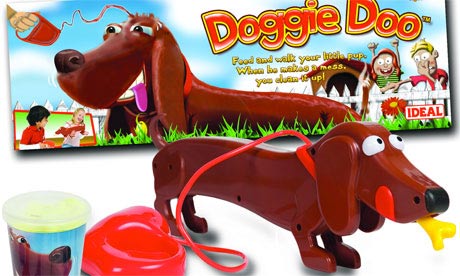
Doggie Doo (above), Fijit Friends, Fireman Sam Pontypandy Rescue Set, Kidizoom Twist, LeapPad Explorer, Let's Rock Elmo, Milky the Bunny, Monster High Lagoona's Hydration Station, Moshling Tree House, Nerf Vortex Nitron Blaster, Ninjago Fire Temple from Lego, and the Star Wars Ultimate Force Tech Lightsaber Assortment.
After the announcement, the Toronto Star's headline read: Is a pooping dog this year's hottest Christmas toy?
My question exactly. We'll know the answer before long.
Lego City Airport, Fireman Sam Deluxe Fire Station Playset, Hasbro's FurReal Go Go Walking Pup, Mattel's Jet Pack Buzz Lightyear, Kidizoom VideoCam, Monopoly Revolution, Moon Dough Barn, Nerf N Strike Stampede, Paper Jamz Guitar, ‘Pumpaloons’ – action game, Sylvanian Families Motorcycle and Sidecar, and ZhuZhu Grooming Salon.
In 2011, the association predicts that these toys will top holiday gift lists:
Doggie Doo (above), Fijit Friends, Fireman Sam Pontypandy Rescue Set, Kidizoom Twist, LeapPad Explorer, Let's Rock Elmo, Milky the Bunny, Monster High Lagoona's Hydration Station, Moshling Tree House, Nerf Vortex Nitron Blaster, Ninjago Fire Temple from Lego, and the Star Wars Ultimate Force Tech Lightsaber Assortment.
After the announcement, the Toronto Star's headline read: Is a pooping dog this year's hottest Christmas toy?
My question exactly. We'll know the answer before long.
Monday, 24 October 2011
There's an app for that: shopping by mobile
These days, most major retailers offer a downloadable app for browsing and shopping by mobile. Want to check Amazon.com's stock and prices? There's an app for that. Want to bid or buy on eBay? There's an app for that.
Waitrose offers a special Christmas shopping app. Sainsbury has apps for meal planning and grocery shopping.
Asda even has an app to compare prices at competing stores as part of its low-price guarantee (illustrated here). Tesco is testing an app to help shoppers find the most efficient route through its stores.
Will retailers offer apps for finding and viewing holiday window displays this year?
Asda even has an app to compare prices at competing stores as part of its low-price guarantee (illustrated here). Tesco is testing an app to help shoppers find the most efficient route through its stores.
Will retailers offer apps for finding and viewing holiday window displays this year?
Saturday, 22 October 2011
Will Internet outposts succeed?
House of Fraser has just opened an "Internet only" retail outlet in Aberdeen. You won't find any shelves of merchandise, no racks of clothing, no inventory of any kind.
This new location is only an outpost: You can browse the store's stock on screen, click to order, and return the next day to try on clothes you ordered or pick up your purchases.
Will such outposts succeed in today's multichannel world? In the United States, JC Penney and other catalog merchants used to have catalog outlets that worked in a similar way, without the Internet interactivity, of course. Some carried a limited range of products, but most were focused on taking catalog orders. Most or all are now gone.
Dell also had a version of this concept at one time, putting small stores or kiosks in shopping centers where customers could try different laptops or computers and ask questions, then order online or via phone. After a few years, Dell closed the kiosks and widened its retail distribution base, allowing customers the choice of trying and buying at the store and being able to carry home purchases for immediate use.
These days, Internet kiosks inside stores are frequently used to let customers locate additional merchandise that can be ordered or obtain details about products available right there. Debenhams is installing many such kiosks to supplement its in-store range. John Lewis is opening limited-range stores with kiosks where customers can view the full range of stock and place orders.
The question is: Will shoppers travel to an outpost merely to browse online offerings? Will limited-range stores generate enough turnover--even with Internet kiosks--to be profitable? Or will multichannel strategies that combine Internet and mobile access from the customer's home or office with traditional store shopping offers be more effective?
This new location is only an outpost: You can browse the store's stock on screen, click to order, and return the next day to try on clothes you ordered or pick up your purchases.
Will such outposts succeed in today's multichannel world? In the United States, JC Penney and other catalog merchants used to have catalog outlets that worked in a similar way, without the Internet interactivity, of course. Some carried a limited range of products, but most were focused on taking catalog orders. Most or all are now gone.
Dell also had a version of this concept at one time, putting small stores or kiosks in shopping centers where customers could try different laptops or computers and ask questions, then order online or via phone. After a few years, Dell closed the kiosks and widened its retail distribution base, allowing customers the choice of trying and buying at the store and being able to carry home purchases for immediate use.
These days, Internet kiosks inside stores are frequently used to let customers locate additional merchandise that can be ordered or obtain details about products available right there. Debenhams is installing many such kiosks to supplement its in-store range. John Lewis is opening limited-range stores with kiosks where customers can view the full range of stock and place orders.
The question is: Will shoppers travel to an outpost merely to browse online offerings? Will limited-range stores generate enough turnover--even with Internet kiosks--to be profitable? Or will multichannel strategies that combine Internet and mobile access from the customer's home or office with traditional store shopping offers be more effective?
Tuesday, 18 October 2011
Lego versus Mickey: Theme parks battle for visitors
The first LegoLand theme park opened in 1968. Now its owner, Merlin Entertainments, is expanding globally and has just opened the fifth LegoLand theme park, an easy drive from where DisneyWorld is located in Florida, USA.
Merlin operates 77 entertainment sites in 17 countries, achieving £800m annual sales worldwide. Its brands include Madame Tussauds, the London Eye and of course, LegoLand. The company knows its way around the theme park business and its Lego brand appeal is very strong.
LegoLand is also facing competition from other nearby theme parks (Universal Studios and SeaWorld). Florida is home to many other family-friendly attractions, as well. Can Merlin's marketing muscle (and 50 million Lego blocks) help LegoLand Florida beat the Mouse?
Merlin operates 77 entertainment sites in 17 countries, achieving £800m annual sales worldwide. Its brands include Madame Tussauds, the London Eye and of course, LegoLand. The company knows its way around the theme park business and its Lego brand appeal is very strong.
LegoLand is also facing competition from other nearby theme parks (Universal Studios and SeaWorld). Florida is home to many other family-friendly attractions, as well. Can Merlin's marketing muscle (and 50 million Lego blocks) help LegoLand Florida beat the Mouse?
Saturday, 15 October 2011
Another Successful Byte Night
The most recent Byte Night, held earlier this month, raised over 650,000 pounds to benefit the nonprofit Action for Children.
If you haven't heard of Byte Night, it's the info-tech industry's annual "sleep rough" fundraiser. Corporate teams and individuals sleep out in the elements to raise money for programmes that help vulnerable and neglected children around the UK.
Accenture conducted research about "the generous generation," examining how tech-savvy adults in their 20s and 30s stay involved with the causes they care about. Not surprisingly, the research showed that technology such as social media plays a vital role.
In fact, a lot of technology was used to market Byte Night and recruit sponsors and sleepers. Twitter messages kept the momentum going minute by minute and engaged all participants; a countdown on Facebook (left) reminded participants of when and where to go; organisers and participants used YouTube to share videos of the experience; and LinkedIn was helpful for corporate connections. As shown above, contributors could text their donations, as well.
Congratulations to Byte Night!
If you haven't heard of Byte Night, it's the info-tech industry's annual "sleep rough" fundraiser. Corporate teams and individuals sleep out in the elements to raise money for programmes that help vulnerable and neglected children around the UK.
Accenture conducted research about "the generous generation," examining how tech-savvy adults in their 20s and 30s stay involved with the causes they care about. Not surprisingly, the research showed that technology such as social media plays a vital role.
Congratulations to Byte Night!
Thursday, 13 October 2011
KidZania!
Have you heard of KidZania?
Kids from Mexico City to Tokyo and beyond are having fun playing career roles in mini-cities created by KidZania.
The "cities"--spaces in malls--have different areas devoted to occupations such as pilot, veterinarian, and so on.
Now the company, founded in 1996, is expanding rapidly through franchising in different regions. Take a look at this slide show for more.
What makes KidZania even more interesting (from a marketing perspective) is that brands such as the US-based Coca-Cola and Portugal-based Cin are sponsoring areas or props in various career areas of local KidZania spaces. Kids who want to try out medical careers, for instance, play in the Johnson & Johnson-branded infirmary. Cin sponsors areas where kids paint walls as part of construction/home decorating occupations.
What issues are raised by putting brands into kids' hands and minds earlier and earlier?
Kids from Mexico City to Tokyo and beyond are having fun playing career roles in mini-cities created by KidZania.
The "cities"--spaces in malls--have different areas devoted to occupations such as pilot, veterinarian, and so on.
Now the company, founded in 1996, is expanding rapidly through franchising in different regions. Take a look at this slide show for more.
What makes KidZania even more interesting (from a marketing perspective) is that brands such as the US-based Coca-Cola and Portugal-based Cin are sponsoring areas or props in various career areas of local KidZania spaces. Kids who want to try out medical careers, for instance, play in the Johnson & Johnson-branded infirmary. Cin sponsors areas where kids paint walls as part of construction/home decorating occupations.
What issues are raised by putting brands into kids' hands and minds earlier and earlier?
Subscribe to:
Posts (Atom)