Showing posts with label tablet computer. Show all posts

Tuesday, 21 August 2018

Trends in UK consumer media usage

https://www.ofcom.org.uk/about-ofcom/latest/media/media-releases/2018/decade-of-digital-dependency
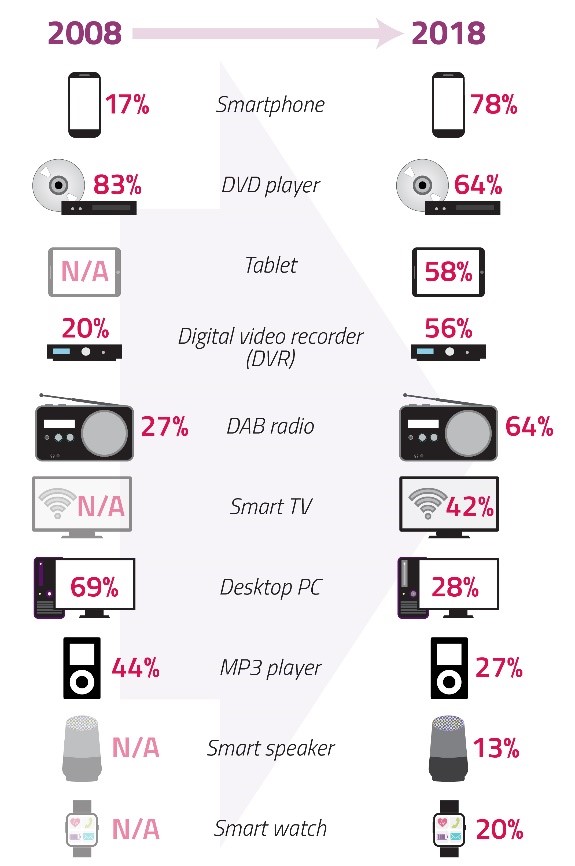
No surprise: UK adult consumers continue to be online for many hours of the day. According to Ofcom, which regulates UK telecommunications, they are online, on average, more than 24 hours every week. One in five UK adults is online 40 hours per week.

As shown in the chart above, fewer UK consumers are using desktop PCs. Instead, they're using mobile devices like smartphones and tablets (which were in their infancy in 2008).
Similarly, both smart watches and smart speakers are gaining in popularity--products that weren't available a decade earlier.

On the other hand, DVD players are losing ground, as are MP3 players.

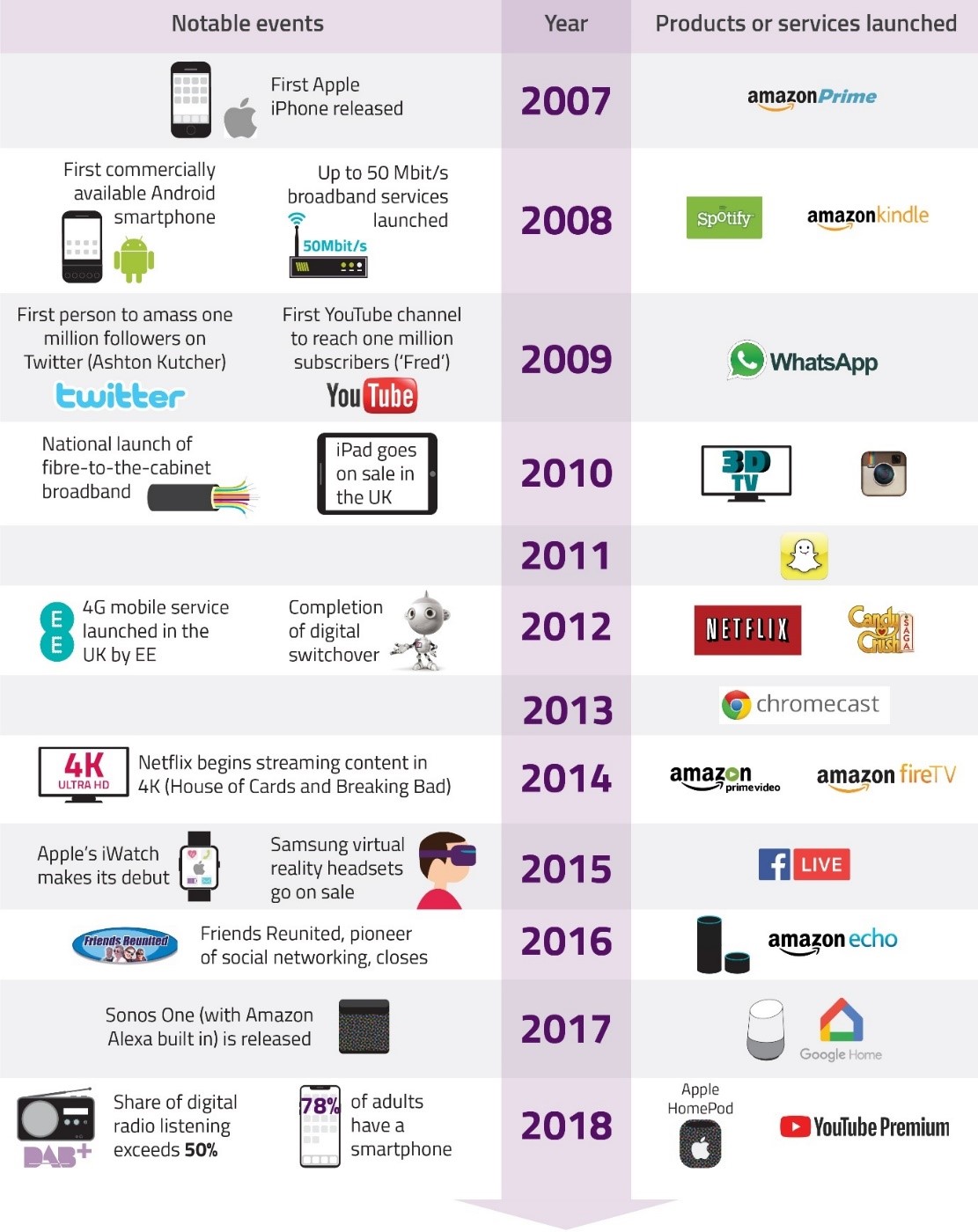
Ofcom presents this timeline showing what products and services were introduced, and when.

How many of the products and companies named in this infographic will still be going strong in 2028?

Note that eMarketer recently reported that UK consumers consume media for 9 hours and 23 minutes per day, on average. This covers books and newspapers, not just broadcast and digital media. No growth since the previous year, indicating overall media consumption is not growing. However, mobile usage is up, within that 'flat' media usage statistic.

Thursday, 31 July 2014

More mobiles, more mobile advertising

Spending on mobile ads to UK consumers will exceed £2 billion in 2014, according to eMarketer. That puts mobile ad spend on a par with print ads--but by 2015, mobile ad spend is projected to be higher than newspaper ad spend. By 2016, mobile ad spend could even surpass TV ad spend.

Marketers know consumers are using mobile devices like iPhones and iPads for everything from communication to price-checking to shopping to . . . social networking. And with lower-priced smartphones widely available, mobile ownership continues to rise.

No wonder marketers are testing new ad formats and configuring ads specifically for mobile users. Screen sizes differ among mobile devices, an important consideration in ad design.

Also, marketers must understand the buying decision process--where and how consumers use mobile to search for products or brands, to compare prices, to make purchases. That consumer behaviour background will help companies determine what messages to craft, what media to use and when to advertise to best advantage.

Wednesday, 8 January 2014

Tesco, Hudl and multichannel marketing

Now that Tesco is out of its disastrous Fresh & Easy US convenience store chain, the UK retail giant is (like every smart retailer) focusing on multichannel marketing strategy. It's also thinking global and looking beyond retailing to enhance relationships with consumers.
  • Tesco has been introducing drive-through grocery pickup at select locations. Shoppers log onto the Tesco website to buy, indicate a two-hour window for pickup and then collect their groceries from the store or pickup location of their choice.
  • Supporting its online grocery sales, Tesco has opened its sixth warehouse for picking and packing customer orders.
  • Tesco is getting good reviews for its Hudl budget-priced tablet computer (right), and plans a new model this year. Putting the spotlight on tech updates the retailer's image and reinforces its commitment to multichannel marketing. It also helps Tesco compete against Asda, which has its own Lifetab tablet.
  • Tesco is moving ahead in India, a continuation of its partnership with Tata that began in 2008, to build sales and gain experience in this unusual retail environment.
  • Years after launching Tesco Bank, the company has begun offering a current account, which in combination with its mortgage offerings will raise the firm's profile and attract new interest. Especially with the "easy switch" banking rules now in effect, Tesco Bank sees new opportunity to deepen its relationships with consumers who shop in its stores.

Friday, 25 March 2011

Tablet Computers: Privacy vs Convenience

Tablet computers--iPads and competing tablets--are so light and convenient that shopkeepers in Estonia are using them to show YouTube product demonstrations and tally customers' purchases. Restaurant owners in Tokyo are testing iPad-based menus that allow customers to order with a touch (below). Small and medium-sized businesses are adopting tablets, as well. In hospitals, iPads are making the rounds with physicians.

But will the rush for convenience overwhelm the need for securing private data such as credit card numbers, customer details, and proprietary business information?

Tablet malware is a small but growing problem, for example. And a Harris Interactive poll shows that nearly half of the tablet users in the study are sending sensitive data via tablets.

UK and European regulators have established strict rules for data storage and protection. But they can't force every tablet user to input a strong password and they can't secure every wireless connection. Marketers should consider the privacy angle very carefully before they begin relying on a tablet for business functions.

Sunday, 27 February 2011

Tablet computing heats up

Without question, Apple's iPad is the best-known tablet computer on the market today. Others came before, but the iPad redefined the concept with its usual high-style design, touch-functionality and multiple features. Now HTC, the master of smartphones, is developing its own tablet computer to challenge Apple's dominance. "I think we are just at the beginning for innovation in the tablet market," HTC's John Wang told the Guardian. In fact, HTC revealed a prototype of its Flyer tablet (left) just two weeks ago.Reportedly, the Flyer will run on Google's Android system and will feature a stylus as the main input method. The projected price: 499 euros.

Since iPad prices vary around the world (see Economist table below), HTC may decide to vary its Flyer price, as well. In fact, a study out today says that tablet prices will have to drop before this becomes a mass-market product with significant sales volume. No matter what the price, HTC's new entry will give customers a new choice and put pressure on Apple and other rivals to continue innovating AND dropping prices.