Blockchain is best known as the secure technology driving crytocurrencies such as bitcoin. Because of its security and the speed/accuracy of exchanging data, blockchain is increasingly being considered by retail marketers worldwide.
One key function of blockchain is to identify the supply-chain provenance of a product and track its movement through the distribution network. This is extremely important as retailers source products from around the world.
Carrefour, the French hypermarket retailer, is planning to implement blockchain for fresh foods such as tomatoes and chickens. This will enable the retailer to trace back to the source any possible problems.
Consumers will be reassured that Carrefour can quickly and accurately identify where fresh foods come from--and have confidence about the source. With 33,000 stores in 12 nations, blockchain will be a plus for Carrefour's ability to manage its fresh foods supply chain.
'The key thing for us as Carrefour is to be able to say when there is a crisis that we have the blockchain technology, so we are able to trace products and tell the story of the products', says the retailer's Secretary General.
Showing posts with label supply chain. Show all posts
Showing posts with label supply chain. Show all posts
Wednesday, 24 October 2018
Wednesday, 18 March 2015
World's biggest clothing retailer expands online
Do you know which company is the world's biggest clothing retailer?
Hint: The company is based in Spain and has 6,700 stores in 54 nations. It designs, manufactures, distributes and retails its own products using the 'fast fashion' business model.
Not only can this company make the most of emerging fashion trends, it can minimise markdowns and increase profitability because of its extraordinary ability to capture and analyse purchase data and because it controls the supply chain.
The firm's retail brands include Pull & Bear, Massimo Dutti, Bershka, Stradivarius, Uterqüe, Oysho, Zara and Zara Home.
Yes, the company is Inditex, which has just reported excellent profits. Zara is its best-known brand in most countries. Knowing its customers' digital preferences, Zara is very social, with 3 million Instagram followers, 24 million Facebook likes, 735,000 Twitter followers and 125,000 Pinterest followers.
However, online-only fashion retailers are a threat to the parent company's retail sales momentum. That's why Inditex is expanding its online operations and also moving toward larger stores rather than smaller ones--to make a retail statement, offer more styles in more sizes and colours, and reinforce a strong competitive image in top metropolitan markets where fashion stores are almost everywhere.
Nothing is left to chance. Inditex has pilot stores where it tests marketing elements such as window displays and merchandise layout. Elements that test well are put into action quickly, and the company is always testing something new.
Hint: The company is based in Spain and has 6,700 stores in 54 nations. It designs, manufactures, distributes and retails its own products using the 'fast fashion' business model.
Not only can this company make the most of emerging fashion trends, it can minimise markdowns and increase profitability because of its extraordinary ability to capture and analyse purchase data and because it controls the supply chain.
The firm's retail brands include Pull & Bear, Massimo Dutti, Bershka, Stradivarius, Uterqüe, Oysho, Zara and Zara Home.
Yes, the company is Inditex, which has just reported excellent profits. Zara is its best-known brand in most countries. Knowing its customers' digital preferences, Zara is very social, with 3 million Instagram followers, 24 million Facebook likes, 735,000 Twitter followers and 125,000 Pinterest followers.
However, online-only fashion retailers are a threat to the parent company's retail sales momentum. That's why Inditex is expanding its online operations and also moving toward larger stores rather than smaller ones--to make a retail statement, offer more styles in more sizes and colours, and reinforce a strong competitive image in top metropolitan markets where fashion stores are almost everywhere.
Nothing is left to chance. Inditex has pilot stores where it tests marketing elements such as window displays and merchandise layout. Elements that test well are put into action quickly, and the company is always testing something new.

Tuesday, 17 June 2014
Costa brews up supply-chain success

Costa Coffee is opening new stores as the economy improves and customers regain their spending momentum. The brand is social, with 1.1 million Facebook likes and 94,000 Twitter followers.
New products are launched with YouTube support on Costa's Coffee Lovers channel. And Instagram is another way Costa promotes its brand, its products and its special events.
Wednesday, 5 June 2013
Transparency in marketing builds trust
In a world where consumers have more information, more choices and more power than ever before, transparency is needed to build trust and reinforce brand loyalty.
Transparent pricing is often a major concern, especially because different online sites may quote different prices for the same offering (airfares, for instance, and hotel rooms). Who can you trust to give you the best price?
 'The transparency issue is not going away', says a vice-president of InterContinental Hotels Group. 'It's not only on our rates but also our company and who we do business with--corporate responsibility'. After InterContinental instituted a Best Rate Guarantee for customers who reserve rooms through its website, research showed that more than 80% of customers cited this price transparency as the main reason for their repeat purchasing and loyalty.
Yet pricing isn't the only marketing element that requires transparency. Scandals surrounding dangerous, deadly worker conditions in Bangladesh and China, and public outrage over horse meat found in food products, are only two areas that put behind-the-scenes conditions in the spotlight.
 Customers, it turns out, really do care about ethics in the supply chain, starting with raw materials and moving through production and distribution. This is why Fair Trade food products are increasingly popular, and even smartphones made from ethically-sourced parts are starting to attract customers.
Transparency is a major point of differentiation for upmarket goods, in particular. Brunello Cucinelli, Italy's 'King of Cashmere', recently paid his 700 employees a significant bonus for their skilled work on chic cashmere knitwear (as in photo at right). 'Luxury consumers want to know, or will want to know, that their goods are made humanely', Cucinelli explains.
Transparent pricing is often a major concern, especially because different online sites may quote different prices for the same offering (airfares, for instance, and hotel rooms). Who can you trust to give you the best price?

Yet pricing isn't the only marketing element that requires transparency. Scandals surrounding dangerous, deadly worker conditions in Bangladesh and China, and public outrage over horse meat found in food products, are only two areas that put behind-the-scenes conditions in the spotlight.
Customers, it turns out, really do care about ethics in the supply chain, starting with raw materials and moving through production and distribution. This is why Fair Trade food products are increasingly popular, and even smartphones made from ethically-sourced parts are starting to attract customers.Transparency is a major point of differentiation for upmarket goods, in particular. Brunello Cucinelli, Italy's 'King of Cashmere', recently paid his 700 employees a significant bonus for their skilled work on chic cashmere knitwear (as in photo at right). 'Luxury consumers want to know, or will want to know, that their goods are made humanely', Cucinelli explains.
Wednesday, 15 May 2013
Retailers deal with supply-chain workers' safety
Much of the world's clothing is made in Bangladesh factories, some unknown number possibly as dangerous as the factory where last month, more than 1,100 workers tragically lost their lives in a building collapse.
 Now H&M, Zara, Benetton and several other big-name retailers have committed to working closely with factory owners and the government to improve conditions. H&M issued a statement saying it wants to create an environment 'in which no worker needs to fear fires, building collapses or other
accidents that could be prevented with reasonable health and safety
measures'.
Now H&M, Zara, Benetton and several other big-name retailers have committed to working closely with factory owners and the government to improve conditions. H&M issued a statement saying it wants to create an environment 'in which no worker needs to fear fires, building collapses or other
accidents that could be prevented with reasonable health and safety
measures'.
UK's Primark and Canada's Loblaw will compensate the family of victims of the factory collapse. According to a Loblaw statement, 'We are working to ensure that we will deliver support in the best and most meaningful way possible, and with the goal of ensuring that victims and their families receive benefits now and in the future'.
Walmart has so far decided to conduct safety inspections on its own, saying it believes this is the fastest way to uncover and correct potential problems. The world's largest retailer plans to post the results of its factory inspections on its website, because 'transparency is the ultimate accountability mechanism'.
UK's Primark and Canada's Loblaw will compensate the family of victims of the factory collapse. According to a Loblaw statement, 'We are working to ensure that we will deliver support in the best and most meaningful way possible, and with the goal of ensuring that victims and their families receive benefits now and in the future'.
Walmart has so far decided to conduct safety inspections on its own, saying it believes this is the fastest way to uncover and correct potential problems. The world's largest retailer plans to post the results of its factory inspections on its website, because 'transparency is the ultimate accountability mechanism'.
Thursday, 25 April 2013
Samsung vs Apple: The supply chain holds the key
Largely invisible to customers, your supply chain is a vital element in marketing. Do you have the right suppliers, the right materials and the right inventory levels to deliver enough products to meet demand?
 Samsung is currently experiencing a supply chain problem that's delaying its intro of the Galaxy S4 smartphone in some markets. Why? Because global demand is unexpectedly high and Samsung's suppliers simply can't keep up.
Unfortunately, other elements of Samsung's marketing plan have already been implemented--including glitzy product launch parties, ads, and other activities. Customers are therefore seeing promotional messages and getting interested in the S4, only to learn that they can't buy one yet.
And that's a problem because Samsung is a major challenger to Apple in the smartphone market. In fact, Samsung sells more Galaxy mobiles than Apple sells iPhones. But if the supply chain can't keep up with demand, Samsung's customers (and distributors) will have to wait. Delays could change the way customers view Samsung and affect their ultimate buying decision.
Meanwhile, Samsung's profits have reached record-high levels. And, interestingly, Samsung is an important supplier in rival Apple's supply chain, making special microprocessor chips for iPhones. Both firms are clearly profiting from the continued increase in demand for smartphones.

Unfortunately, other elements of Samsung's marketing plan have already been implemented--including glitzy product launch parties, ads, and other activities. Customers are therefore seeing promotional messages and getting interested in the S4, only to learn that they can't buy one yet.
And that's a problem because Samsung is a major challenger to Apple in the smartphone market. In fact, Samsung sells more Galaxy mobiles than Apple sells iPhones. But if the supply chain can't keep up with demand, Samsung's customers (and distributors) will have to wait. Delays could change the way customers view Samsung and affect their ultimate buying decision.
Meanwhile, Samsung's profits have reached record-high levels. And, interestingly, Samsung is an important supplier in rival Apple's supply chain, making special microprocessor chips for iPhones. Both firms are clearly profiting from the continued increase in demand for smartphones.
Monday, 25 February 2013
Celebrating 30 years of Swatch watches
 |
Wristwatches were sometimes a status symbol and always functional but rarely a pop-culture fashion statement until a Swiss company launched the Swatch brand of affordable, fun plastic watches in 1983--changing the industry forever. This shift in strategy was so critical to the company's success that it changed its name to Swatch in 1998.
Today the Swatch Group is the world's largest maker of wristwatches--and it's celebrating the 30th anniversary of the original Swatch this year. The company's brands actually cover every price point from the low end (Swatch and Flik Flak) to the very high end (Omega, Breguet, Tiffany etc). You may remember that Omega was one of the official Olympics sponsors in 2012, a brand-building move that reinforced its reputation for precision.

Despite competition from low-price, Chinese-made wristwatches, Swatch continues to grow and prosper by emphasising brand value and by controlling much of its supply chain. The company is a global supplier of the movements that make wristwatches tick and the balance springs that regulate wristwatches. Because Swatch wants to reduce the quantities of components it sells to non-Swatch companies, competitors such as LVMH are looking to acquire component manufacturers so they, too, can control their supply chains.
In this 30th anniversary year, watch for advertising and in-store materials promoting Swatch's celebrations and the roots of its fashion heritage.
Wednesday, 13 April 2011
Japan and the Global Supply Chain
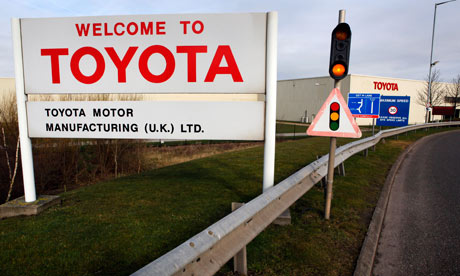
For example, Toyota's UK plants are temporarily shut because they can't get sufficient parts from Japan to continue production. Nissan and Ford have slowed or halted production at some factories, due to parts shortages. Manufacturers of other products that use Japan-made computer chips are worried about disruptions, as well.
Chip factories in Japan are working hard to bring production back to normal, but it will simply take time. As Japanese business inches towards normalcy, the economy will slowly improve and connections with the global supply chain will improve, too.
Subscribe to:
Posts (Atom)