Showing posts with label Nestle. Show all posts

Friday, 8 September 2017

Unilever and Nestle Pursue Niche Growth

Sweet Earth is being acquired by Nestle
Switzerland-based Nestle is buying a small California firm known for vegan and vegetarian foods; Dutch-British Unilever is buying a company that makes herbal organic teas.

Unilever is acquiring Pukka Herbs
Both of these multinationals are building part of their growth strategies around acquiring businesses and products in niches that are attractive because of increasing consumer appeal and the ability to be noticed through distinctive brands/products.

Unilever, for example, pursued Pukka Herbs because it is unusually fast-growing in its niche. Unilever's top tea executive explains: 'In the morning a lot of people still drink black tea as it picks you up, but in the afternoon or evening herbal tea is wonderful with different benefits'. In other words, Pukka Herbs complements Unilever's existing tea brands and products.

Nestle bought Sweet Earth, a vegan/vegetarian food marketer, to get firmly established in the plant-based protein market. Nestle USA's CEO comments: 'One of Nestlé’s strategic priorities is to build out our portfolio of vegetarian and flexitarian choices in line with modern health trends'.

Mainstream brands/products continue to sell--but certain niches are growing more rapidly and delivering customer acquisition (and profits) through specialization. That's why more multinationals will be exploiting growth opportunities by buying firms that have a following and a strong brand image in a well-defined niche.

Thursday, 1 December 2016

What's new in chocolate marketing?

Chocolate for the holidays . . . chocolate as an everyday affordable luxury . . . chocolate as a socially-responsible snack. These are some of the ways that chocolate marketers position their products. The world of chocolate marketing is changing, thanks to changes in technology, consumer behaviour and society.

  • Nestlé announced today that it has discovered a scientific way to reduce the amount of sugar in a chocolate bar without sacrificing taste. The company has been trying to reformulate its products to reduce levels of sugar. With obesity a concern in many nations, marketing chocolate with lower sugar could make products like Nestlé's KitKat bars more appealing to a wider market. 
  • Toblerone, made by Mondelez International, recently changed two of its chocolate bars to reduce the weight, in response to higher ingredient costs. Most if not all chocolate marketers are experiencing higher costs, which some can absorb for months and others must pass along in the form of higher prices or reduced-size products. 
  • Consumers are often interested in where a product's ingredients come from, seeking out ethically-sourced chocolate from companies that have a social responsibility agenda. 'Single-origin' chocolate is sourced from one area, ideally from one group of cocoa growers who receive fair-market pay for their crops. Single-origin chocolate also reflects the distinctive flavour of its beans. Waitrose, for example, is marketing chocolate bars from specific sources, each with its own flavour. 

  • Hotel Chocolat was a leader in single-origin chocolate, a first-mover advantage in mystique that has helped build its brand. Now Hotel Chocolat, which has a chain of branded shops, is continuing its growth by opening cafés where customers can experience its chocolates in a branded restaurant-style setting.
Some of these trends are discussed in the updated sample marketing plan for the fictional company Lost Legends Luxury Chocolatier, when my next edition of the Essential Guide to Marketing Planning is published in 2017.

Wednesday, 22 January 2014

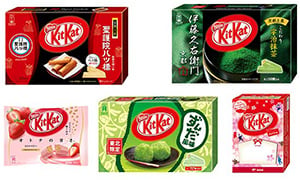
Sweet marketing for KitKat in Japan

Inside the Seibu department store at the Ikebukuro train station in Tokyo is a new chocolate boutique featuring one of Japan's favourite brands: Nestle's KitKat. The brand name has become associated with good luck because it sounds like the phrase 'I hope you will win'. Students in Japan buy KitKats with the thought that it will help them do well on exams.

Not surprisingly, KitKat uses marketing to build on this good luck perception. The new boutique sells some exclusive KitKat flavours created by chocolatier Takagi for Nestle, including Sublime Bitter, Special Sakura Green Tea and Special Chilli. The boutique is already selling out its limited-edition products daily, but revenues aren't the only reason for this retail venture: It's actually a high-profile brand-builder. Simply type "KitKat Chocolatory" or "KitKat Japan" into a search engine and you'll see the boutique's worldwide media coverage.

From 2007, Nestle has developed KitKat variations only for Japan. In fact, depending on where in Japanese consumers buy KitKats, they will find flavours not available in other areas (like Purple Potato). Most KitKat packaging features English (the brand and the brand owner) as well as Japanese, adding a 'global' angle that enhances the product's sweet marketing appeal.


Monday, 7 October 2013

No Cadbury trademark for Dairy Milk purple

Colour really counts: Consumers often recognise products by the distinctive packaging or labelling colours. Over time, a certain colour comes to be closely associated with the brand and individual branded products. Cadbury has been wrapping its milk chocolate bars in purple packaging since 1905, so when it applied to trademark the colour in 2004, that tradition seemed in the brand's favour.

In 2008, rival chocolatier Nestle contested the trademark, starting a legal battle that appears to be over--for now. Last year, Cadbury prevailed in court. Last week, however, the UK Court of Appeal ruled that Cadbury cannot have the trademark because the application 'required clarity, precision, self containment, durability and objectivity to qualify for registration'.

The result is that Cadbury is not able to have exclusive use of this purple colour for milk chocolate bars or any other product. However, it still retains the legal right to prevent competitors from copying its trade dress (the visual appearance of a product, including its shape and the colour of packaging) in an attempt to 'pass off their products as Cadbury chocolate', as the company notes in a statement.

Cadbury has the option of appealing through EU legal channels. Or it may reapply for trademark protection with more specific language.

Tuesday, 11 June 2013

Hot market for single-serve coffee pods

The global market for single-serve coffee capsules is enormous, estimated at €9 billion  this year alone--with more growth on the way.

No wonder Nestle's Nespresso, which practically invented the industry, is about to feel even more of a competitive squeeze.

The company is known for its stylish boutiques (see left, a view of its Copenhagen store) and full range of feature-rich espresso and coffee machines.

Customers can buy from Nespresso's stores or order online for home or office delivery, an added convenience reflecting brand loyalty.

In recent years, Nespresso has faced a growing mountain of competition from companies that are making replacement coffee pods designed to fit Nespresso machines. Although Nestle has taken some of these rivals to court, it has lost its legal battles in Germany and in the UK, so far.

This week, Mondelez (formerly Kraft Foods), announced plans to introduce its own version of single-serve coffee pods to fit Nespresso machines. The Mondelez executive heading up the product introduction says: 'We'll see very strong growth coming out of this particular launch'.

For his part, Nespresso's CEO has a positive attitude about the market it dominated for many years. He says: 'Competition is an innovation driver for us' as his company continues to use quality as a key point of differentiation.

Monday, 3 June 2013

Connecting with pet owners

According to the Pet Food Manufacturers Association, nearly half (48%) of all UK households have a pet (or more than one).

In addition to the approximately 8 million cats and 8 million dogs, the UK pet population includes an estimated 500,000+ hamsters, one million caged birds and 300,000 lizards.

The industry is highly competitive and brands must differentiate themselves in a meaningful way in order to maintain or increase market share. This means segmenting the market to target specific groups such as consumers who prefer all-natural pet foods or those whose pets have specific nutritional needs, as just two examples.

So how are pet food manufacturers reaching out to pet owners? Through advertising, of course, but also via apps and social media.
  • Mars, maker of Pedigree, Cesar, Sheba and Whiskas has just introduced a new UK campaign focused on health and nutrition. 'Nutrition is what makes dogs and cats healthy and happy and that’s fundamental to every owner', explains the marketing director. 'We know more about [dog and cat] nutrition than any other company out there and have developed a strategy that helps establish that expertise in an accessible way for pet owners'. The Pedigree brand hosts a Facebook page titled We're for Dogs.
  • Nestle Purina's strapline is 'Helping pets lead healthy, happy lives for over 85 years'. Purina is targeting niches as well as the mainstream pet owner. With 'my dog uk', Purina offers an app that will show owners where dogs are welcome or help owners find a vet in a hurry (left). The firm also has a Facebook page devoted to battling pet obesity.
  • Hill's Pet Nutrition is launching a new pet food available only through vets, promoting the benefit of weight loss for cats and dogs. Other products feature nutritional benefits geared to the pet's age, weight and sensitivity to ingredients. Yes, Hill's is social: See its Facebook page, for example. 

Tuesday, 16 October 2012

Cadbury wins battle for purple


Cadbury has been fighting Nestlé for four years over which company has the legal right to use a particular colour of purple on product packaging. Cadbury filed a trademark on Pantone 2685C in 2008, touching off the legal battle with Nestlé, which was using the purple for its Wonka brand.

In December, 2011, Cadbury won a court ruling that gave it the legal right to trademark the purple. Then Nestlé appealed that ruling, saying a colour isn't trademarkable.

Two weeks ago, the High Court ruled that Cadbury is entitled to trademark the colour for use on milk chocolate bar packaging.

The judge noted: 'In my judgment it would not be right to say that the colour purple is distinctive of chocolate generally'.

In fact, Nestlé points out that the ruling actually 'protects our brands by further limiting the range of goods for which Cadbury’s application may be registered'.

Cadbury is already promoting 'our famous colour purple' and introducing new chocolate bars with its purple packaging.

Will the two food companies continue battling over colours in the future?

Thursday, 8 March 2012

Your chocolate personality is...

What's your chocolate personality? Nestle will help you discover it and customise collections of luxury chocolates to your taste, under its upmarket Maison Cailler brand.

Adapting the customisation strategy that has made Nespresso into a major international coffee brand, parent company Nestle wants to help you find the exact choco flavours you like, send you a sampler to test, profile your preferences and then encourage you to buy your customised boxes of Swiss-made chocolates on a regular schedule.

For now, Maison Cailler will be online only, serving two European countries with expansion plans to follow. Or you can visit its retail boutique in Switzerland at the newly-opened Maison Callier chocolate centre, which offers tours and even a chocolate train.

Friday, 27 August 2010

Choco marketing

Because the sample marketing plan in my Essential Guide to Marketing Planning is about Lost Legends Luxury Chocolatier (a made-up firm), I like to watch for developments in marketing chocolate.

The Economist reports that during July, a London-based hedge fund arranged to buy a huge cache of cocoa beans. This is important because the fund actually had the beans delivered to warehouses around Europe, waiting for the right time to resell and profit from market dynamics. And, as the Mail Online notes, it's the largest single purchase of beans in 14 years.

Even before the fund made its move, cocoa prices had been rising, causing choco marketers to either accept slimmer profit margins or--more frequently--increase prices. Nestle projected, late last year, that the UK choco market would not grow in 2010, in part because of higher costs and in part because of consumers' ongoing concerns about the economic outlook. Nestle has a brief overview of its UK choco manufacturing history here.

Meanwhile, Divine Chocolate (below) has been quite successful in marketing Fairtrade choco sourced from West African beans.

Finally, check out the Times 100 business case study on creating a sustainable choco industry, available in .pdf and mp3 formats.

Monday, 6 July 2009

Nestle Wants Trust

Paul Bulcke, Nestle's chief executive, is aiming for more trust. He recently told The Sunday Times:

'One of the targets I put when I defined our vision was to be trusted by all stakeholders. I don’t say "loved", that’s stupid, but trusted. That’s a start.'

Nestle has set objectives for marketing its food, beverage and pet products in every nation on Earth. [Updating my Chapter 5 on direction and objectives.] It's investing especially heavily in regions such as Southeast Asia, where economic growth is pushing consumer income higher year by year.

To position itself for achieving marketing-plan objectives such as capturing higher market share and profits despite intense competition, Nestle needs more than a well-known brand and well-regarded products such as KitKat bars--it needs, as Bulcke observes, 'to be trusted by all stakeholders.'