Sainsbury's recently announced it would offer same-day delivery of groceries ordered by noon. This is one of the ways the supermarket giant is battling aggressive competition from Amazon and no-frills discounters like Aldi. Sainsbury's is also proceeding with its acquisition of Argos, which itself offers same-day delivery or collection of toys and other products.
Amazon is offering same-day grocery delivery in London (in partnership with Morrisons for certain private brands). Whether delivered by drone in the future, as shown above, or not, Amazon Fresh promises Prime members that orders placed before the cutoff time will be at the customer's door by evening.
Rivals Aldi and Lidl are feeling the challenge of Brexit's impact on currency fluctuations. Because both Aldi and Lidl source many products from EU suppliers, the UK stores have to deal with higher costs when the pound sterling is low--and higher costs cut into already thin profit margins. For Sainsbury's and other UK-based retailers, however, this may present an opportunity to press price war advantages.
Meanwhile, speedy delivery is a niche being explored by startups such as Convibo, which offers one-hour delivery of grocery orders from London retailers such as Whole Foods and Waitrose. How much demand exists for one-hour delivery, compared with same-day delivery, is unclear--but this startup is a good example of distribution in general and service in particular as key points of differentiation.
Showing posts with label Morrisons. Show all posts
Tuesday, 2 August 2016
Monday, 23 November 2015
Applying Sensory Marketing
Sensory marketing is the use of marketing techniques to appeal to the consumer's five senses (sound, sight, smell, taste, and touch). The ultimate goal is to encourage a certain attitude or emotion or action when consumers are exposed to the brand or product or marketing message. In other words, to influence consumer behaviour.
British Airways is using sound to enhance the taste of its inflight meals, another example of sensory marketing. Based on research that shows how taste is influenced by sound, among other senses, the airline offers 14 musical tracks chosen to complement the foods that passengers eat during flights.
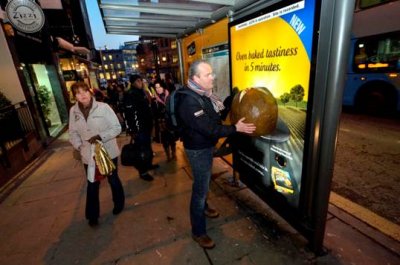
Smell. The frozen food marketer McCains used aroma to advertise a new frozen potato product, pumping the fragrance of freshly baked potatoes into the air in front of selected transit ads (see photo). Thanks to this sensory marketing, the new product attracted a significant percentage of buyers who were new to the category. Every time a perfume marketer offers a free spritz or scents the air in a store, that's sensory marketing.
Sight. Think of those holiday displays in store windows--the use of sensory marketing is a vital element in retailing. Major retailers like Liberty widely publicise the 'unveiling' of their special holiday windows, drawing crowds for weeks. Every rack, every display, every website, every print ad and TV advert employs sight to enhance, influence and reinforce brand awareness, preference, purchase.
Taste. Free food samples are a common example of sensory marketing. When the Saucy Fish Co. began distributing its seafood products through US grocery retailers, it offered in-store sampling so shoppers could taste before making a purchase. Most supermarkets offer food samples during busy shopping periods, letting consumers try risk-free before they pay for something they've never tried before.
Touch. Samples are also important for new products that depend on consumers being able to touch the product, turn it over, examine it carefully from all angles and test its weight or size. Nuby is one of several companies that provide product samples (in this case, of baby products) to subscription sample companies so that customers get a fresh freebie in a box every month. Grocery items are sometimes launched by including a small-size package with a regular-size package.
Next time you see an ad, walk through a store or scroll through a retailer's website, think about how sensory marketing is being used to appeal to your senses and your heart and mind.

Labels:
consumer behaviour,
Liberty,
McCains,
Morrisons,
Nuby,
Saucy Fish,
sensory marketing
Wednesday, 29 April 2015
Market share and competition in UK grocery retailing
UK supermarkets are locked in an intense competitive battle that often focuses on price. According to Statista, Tesco maintains its market-share leadership with 28% of the UK market for groceries, followed by Asda, Sainsbury and Morrisons (12 weeks as of March 1, 2015). Aldi and Lidl are increasing their share as well, making the UK a highly competitive marketplace for all in the grocery industry. Morrisons has just made a change in its marketing plan: It will replace many self-service tills for express checkout of small orders with tills operated by staff members. The change in strategy is due to negative customer feedback about using self-serve for a few items. Surveys show that customers enjoy conversing with staff and they want speedy checkout when shopping for only a few items.
The CEO says: 'These checkouts - and our very helpful staff - will offer a quick and personal service, helping to keep queues low and improving thousands of shopping trips'.
Price wars are still the most visible element in UK grocery retailing, but convenience and personalised service are also important to customers. Now Morrisons (and its rivals) will watch customer behaviour to see reaction.
Labels:
ASDA,
competition,
customer behaviour,
grocery retailing,
market share,
Morrisons,
Sainsbury,
service,
Tesco
Wednesday, 9 October 2013
Supermarket shopping expands on Boxing Day
In today's multichannel world, shoppers can click to buy online or via mobile or on a tablet computer. They can use QR codes or UPC codes or browse virtual products. In short, store shopping isn't the only way to buy.
Yet some supermarkets are already announcing that they'll open more stores on Boxing Day, accelerating a trend that began after the turn of the century (this century!).
Back in 2007, Asda opened NO stores on Boxing Day, while rival Tesco opened a few dozen of its supermarkets. Fast-forward to 2010, when Asda opened 105 of its stores, Tesco opened 410 supermarkets and Sainsbury opened 236 stores.
For 2013, Morrisons will be opening grocery stores on Boxing Day--a first for that chain--while Asda, Sainsbury and Tesco will continue adding to the number of stores they open. Given the slow pace of economic recovery and the intense competition for shoppers, this isn't surprising. A Morrisons manager explains: 'We believe these opening hours mean customers will come to us rather than a competitor'. . .
Supermarket competition is especially intense because, according to a Payments Council study, 58p of every pound spent at a retailer goes to a UK supermarket. Those pence add up, and every grocery chain wants to get their share.
Two more factors are driving these Boxing Day openings: Bargain hunters are shopping at giant deep-discounters such as Aldi and more shoppers are seeking convenience. So even though grocery purchases are forecast to rise in the coming years, supermarkets will be fighting to hold onto their store shoppers every day, including Boxing Day.
Yet some supermarkets are already announcing that they'll open more stores on Boxing Day, accelerating a trend that began after the turn of the century (this century!).
Back in 2007, Asda opened NO stores on Boxing Day, while rival Tesco opened a few dozen of its supermarkets. Fast-forward to 2010, when Asda opened 105 of its stores, Tesco opened 410 supermarkets and Sainsbury opened 236 stores.
For 2013, Morrisons will be opening grocery stores on Boxing Day--a first for that chain--while Asda, Sainsbury and Tesco will continue adding to the number of stores they open. Given the slow pace of economic recovery and the intense competition for shoppers, this isn't surprising. A Morrisons manager explains: 'We believe these opening hours mean customers will come to us rather than a competitor'. . .Supermarket competition is especially intense because, according to a Payments Council study, 58p of every pound spent at a retailer goes to a UK supermarket. Those pence add up, and every grocery chain wants to get their share.
Two more factors are driving these Boxing Day openings: Bargain hunters are shopping at giant deep-discounters such as Aldi and more shoppers are seeking convenience. So even though grocery purchases are forecast to rise in the coming years, supermarkets will be fighting to hold onto their store shoppers every day, including Boxing Day.
Labels:
ASDA,
grocery retailing,
Morrisons,
multichannel strategy,
retailing,
Sainsbury,
Tesco
Monday, 10 June 2013
Using big data to analyse shopping behaviour
Loyalty card databases are big and getting bigger all the time: Tesco has 16 million Clubcard members, for example, and the grocery chain is always sifting through purchase data to detect patterns that will help it improve its marketing, customer by customer. A new initiative is in the works to encourage customers to buy and eat more healthy foods, for example.Yet as the Guardian points out in a recent article, supermarkets don't need your loyalty card to track what you buy and how often. Many big stores aggregate purchases according to individual debit or credit card numbers (without linking personally identifiable details to that number). So if you routinely use the same piece of plastic to pay for your purchases, the stores have a good idea of what you're buying and when. They also notice when you don't shop in one of their branches, because no transactions matching your card number appear in their database.
'It means we know when customers are lapsing because we won't see their card for a week', a Morrisons spokesperson tells the Guardian. But when the card is used again, Morrisons can 'use it to measure the effectiveness of promotions and events'. In fact, product marketers happily pay supermarkets for the right to promote specific items to shopper segments that have purchased competing products in the recent past. Coupons issued to such targeted customer groups, as identified via big data, have extremely high redemption rates. Clearly, the more targeted the offer, the better the response--and this makes the proposition cost-effective for the marketer, of course.
In the future, retailers hope to use big data to assist in-store shoppers in several ways, such as finding the optimal grouping of products that are related to each other in some way. Big data can also help retailers plan for the right merchandise mix according to expected weather patterns, as another example, based on how shoppers have behaved during periods of similar weather in the past. Privacy remains a concern, however, which is why transparency is vital for maintaining customer trust in this era of big data.
Saturday, 9 February 2013
What's in store for private brands?
Private brands continue to sell well as bargain-hunting buyers seek out savings, not just in groceries but also in other categories. Already, grocery-store brands account for 45% of all UK supermarket sales. Looking ahead, one survey found that shoppers will increase their purchases of private brands by 22% during 2013.
Not surprisingly, stores are putting marketing power behind their private brands, because promotions add visibility and highlight the value benefits.
- Tesco reintroduced its range of private-brand baby products as 'Tesco Loves Baby'. The idea is to encourage shopper loyalty among new parents. Think about the extra revenue and profits if new parents adopt Tesco brands for baby's early years, and buy extras while in the store. Plus the parents club will provide input to help Tesco improve its products.
- Waitrose's website features its 'essential' range of 1,500 products, everything from pet food and pasta to coffee and crisps. The retailer describes its private brand this way: 'At the heart of our essential range is the belief that you shouldn’t have to compromise your standards, even on the everyday items you depend on'. (Waitrose has 93,000 Facebook likes.)
- Morrisons is launching a new private brand of children's clothing and 'essentials' clothing for everyone. Margins on such products tend to be better than the margins on food, so this move is expected to help the bottom line if customers buy and clothing revenue is strong.
- Asda was a pioneer of private brand fashions in its stores--its George brand appears on everything from baby clothes and blazers to shoes and socks. The George Style blog keeps brand fans updated on the latest styles. Of course George has more than 120,000 Facebook likes.
Labels:
ASDA,
George,
Morrisons,
private brand,
social media marketing,
supermarkets,
Tesco,
value,
Waitrose
Friday, 28 September 2012
Supermarket fashion: Morrisons joins the trend
Shop for tops and socks where you buy tomatoes and soups? Yes, the market for clothing sold in supermarkets is expanding, year by year, both in stores and online.
Morrisons has just announced its plan for the Nutmeg brand of children's clothing. Clothing director Tim Bettley explains: 'Customers tell us that they want a range which is fashionable but hard-wearing. We’ll also meet their need for simpler clothing that they can pick up as they do their food shop'.
Created by George Davies of 'Next' fame, George has given Asda momentum in building a nationally-known apparel brand with wide appeal and significant revenue opportunity. George's Facebook page (more than 95,000 likes) features the latest fashions and promotions.
Tesco's F&F fashion brand is also on Facebook (nearly 212,000 likes), with a virtual fitting room and savings vouchers plus, of course, photos of current fashions. The retailer opened Jubilee-themed F&F pop-up shops earlier in the year in busy London areas such as Covent Garden, complete with augmented reality fitting-room technology.
Sainsbury offered its range of Tu clothing in stores only for the brand's first 8 years. Now the retailer will be putting Tu online, just in time for year-end holiday shopping. Collections designed by Gok Wan (above) have helped Sainsbury boost sales and compete against its retail rivals.
Morrisons has just announced its plan for the Nutmeg brand of children's clothing. Clothing director Tim Bettley explains: 'Customers tell us that they want a range which is fashionable but hard-wearing. We’ll also meet their need for simpler clothing that they can pick up as they do their food shop'.
Created by George Davies of 'Next' fame, George has given Asda momentum in building a nationally-known apparel brand with wide appeal and significant revenue opportunity. George's Facebook page (more than 95,000 likes) features the latest fashions and promotions.
Tesco's F&F fashion brand is also on Facebook (nearly 212,000 likes), with a virtual fitting room and savings vouchers plus, of course, photos of current fashions. The retailer opened Jubilee-themed F&F pop-up shops earlier in the year in busy London areas such as Covent Garden, complete with augmented reality fitting-room technology.
Sainsbury offered its range of Tu clothing in stores only for the brand's first 8 years. Now the retailer will be putting Tu online, just in time for year-end holiday shopping. Collections designed by Gok Wan (above) have helped Sainsbury boost sales and compete against its retail rivals.
Friday, 11 March 2011
Battleground: Online grocery shopping
According to one forecast, UK online grocery shopping will reach almost 10 billion pounds by 2015, about twice the amount that UK shoppers spend today. No wonder so many supermarket chains are fighting for position in such a potentially lucrative market.
Morrisons is the #4 UK grocery firm and, until now, it has not been very active in online grocery sales/delivery. The company just invested in the very successful US company Fresh Direct, which has a fresh approach to the online grocery business. In addition to the usual farm-fresh fruits and vegetables, Fresh Direct offers 600 prepared meals, made fresh daily, for the convenience of its customers. It serves the New York City area and is quite profitable, not to mention popular--and it's growing day by day.
If Morrisons can learn lessons from Fresh Direct, it will be better able to battle Ocado, Sainsbury and other rivals active in Internet-based grocery shopping and delivery. Richard Pennycook, finance director for Morrisons, says the firm would only get involved in online grocery sales if it can expect to make a profit: "We will not go into a model where we haven't figured out how it is going to work." Morrisons plans to launch its online site in 2013, if it decides to move ahead.
Morrisons is the #4 UK grocery firm and, until now, it has not been very active in online grocery sales/delivery. The company just invested in the very successful US company Fresh Direct, which has a fresh approach to the online grocery business. In addition to the usual farm-fresh fruits and vegetables, Fresh Direct offers 600 prepared meals, made fresh daily, for the convenience of its customers. It serves the New York City area and is quite profitable, not to mention popular--and it's growing day by day.
If Morrisons can learn lessons from Fresh Direct, it will be better able to battle Ocado, Sainsbury and other rivals active in Internet-based grocery shopping and delivery. Richard Pennycook, finance director for Morrisons, says the firm would only get involved in online grocery sales if it can expect to make a profit: "We will not go into a model where we haven't figured out how it is going to work." Morrisons plans to launch its online site in 2013, if it decides to move ahead.
Subscribe to:
Posts (Atom)