Showing posts with label China. Show all posts

Saturday, 17 February 2018

UK brands market in China

www.newlook.com/uk
UK brands of all sizes are increasing their investments in marketing to the fast-growing consumer market in China. From 2010 to today, UK exports to China have grown by a healthy 60%.

Why China? For one thing, Brexit uncertainty is an issue in the business environment and therefore, many marketers are looking to new markets for new opportunities. This is one of the reasons why British fruit grower Haygrove farm is expanding in China, providing berries grown in China for that market.

Other brands are choosing to enter the Chinese market through online shopping portals. For instance, JD Worldwide (jd.com) is a popular shopping portal in China that already features signature UK fashion brands like Burberry, Stella McCartney and Alexander McQueen.

Also, Chinese consumers are buying from UK marketers because they don't want to risk buying counterfeit goods--they want the real thing, purchased directly from the brand or an authorised retailer.

Alibaba, the largest ecommerce firm in China (or perhaps anywhere), is targeting British marketers that want to connect with Chinese consumers. On Alibaba's Singles Day (11 Nov), UK brands (including New Look and Marks & Spencer) received an enthusiastic response by Chinese buyers making purchases from Alibaba. Watch for more UK brands to target Chinese consumers as they expand their global marketing.

Tuesday, 18 April 2017

What about Weetabix?

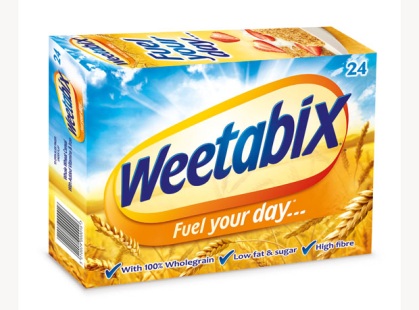
Weetabix has undergone a series of ownership changes as the packaged cereal marketers of the world try to change consumer behaviour regarding breakfast. In fact, the Weetabix UK website has a section titled 'Why bother with breakfast?' That sums up the marketing challenge for Weetabix at a time when many people skip breakfast or buy on the way to work/school or prefer handheld foods to cereals in a bowl. It's also a challenge gaining brand fans in markets where breakfast cereals aren't traditional.

Headquartered in Northamptonshire, Weetabix is the UK's largest cereal producer, and the wheat used in Weetabix is grown close to the company's home base. That's a plus, both for UK customers and others worldwide who like to know where their foods come from.

Weetabix was sold to a private equity firm in 2004, then resold to another private equity firm before Bright Food, a Chinese company, bought a majority stake in 2012.

Despite boosting Weetabix sales in the burgeoning market of China, consumer behaviour is slow to shift and traditional breakfast foods continue to be more popular than packaged cereals. So Bright Food decided to sell. And the buyer is US-based Post Holdings, which has a complementary set of packaged cereal products.

Weetabix's CEO says: 'The past five years have seen us increase our branded sales at home and overseas. I’m confident [Post] will help us open doors for continued expansion'.

With 611k Facebook followers, 19k Twitter followers and 11k Instagram followers, Weetabix is going social to keep its brand in the conversation and encourage consumption of packaged cereal. The Instagram description requests: 'Tag us is in your brekky snaps using #NeverendingBreakfast.'

Monday, 20 February 2017

Who's marketing in China?

The Chinese market is large and its economic growth is outpacing that of many major markets worldwide. No wonder so many companies see China as a key market for goods and services. Four examples:
  • Reckitt Benckiser recently acquired the baby formula firm Mead Johnson with an eye towards selling more in China, now that the one-child policy has been changed and the birth rate is increasing. RB has marketed other brands in China, recognising the power of global brands that are already established.
  • Mattel, which owns Barbie and other toy brands, is working with Chinese e-commerce giant Alibaba to research the local market and develop appropriate products. 'By combining Mattel's unmatched expertise in childhood learning and development with Alibaba's immense reach and unique consumer insights, our goal is to help parents in China raise children to be their personal best', says Mattel's CEO.
  • Shanghai Disney, opened in June 2016, expects to welcome 10 million visitors by the time it celebrates its first anniversary. Just as important, the strong attendance is helping the theme park race towards its break-even point and become profitable soon, banking on the high brand awareness of Disney characters and the entertainment experience of family fun.
  • The luxury watch brand Cartier markets in China by leveraging its connection with singer/actor Lu Han and through social media marketing. Celebrity spokespeople are credible and influential here, and world-class status-symbol brands are also coveted.

Wednesday, 1 February 2017

Marketing mobile payments and mobile donations

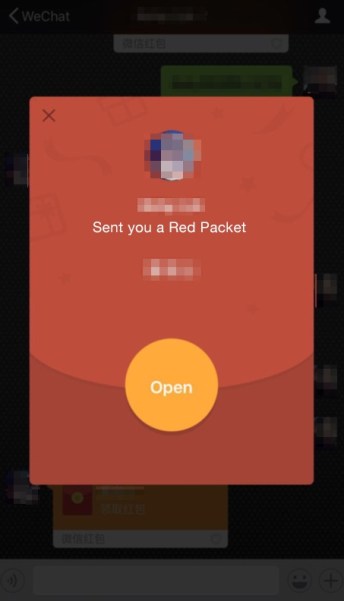
For the Chinese New Year, hundreds of millions of people sent the traditional red envelope of cash to friends--but for 2017, these were digital packets and digital payments delivered via social media networks and mobile apps.

In fact, mobile apps facilitate many e-commerce and personal payments, not just holiday gift traditions.

Mobile payments are gaining ground around the globe, sometimes aided by government actions to remove obstacles, as India is doing. In-store mobile payments are also increasing, with Chinese shoppers especially enthusiastic about the convenience and speed.

French shoppers are less enthusiastic, however, and German shoppers are not adopting mobile payments in large numbers either.

In the UK, mobile payments are more popular than in many other markets. Why? One reason is that credit and debit cards are widespread in the UK, so linking them with a mobile payment app streamlines the process and makes everything simple. Also, national retailers like Tesco have their own mobile payment plans, which encourages shoppers to try when they buy.

Now Oxfam and other UK charities are inviting cashless mobile payment donations, making it convenient to give a small preset amount with just a tap or swipe or click.

Thursday, 7 July 2016

Top brands in China

In this final post for my 'marketing in China' series, a look at the top brands in China. Not surprisingly, different groups rank brands in different ways.

According to BrandZ Top 100 Most Valuable Chinese Brands 2016, the top brands are: (5) Baidu (a tech brand), (4) ICBC (financial services), (3) Alibaba (e-commerce), (2) China Mobile (telecomms) and (1) Tencent (e-commerce and technology, owner of WeChat app). Market-driven brands are gaining ground compared with state-owned company brands.

Campaign Asia ranks the top global brands active in China, with this result: (5) Sony (electronics), (4) Apple (electronics), (3) Chanel (fashion), (2) Nestle (food) and (1) Samsung (electronics). The 2016 ranking was unchanged from 2015.

Kantar ranks China's 'most chosen' brands amongst fast-moving consumer goods, with this result: (3) Mengniu (ice-cream and other dairy products), (2) Master Kong (instant noodles) and (1) Yili (yoghurt and other milk products).

Five fast-growing Chinese brands to keep your eye on are: ZTE (smartphone manufacturer), WeChat/Tencent (messaging/e-commerce), Huawei (appliances and technology products), JD.com (e-commerce) and LeEco (entertainment content and devices).

Friday, 1 July 2016

Western brands market on China's WeChat

WeChat QR code
China's wildly popular mobile text/messaging app WeChat serves more than 700 million users (the number will probably be even higher when you read this).

Users are so glued to the WeChat app that brands, naturally, want to be part of the experience. Here are just a few ways that Western brands are marketing via WeChat:

  • Burberry announces new products and showcases classic styles, as well as using WeChat for customer service.
  • L’Oréal Paris uses WeChat as part of its frequent-buyer rewards scheme.
  • Procter & Gamble's beauty brands have advertised on WeChat to engage consumers and build buzz.
  • Mulberry has used WeChat to target gift-givers on special occasions.
The marketing lesson: Brands have to be where their customers are, and adapt quickly to digital media or whatever new technology is on the ascendancy.

Tuesday, 28 June 2016

Marketing Starbucks in China

Continuing a look at global brands in China, this entry is about Starbucks, the US-based coffee shop company that has made lattes and espressos part of daily life all over the world.

Starbucks just opened a spacious flagship cafe in the new Shanghai Disney resort. This isn't the first Starbucks connected with a Disney resort, but it is the first of this ultra-modern design...with more than 100 employees to serve thousands of customers every day. The company says this will be the busiest Starbucks on the planet.

China is an attractive market for Starbucks because coffee consumption is still relatively low compared with consumption in other areas--which means a lot of growth potential as consumers adopt the 'coffee culture'. Starbucks already has 2000 cafes in China and plans to open 2500 new cafes over the course of 5 years.

To reinforce its brand image and provide an upmarket consumption and sampling experience, Starbucks plans a new Roastery and Reserve Tasting Room for Shanghai. Modeled on the tasting room near the company's headquarters in Seattle, this Shanghai location will demonstrate the roasting process and offer samples of various coffees and flavours.

Will consumers in China pay the luxury price for a luxury coffee often enough for Starbucks to profit handsomely from its investment? 

Thursday, 23 June 2016

'Authentically Disney and distinctly Chinese'

From Walt Disney Company news
Disney has opened a giant new theme park outside Shanghai, featuring six distinct areas in 963 acres to explore: Adventure Isle, Fantasyland, Gardens of Imagination, Mickey Avenue, Tomorrowland and Treasure Cove.

The path from idea to approval to construction to opening was long and challenging. Disney originally proposed the theme park 20 years ago, but political and economic factors slowed progress.

The target market is the 330 million people who live within three hours of the park. Millions more may travel longer distances to visit, increasing domestic tourism and spreading awareness of the Disney brand throughout China.

As the head of Disney states: 'Shanghai Disneyland is authentically Disney and distinctly Chinese'.

Disney, whose characters are increasingly familiar to Chinese families, faces considerable competition from diverse theme parks already attracting crowds in China. Dalian Wanda Group is opening 10 entertainment complexes, with admission prices below those set by Disney. Other theme parks (such as Hello Kitty) are also competing for the middle class family's attention and money. How will Disney do in this super-competitive environment?

Wednesday, 11 November 2015

Alibaba Makes Singles Day into a Global Phenomenon

From Alibaba Group, a screen shot of its video about Singles Day shopping
Singles Day is, like Black Friday, a retailer-promoted shopping day of discounts in which consumers in China (mainly single people but in reality, anyone looking for a bargain) are encouraged to buy for themselves.

Also known as 11-11 or Double 11 in China, Singles Day has become a shopping phenomenon because of the incredible marketing muscle of Alibaba Group, China's powerhouse e-commerce retailing group.

Alibaba began promoting Singles Day in 2009, when millions of Chinese consumers were becoming accustomed to shopping online. The first year, 27 merchants participated.

Today, nearly 700 million consumers in China shop online--a gigantic audience that warrants the serious attention of retailers in China and beyond.

In 2015, Alibaba targeted shoppers worldwide with 11-11 super-bargains, and it saw purchases surge 60% beyond last year's total. During the 24 hours of Singles Day, the company's retail sites processed purchases worth an estimated £9.4 billion, with well more than half of the purchases being made via mobile devices.

Black Friday originated in the US but is increasingly spreading to other countries. UK shoppers are already changing their buying patterns, analysts say, in anticipation of big discounts being offered on 27 November, the day after the US Thanksgiving Day.

Tuesday, 1 September 2015

McDonald's newest marketing ideas

NEW IN MARKETING AT MCDONALD'S
McDonald's is going hyper-local to satisfy food tastes in certain regions--and to reassure customers of the purity of its ingredients. It's also adjusting its marketing strategy to better differentiate itself and attract new customers, while maintaining the loyalty of current customers who are tempted by the many fast-casual alternatives.

On the McDonald's Japan site, you can see a photo of the newest sandwich, a 'burger with an egg on top' that features cheese from the region of Hokkaido plus a strip of bacon and a dab of secret sauce. Not only does this product introduction fit with changing consumer tastes--such as a preference for eating locally-produced foods--it also fits with a seasonal moon-viewing festival in the autumn, when round-shaped foods are in favour.

Another new marketing idea for McDonald's is table service. After experiments in France, Australia and other nations, McDonald's is testing in-restaurant service in Manchester. The UK market is a bright spot in the McDonald's global empire, because sales continue to increase in the UK even as they've plateaued in the US, where competition is extremely intense and other casual-dining chains are growing quickly.

McDonald's knows that many of its customers are mobile-savvy, so it's preparing its mobile ordering and payment strategy for more convenience and speed in China, among other markets.

Monday, 5 May 2014

Marketing cereal in China: Think green or black

Yes, Weetabix is marketing in China. The UK cereal company is now majority-owned by China's Bright Food business, and thanks to local knowledge, Weetabix's marketing plan calls for adding flavours and ingredients favoured by Chinese consumers.

Last year, the Weetabix chief executive said its Chinese breakfast foods are likely to be hot and savoury, in keeping with local tastes. Even though Weetabix made its name in cereal, the new products in China may not necessarily be cereals. Currently, its cereal bars are gaining popularity, thanks to their on-the-go convenience, which fits the busy lifestyle of many consumers.

Looking ahead, Weetabix is investigating new products such as green tea cereal, and less-sweet varieties that appeal to Chinese tastes. For now, the company will put a lot of marketing emphasis on its made-in-UK heritage and nutritional value because Chinese consumers are concerned about food purity and often perceive non-Chinese brands as safer.

Weetabix faces local competition from companies that are already marketing breakfast foods linked to the latest trends. One Chinese company makes cereal from black grains--tapping into the health associations with this colour. Another emerging food fad involves adding protein by adding peas to breakfast products. What's next for cereal marketing?

Wednesday, 23 October 2013

More top brands lists from around the world

According to the research firm Colmar Brunton, the top brands in New Zealand are mainly those with a long history in the country:

  1. Whittakers (chocolate)
  2. Tip Top (ice cream)
  3. All Black's (rugby)
  4. Cadbury (chocolate)
  5. Trade Me (online auctions)
  6. Air New Zealand (airline)
  7. Pineapple Lumps (choco-covered sweets)
  8. Edmonds (baking products)
  9. Heinz Wattie's (foods)
  10. L&P Lemon & Paeroa (soft drink)
According to the Reputation Institute, the top brands in Canada are also well established--and, interestingly, local brand Tim Horton's is #10, while global fave Apple is way down the list at #27:
  1. Disney (entertainment)
  2. LEGO (toys)
  3. Johnson & Johnson (health)
  4. Rolex (luxury watches)
  5. Nestle (foods)
  6. Microsoft (software)
  7. Google (you know)
  8. BMW (autos)
  9. Sony (electronics)
  10. Tim Horton's (restaurants)
According to Millward Brown, the top 10 most valuable local brands in China are:
  1. China Mobile (telecom)
  2. ICBC (banking)
  3. China Construction Bank (banking)
  4. Baidu (tech)
  5. Tencent (tech)
  6. Agricultural Bank of China (banking)
  7. China Life (insurance)
  8. Bank of China (banking)
  9. Moutai Baijiu (alcoholic beverages)
  10. Sinodec (petrol/gas)

Thursday, 26 September 2013

VW gears up for the future

Volkswagen's iconic camper-van, above, is not going to be part of the German company's product line for much longer. Because of the difficulty of adding airbags to protect all passengers, the van is being dropped in favor of newer models and technologies that will help in the drive for future growth. This is part of VW's long-term goal of becoming the world's number one automaker by 2018.

China is VW's most important market these days, so the company is boosting production of the Golf and other models to meet projected demand. It's also investing more heavily in its existing joint ventures inside China, where the ever-expanding middle class segment has the income to buy new vehicles.

Meanwhile, European car sales have been slow but as the economic recovery continues, volume is likely to rise. Thanks to VW's large portfolio of brands, it remains Europe's top-selling car company. Its truck brand, Scania, reports healthy sales as fleet operators get ready for stricter emissions rules.

Like other automakers, VW is increasingly active in engaging car buyers through social media. Its UK website has links to Facebook (404,000 likes), Twitter (63,000 followers), YouTube, and Flickr. VW US has a popular Pinterest board, as well.

Wednesday, 26 June 2013

The world's largest e-commerce firm

In terms of revenue, the largest c-commerce firm on Earth is . . .

. . . not Amazon.com or eBay or even Google.

Think East. Far East.

Alibaba Group, owner of fast-growing e-commerce sites such as Tmall, taobao.com and 1688.com, rings up more revenue than Amazon and eBay combined.

Its 1688.com is the world's largest B2B marketplace, with 100 million users.

Taobao (see screen shot), now a decade old, is China's largest online shopping market, with 500 million users and 24 million transactions every day. Taobao is already expanding beyond China into Taiwan, Malaysia, Singapore and elsewhere in Asia.

According to one estimate, e-commerce currently represents only 6% of China's total retail revenue. With so much opportunity for growth and profit, Alibaba has announced the construction of a new logistics system it plans to use for overnight delivery of purchases to any urban area in China. In other words, Alibaba is spending today to be ready for the shoppers of tomorrow.

Wednesday, 10 April 2013

L'Oréal in China

Eyeing the growing affluence of Chinese consumers, global beauty giant L'Oréal is implementing a major marketing strategy to increase sales in that country by at least 10% during 2013. It purchased local brand Yue Sai in 2004 and has expanded retail coverage to reach more shoppers in more Chinese markets and introduce its other brands, not only in the largest cities but in smaller cities around the country.

With market segmentation, L'Oréal is using a differentiation strategy to target specific segments. The CEO for China states: 'You have to have an answer for very different needs'. In other words, one beauty brand or product does not fit all.

That's why L'Oréal has specialised product development programmes in place, as well as retail marketing elements geared to the buying patterns of Chinese consumers.

Because beauty products are aspirational, internationally-known celebrities like Emma Watson and local superstars like Fan Bingbing and Andy Lau add cachet to the firm's Chinese promotions.

And if you think the company is targeting only women, think again. As in other parts of the world, L'Oréal is also targeting men who buy skin-care products and other personal care items. 'We estimate that the men's cosmetics sector has grown at twice the rate of the total beauty market in China', says the chief executive.

Leveraging its French luxury image, L'Oréal is now ranked as the second-most valuable beauty brand in the world (behind Olay, owned by rival Procter & Gamble).

Tuesday, 20 November 2012

Singles Day boosts online shopping in China

More than a decade ago, college students in China decided to start a new tradition of celebrating Singles Day on 11 November (you know, 1111--four singles). The idea was to give gifts to good friends in the hopes of helping romance blossom.


Now Singles Day has become perhaps the busiest cyber-shopping day in China. Alibaba (one of the country's most popular e-commerce sites) received orders for more than £ 1 billion worth of goods in just the first 13 hours of this year's Singles Day. By the end of the day, total purchasing was reportedly even higher than on Cyber Monday in the US.

Smaller online merchants such as Seventh Princess (photo above) saw significant sales increases, as well. Online travel companies promoted special savings, and retailers with store locations also offered special deals to attract buyers. And of course, delivery services had to be ready to put all those packages into the hands of recipients, another major plus for the day's economic activity.


Sunday, 9 September 2012

PepsiCo markets to local tastes

PepsiCo has US roots but years of experience satisfying international taste buds.

Making a big play for market share in China, where it's been selling soft drinks and snacks for more than 3 decades, Pepsi is introducing flavours favoured by local consumers, from hot-and-sour fish soup potato crisps and cola chicken crisps to wolfberry oatmeal.

The Chinese market is so large and still growing so rapidly that Pepsi must forge alliances with local firms, build new production plants and expand its supply chain to keep up with projections.

Pepsi is vying for market share with a vast variety of competitors in China...not only local firms like Want Want but also long-time rival Coca-Cola, which uses superstar athletes and pop stars in its ads.

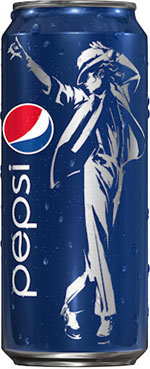
Then again, Pepsi's exclusive 'King of Pop' cans featuring Michael Jackson were a sensation in China, showing that Pepsi understands local tastes in music as well as in food.

Sunday, 29 April 2012

Year of the Dragon at Beijing Auto Show

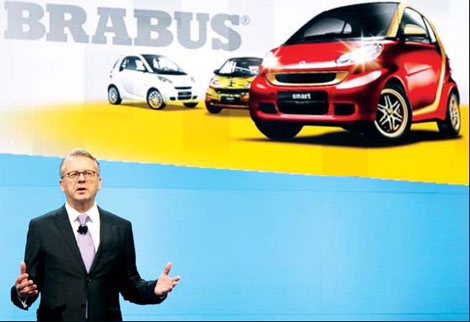
Daimler's new 'smart Dragon' car
As many as 800,000 people are attending this week's auto show in Beijing, attracted by dozens of new concept cars and new model-year cars. China is the world's largest market for passenger vehicles; luxury cars accounted for nearly 8% of Chinese auto sales last year. SUV sales are strong, and brands such as Jeep are popular in China for the outdoor lifestyle they represent.

A number of models have been named for the Year of the Dragon, including a super-compact smart car from Daimler (above) and luxury cars such as the Rolls-Royce Year of the Dragon Phantom. The bespoke Phantom, available with many custom options, sold out the entire year's production in only 8 weeks--indicating that the appetite for upmarket consumer goods continues to be very strong in China.

The Aston Martin Dragon88 costs 5 million yuan, not as much as the Phantom, yet buyers are crowding in to look at it and pay deposits, since only 88 of these cars will be produced. For a gallery of photos from the show, click here.


Thursday, 22 September 2011

Brands Look East for Growth

Some well-known brands are popping up all over Asia, where sales to status-conscious middle-class consumers are driving higher growth.

The Asian rights to the Aquascutum brand are now owned by a Hong Kong company that's opening stores in China and elsewhere in Asia. The brand's traditional British heritage and long-standing reputation for quality has helped build a loyal following among Asian consumers. The stores reinforce the upmarket image through careful presentation and understated ambiance.

Burberry (below), not surprisingly, has a growing presence in China, as does Hermes, due to rising demand for high fashion products.

Nike is another Western brand enjoying high sales in China, because its brand personality appeals to status-minded buyers of sports apparel and equipment.

At the same time, now that the Beijing Olympics are in the past, and the crowds of visitors have thinned a bit, retail vacancies are visible in some areas. This means prestigious retail locations are again available.

Meanwhile, Chinese brands are looking West for expansion possibilities. Through events such as the European Showcase for Brands of China, they're bringing their products to UK exhibitions and seeking to win new markets beyond their home country.

Monday, 27 June 2011

Luxury thrives in a parallel marketing universe

Earlier this month, I blogged about how UK bargain hunters are buying, buying, buying at 99p Stores, contributing to the retailer's sharply higher turnover and profits.

At the same time, luxury products are thriving in what may be a parallel marketing universe. Burberry has rebounded, Mulberry's profits are higher (see its collection above), Prada is still popular and LVMH continues to do well. In this universe, segmentation by brand loyalty and brand aspiration is just as important as segmentation by household income.

Much of the upmarket activity is taking place in Asia, where appetite for top brands has always been strong. China's millionaires aren't only buying luxe products; they're also seeking upmarket travel experiences (while remaining loyal to well-known brands such as Shangri-La hotels). As CNN International recently reported, 'kaching, kaching, kaching'! And there's no end in sight as Asia's economies move ahead.