Tuesday, 4 September 2018

Discount train travel builds customer base

Italo (nick-named the 'Ferrari train') was founded in 2012 as a high-speed, low-fare direct competitor to Trenitalia, Italy's state-controlled railway system. The combination of low fares and speedy, comfortable travel has attracted millions of loyal passengers and given Italo a profit margin of more than 30%.

Some of these customers used to ride Trenitalia's trains and some used to fly Ryanair and Easyjet between Rome and Milan. Now Italo is adding more trains and extending its coverage to new destinations as its discount pricing structure has helped it grow to the second-largest train system in Italy.

Four price levels allow passengers to choose the value they're willing to pay for. Italo even has a frequent-rider loyalty reward scheme and a cobranded American Express credit card that offers upgrades and other benefits.

Watch for discount train travel to become more of a competitive challenge for railway systems and no-frills airlines in other European nations, as well.

Tuesday, 28 August 2018

Why is red used so often in retail logos?

According to a recent international study of logos, red is frequently chosen by retailers like Argos and Tesco to attract the attention of shoppers. This makes sense: people walking or driving past a store are more likely to notice a bright, bold, vivid colour. The same holds true for McDonald's, which has a red and yellow logo that is easy to see, day or night, from a distance.

Today, what are the UK's top 5 favourite brand logos? According to Avery UK's poll, they are: (1) Coca-Cola (the red really attracts attention), (2) McDonald's (again, attention-getting), (3) Mickey Mouse (the well-known silhouette of mouse ears, a Disney brand), (4) Cadbury (featuring a special purple it has tried to trademark) and (5) Apple (shape and rainbow colours are unique).

The Coca-Cola logo is more than a century old and still popular, always distinctive--important in the ongoing cola marketing battles. Cadbury's purple logo stands out on its wrappers and in its adverts, a quick identifier for buyers. Apple's logo is an apple with one bite gone, simple yet powerful as a point of differentiation in the sea of logos.

Tuesday, 21 August 2018

Trends in UK consumer media usage

https://www.ofcom.org.uk/about-ofcom/latest/media/media-releases/2018/decade-of-digital-dependency
No surprise: UK adult consumers continue to be online for many hours of the day. According to Ofcom, which regulates UK telecommunications, they are online, on average, more than 24 hours every week. One in five UK adults is online 40 hours per week.

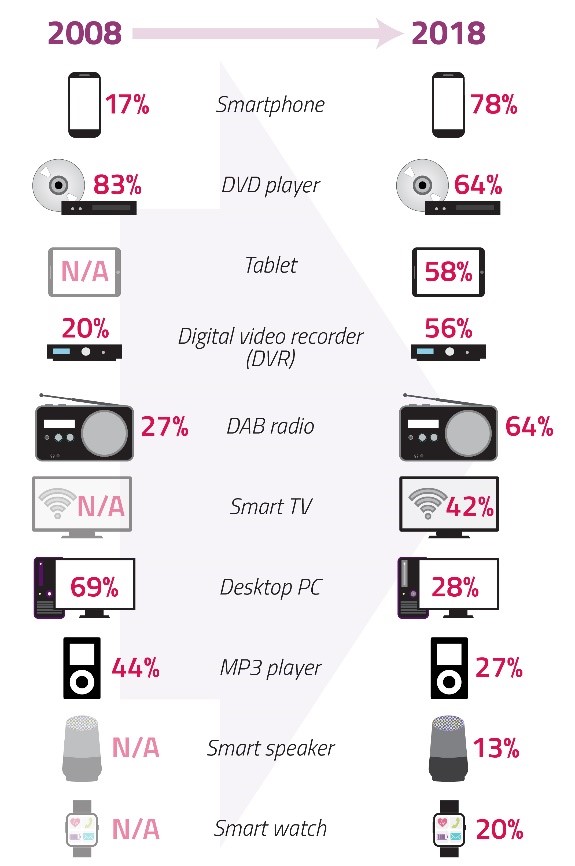
As shown in the chart above, fewer UK consumers are using desktop PCs. Instead, they're using mobile devices like smartphones and tablets (which were in their infancy in 2008).

Similarly, both smart watches and smart speakers are gaining in popularity--products that weren't available a decade earlier.

On the other hand, DVD players are losing ground, as are MP3 players.

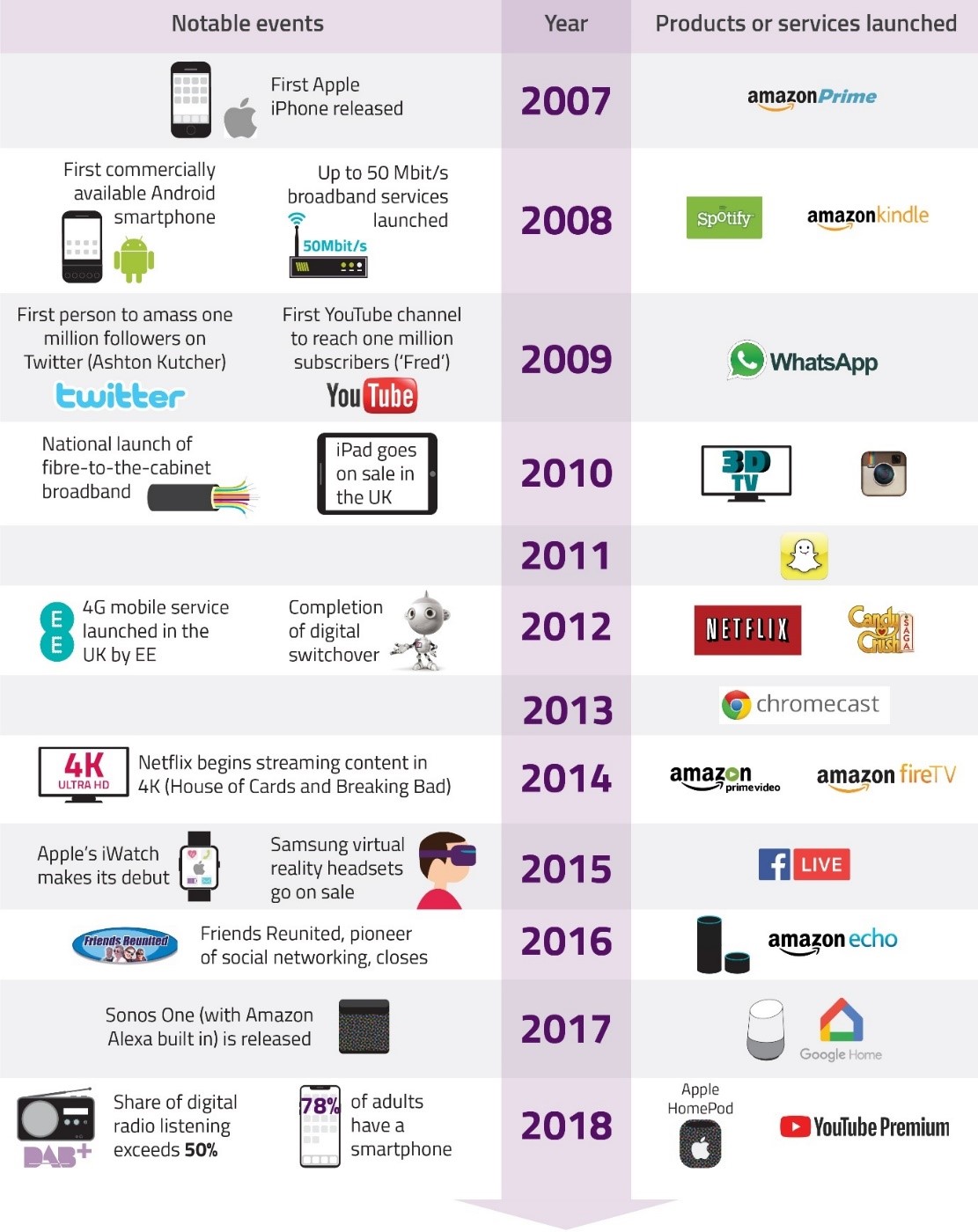
Ofcom presents this timeline showing what products and services were introduced, and when.

How many of the products and companies named in this infographic will still be going strong in 2028?

Note that eMarketer recently reported that UK consumers consume media for 9 hours and 23 minutes per day, on average. This covers books and newspapers, not just broadcast and digital media. No growth since the previous year, indicating overall media consumption is not growing. However, mobile usage is up, within that 'flat' media usage statistic.

Tuesday, 14 August 2018

L'Occitane teams with TerraCycle for sustainability

Group L'Occitane markets all-natural and organic personal care products through 3,200+ retail stores in 90 nations. With headquarters in Luxembourg and Switzerland, L'Occitane's annual turnover exceeds €1,300 million.

Tech-savvy L'Occitane is leveraging the trend of consumers connecting via mobile devices to personalise offers and encourage purchasing through the firm's many e-commerce sites worldwide.

Behind the scenes, the company also works with Provence-based suppliers to source sustainably-produced ingredients for its beauty products.

It's very committed to achieving goals for recycling. As this window display shows, L'Occitane stores in Canada and the US will accept empty containers from any cosmetics brand and recycle them in partnership with Terracycle, which turns the recycled and upcycled materials into eco-friendly new products for sale.

UK consumers can participate in Terracycle recycling in various ways, including bringing recyclable items to a nearby 'brigade' for free recycling.

This post offers an additional example of societal objectives as covered in Chapter 5 of my Essential Guide to Marketing Planning.

Friday, 10 August 2018

Private brands sell well

Private brands are owned and marketed by retailers and other channel members

Private brands traditionally sell well during periods of economic recession. That certainly was the case after the 2008 financial crash that led to a global financial downturn, when more expensive national and global brands saw price-conscious consumers switching to less-expensive private brands for many categories of purchases.

In fact, premium private brands have been part of the reason for consumers to switch away from other brands. These provide a 'halo effect' to help boost the image of all the private-brand products in the marketer's portfolio and make these products look more appealing in the eyes of consumers.

Private brands reportedly outperform national brands in four European nations, according to one source. They are strongest in the UK grocery market; research shows consumers consider the quality to be equal to that of national brands (and some consumers say the quality of private brands even exceeds that of national brands).

Many UK supermarket shoppers are admittedly looking for value. The rise of deep-discount grocery chains like Aldi and Lidl is due, in part, to the attractiveness of private brands that provide price-conscious consumers with quality alternatives to national brands.

This post updates private brand coverage in Chapter 6 of my Essential Guide to Marketing Planning, 4e.

Monday, 6 August 2018

What makes co-branding successful?

Co-branding . . . when a product carries two (or more) brands. 

One of the classic co-branding categories is the credit card. For years, companies like MasterCard and Visa have offered co-branding opportunities. Virgin Group co-brands credit cards with MasterCard, for instance. American Express co-brands a credit card with British Airways, as another example. Individual banks that issue cards are also co-branding, as Barclaycard has done with its Uber Visa card (combining 3 brands in all).

Co-branding is most successful when both brands are well known, reputable and able to appeal to each other's customer base. The communication styles and marketing content of the brands involved must be compatible, as well. The synergy from combining brands will be strongest under these conditions.

Google has used co-branding to name its Android operating systems more than once. Last year, it co-branded with the famous biscuit brand Oreo to name the Android Oreo OS. In 2013, it co-branded with the popular chocolate bar KitKat for an Android OS name that also appeared on the candy bar wrappers. The co-branding worked because the combined names were quirky and attention-getting.

This post updates material on co-branding in Chapter 6 of my Essential Guide to Marketing Planning, 4e.

Thursday, 2 August 2018

Lego: 60 years of marketing plastic bricks

60 YEARS OF LEGO BRICKS

The Lego Group began marketing its iconic plastic brick sets in 1958. Fast-forward to 2018, and the 60-year-old product is one of the world's most popular toys, with marketing reinvented for the next generation. The brand is also estimated to be the world's most valuable toy brand.

The CMO notes that the brand's mission is 'to inspire and develop the builders of tomorrow, to reach more kids'. It continues to introduce new building sets, many linked to strong brand franchises like Star Wars, Harry Potter, and Ninjago.

Lego's sales in Europe and the US didn't meet company expectations last year. It experienced very good growth in China, however, and the company plans to open more branded stores there as demand surges.

The brand is also building on the strength of Legoland theme parks to keep its toys in the public eye. For the royal wedding of Prince Harry and Meghan Markle, for instance, Lego built a small-scale version of Windsor Castle on the grounds of Legoland Windsor.

And, with an eye toward social responsibility, Lego is beginning to make some of its bricks from plant-based materials. The idea is to become more environmentally-friendly and demonstrate good corporate citizenship.

This post updates the Lego Group example that opens Chapter 5 of my Essential Guide to Marketing Planning.

Tuesday, 24 July 2018

Omni-channel choices for cosmetics buyers

https://twitter.com/avon_uk
For more than 125 years, Avon (now headquartered in the UK) has sold its beauty products door to door, via representatives who meet with customers, demonstrate makeup techniques, take orders and deliver products personally.

These days, however, time-pressured buyers are often buying online and watching social media tutorials rather than working with door-to-door salespeople.

So Avon now offers omni-channel choices. Buyers can still request a representative visit. They can also click to buy directly from the online Avon shop and receive purchases via courier.

To engage with buyers, Avon UK is active on Twitter (102k followers), Instagram (115k), Facebook (more than 20m followers), YouTube (24k subscribers) and its own Beauty Connects club blog (254k members).

Some Avon reps have their own social media accounts to show products and explain benefits. After all, in a world where makeup experts can attract hundreds of thousands of social media followers, Avon's reps can shine by offering special tips and personalised service for buyers.

Avon's products are competitively priced and attractively positioned. However, with improved profitability in mind, the global beauty brand is closing some markets to focus on higher-potential regions.

Monday, 23 July 2018

Three visions of the future of retailing

Suning
What is the future of retailing? Different businesses have differing visions of how people will shop and buy in the future. Here are three visions among the many being planned and tested worldwide:

  • Suning, a Chinese retailer, is testing unstaffed stores. (Photo above is from its news release.) The company calls this 'smart retailing' because of omnichannel choices and automation. Shoppers who have registered their Suning financial services account are identified via facial recognition and gain entry to the unstaffed stores. The idea is that some shoppers prefer to examine merchandise and buy in person, with tech assistance to speed transactions. 
    Start Today
  • Twenty-year-old Japanese fashion e-commerce firm Start Today wants to help customers order clothing in the correct size. Shoppers dress in a Zozosuit and their measurements are captured electronically. Then shoppers can order clothing made to fit. 
  • Retailers (both online and offline) are increasingly stocking a larger selection of preowned products (meaning gently-used merchandise). This is a trend in the upmarket wristwatch business, for example. It's also a trend in designer clothing and accessories. Not vintage, necessarily, but used items that originally were luxury priced.

Thursday, 19 July 2018

Bargains Draw Buyers on Amazon Prime Day

Once again, Amazon Prime Day has broken all records for merchandise sales. Eager shoppers clicked or swiped to buy more merchandise on 16 July than on Black Friday or CyberMonday, two "shopping holidays" that lead into Christmas buying season. Small businesses were among the big winners, promoting discounts to their customers via the Amazon retail platform.

Although Amazon generally puts special emphasis on electronics on Prime Day, Drapers reports that the retailer sold 287k clothing items during its shopping holiday--many of these from the company's private brand collections. Amazon has been more aggressively promoting its private brands in recent years, with product launches scheduled during Prime Day in 2018.

One of the year's most popular appliances sold out--the Instant Pot. But, not surprisingly, Amazon's own Echo Dot speaker was the biggest seller of all on Prime Day, along with its own Fire Stick TV device.