Showing posts with label plain packaging regulations. Show all posts

Wednesday, 1 November 2017

Update on plain packaging for tobacco

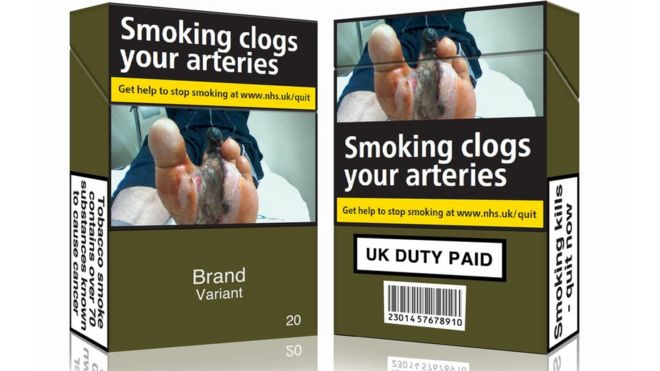
In the UK, cigarettes are sold only in plain packaging with prominent health warnings, part of a years-long public health initiative to reduce illness and deaths from smoking. Above, an example of what this legally-required standardised packaging looks like, with space for the brand name on the lower one-third of the green band.

Advertising of tobacco products on UK billboards was banned long ago, even as ad campaigns have been launched to encourage current smokers to quit and discourage young people from even trying cigarettes. Now other countries are considering whether to force tobacco marketers to switch to plain packaging.

Meanwhile, marketers of popular brands like Winston and Drum have had to look beyond packaging and advertising to sell cigarettes. Imperial, which owns Winston and Drum, says it continues to be successful in Australia, for instance, where plain packaging has been the law for five years. Imperial's chief executive explains that 'commercially, we’re very capable in terms of operating in plain-packaging markets'.

Public health activists are discussing whether illness and deaths would be reduced by requiring other products--particularly alcoholic beverages--to be marketed in plain packaging. Alcohol brands object. Already, the industry has agreed to carry voluntary warnings on alcohol packaging. Will plain packaging eventually be required for alcohol? Unlikely right now, not until the short- and long-term impact of selling cigarettes in plain packaging has been assessed.

Thursday, 19 May 2016

UK tobacco packaging goes plain

In February, I wrote about the latest controversies surrounding tobacco packaging that must carry large and explicit health warnings--and minimal marketing content.

The UK High Court just ruled in a lawsuit filed by the major tobacco manufacturers. The marketers argued that the government was effectively taking away their trademarked intellectual property rights, leaving them unable to display marketing and branding symbols they've invested in and protected legally against competitive use for many decades.

The judge ruled against the tobacco marketers, saying:
'The essence of the case is about whether it is lawful for states to prevent the tobacco industry from continuing to make profits by using their trade marks and other rights to further what the World Health Organisation describes as a health crisis of epidemic proportions and which imposes an immense clean-up cost on the public purse . . . In my judgment the regulations are valid and lawful in all respects'.
In his decision, the judge noted that marketing symbols and brand designs exert 'a causal effect upon consumer behaviour and encouraged smoking'. In addition to requiring plain packaging on cigarettes sold in the UK, certain types of packaging (such as 'lipstick' packs targeting female smokers) will be banned. Retailers are allowed to continue selling current inventory of branded packaging until stocks are depleted. After that, packs such as the one shown above will be the standard, with branding allowed but only within strict guidelines.

Monday, 15 February 2016

More controversy over plain packaging for cigarettes

New Zealand is considering a switch to plain-pack cigarettes, covered in health warning labels, following other countries that have switched to make smoking less attractive, especially to underage and young smokers. England and Ireland have already decided to move to standardised plain-packs. Individual brands will be identifiable only by uniform printing on package tops and fronts--not by 'trade dress', meaning colorful graphics intended to reinforce brand differentiation and image. All packs will have to include specific health warnings about the dangers of smoking.

France expects to implement plain-packaging requirements before June, with the aim of reducing smoking rates. South Korea is watching world developments closely, not only because of the legal challenges from tobacco marketers but also to see whether smoking rates are actually affected by the switch to plain-pack cigarettes.

Some brand experts suggest finding other ways of addressing the public-health consequences of smoking, due to the economic impact of changes such as plain-pack regulations.

The issue is complicated because some tobacco marketers are using legal challenges to delay or derail plain packaging. Meanwhile, packaging businesses are receiving unusually high orders as retailers rush to stock up before any bans go into effect.