According to a recent ranking, the three most relevant brands in the UK are: Apple, Lego and Playstation.
More than 10k consumers responded to the survey, saying that--for the third consecutive year--Apple is the most relevant brand in their lives. What is relevance? According to the Brand Relevance Index, it means 1) consumer obsession, 2) inspiration, 3) innovation and 4) pragmatism.
Lego is #2 in this survey, a brand that understands consumer behaviour and knows how important personal experience influences relevance. Lego is using event marketing and other in-person experiences to compete in newer markets such as Hong Kong. The Lego House in Denmark is an in-person brand experience built from 25 million plastic Lego bricks.
In fact, more brands are marketing themselves through experiences. For instance, Converse--which makes athletic shoes--refashioned a London hotel into a limited-time brand experience earlier this year.
Watch for more brand marketing via experiences during the holiday shopping season as companies seek to build awareness, preference and purchasing.
Showing posts with label consumer behaviour. Show all posts
Showing posts with label consumer behaviour. Show all posts
Wednesday, 3 October 2018
Tuesday, 25 September 2018
Coca-Cola adds coffee with Costa acquisition

This acquisition will enable Coca-Cola to build on Costa's strong brand identity and, at the same time, enhance the non-cola beverage elements of its product portfolio. The acquisition has implications for global marketing, as well. Costa does well in China, for instance, and Coca-Cola already owns the best-selling Georgia coffee brand in Japan.
But as consumer behaviour changes, and coffee consumption grows year after year, Coca-Cola sees Costa as a brand with significant potential for further global expansion. 'Costa has strengths in many countries and in many key distribution channels of the coffee business', says Coca-Cola's CEO.

Tuesday, 11 September 2018
The global reach of Evolve Skateboards
More than 120k Facebook users 'like' Evolve Skateboards, more than 26k Instagram users follow Evolve Skateboards and nearly 16k people subscribe to the company's YouTube channel. Those social media interactions have helped accelerate word of mouth about this fast-growing brand of electric skateboards.
The Australian-based company founded by entrepreneur Jeff Anning and his wife, Fleur Anning, has an international customer base, distribution in multiple countries and many thousands of social media-minded brand fans. Target market: young professionals who see the boards as a convenient and fun way to commute on city streets.
The company was global from its first days in business. Two years ago, when Evolve launched a new product, it attracted A$ 1 million in orders in a single day. One challenge in growing so quickly has been signing with suppliers and manufacturing facilities that meet the firm's quality and performance standards.
Today, Evolve's annual turnover exceeds A$ 15 million as consumers worldwide are introduced to the product category of electric skateboards and come to prefer the Evolve brand. Thanks to social media, Evolve can stay in close contact with its target market in many nations, well beyond the firm's base in Australia.
The Australian-based company founded by entrepreneur Jeff Anning and his wife, Fleur Anning, has an international customer base, distribution in multiple countries and many thousands of social media-minded brand fans. Target market: young professionals who see the boards as a convenient and fun way to commute on city streets.
The company was global from its first days in business. Two years ago, when Evolve launched a new product, it attracted A$ 1 million in orders in a single day. One challenge in growing so quickly has been signing with suppliers and manufacturing facilities that meet the firm's quality and performance standards.
Today, Evolve's annual turnover exceeds A$ 15 million as consumers worldwide are introduced to the product category of electric skateboards and come to prefer the Evolve brand. Thanks to social media, Evolve can stay in close contact with its target market in many nations, well beyond the firm's base in Australia.
Tuesday, 28 August 2018
Why is red used so often in retail logos?
Today, what are the UK's top 5 favourite brand logos? According to Avery UK's poll, they are: (1) Coca-Cola (the red really attracts attention), (2) McDonald's (again, attention-getting), (3) Mickey Mouse (the well-known silhouette of mouse ears, a Disney brand), (4) Cadbury (featuring a special purple it has tried to trademark) and (5) Apple (shape and rainbow colours are unique).
The Coca-Cola logo is more than a century old and still popular, always distinctive--important in the ongoing cola marketing battles. Cadbury's purple logo stands out on its wrappers and in its adverts, a quick identifier for buyers. Apple's logo is an apple with one bite gone, simple yet powerful as a point of differentiation in the sea of logos.
Saturday, 19 May 2018
Barbie and Ken show market segmentation in action

Royal dreams? Mattel markets the Dreamtopia Barbie and Prince Ken. A fan of Jurassic World movies? Buy a Claire Barbie or an Owen Barbie. Got a pocket? Barbie on the Go is sized to go with you to school or play or anywhere (see photo above). Want to try on different hair colours? Try the Barbie Colour Surprise Doll, with hair that changes colour when sprayed with water.
As these products demonstrate, segmentation is not just a matter of age and gender. Mattel segments the market for dolls according to factors such as lifestyle ("on the go" for instance), desire for variety or novelty (Barbie Colour Surprise), interest in a blockbuster movie (like Jurassic World) and royalty fantasy (both prince and princess).
Not that Barbie is alone in the doll world. Bratz, for instance, is a direct competitor. And Barbie also competes with other types of playthings, not just dolls--including videogames and other digital play possibilities. Barbie and Ken have had mixed sales results in recent years. Will further market segmentation have a positive effect on consumer behaviour?
Monday, 30 April 2018
Marketing consequences of merging Sainsbury's and ASDA

Sainsbury's would manage the new entity, with Walmart as a shareholder and partner.
One marketing consequence is the ability for the combined company to pay less for goods and services purchased in larger volume. This will, in turn, reduce costs and therefore allow for lower prices--a key element in this competitive industry.
So far, Sainsbury's says it will slash prices by 10% and will not be closing any stores after the merger is complete. UK regulators may require the sale of some stores to rivals, which would be another marketing consequence of the deal. The marketing environment for all UK retailers could change as a result.
Finally, how will consumers react? Will the merger change consumer behaviour? We'll have to wait and see.
Monday, 16 April 2018
Grocery retailers battle for UK market share
Aldi and Lidl, both based in Germany, have been steadily capturing market share in UK grocery retailing. Recent numbers show that Aldi has increased its market share from 3.9% at the start of 2014 to 7.3% at the start of 2018. Lidl, meanwhile, grew market share from 3.1% in early 2014 to 5.3% in early 2018.
From the perspective of traditional UK supermarkets like Tesco and Waitrose, the battle for market share has another challenge: pressure on profit margins. Aldi and Lidl are deep-discount grocers with no-frills stores. Not so for Tesco and Waitrose, which are full-service grocers. To be sure consumers can see the value in shopping at a full-service store, price promotions are often highlighted--and that cuts into margins.
In fact, price is a key element in consumers' perceptions of a store. Not long ago, Aldi overtook Waitrose as the favourite supermarket of UK consumers who were asked about satisfaction. Affordable prices would naturally be important to satisfaction.
Meanwhile, UK supermarkets will continue to face pressure from the deep discounters as Aldi and Lidl both plan to expand their store networks. At the same time, traditional supermarkets are slowing their store openings to maintain cost control. Will online grocery shopping be the competitive edge for traditional supermarkets? Possibly, as a growing number of UK shoppers try or continue buying food and household products without going into a store. Consumer behaviour is changing, and grocery retailers are learning to adapt so they can compete more effectively.
From the perspective of traditional UK supermarkets like Tesco and Waitrose, the battle for market share has another challenge: pressure on profit margins. Aldi and Lidl are deep-discount grocers with no-frills stores. Not so for Tesco and Waitrose, which are full-service grocers. To be sure consumers can see the value in shopping at a full-service store, price promotions are often highlighted--and that cuts into margins.
In fact, price is a key element in consumers' perceptions of a store. Not long ago, Aldi overtook Waitrose as the favourite supermarket of UK consumers who were asked about satisfaction. Affordable prices would naturally be important to satisfaction.
Meanwhile, UK supermarkets will continue to face pressure from the deep discounters as Aldi and Lidl both plan to expand their store networks. At the same time, traditional supermarkets are slowing their store openings to maintain cost control. Will online grocery shopping be the competitive edge for traditional supermarkets? Possibly, as a growing number of UK shoppers try or continue buying food and household products without going into a store. Consumer behaviour is changing, and grocery retailers are learning to adapt so they can compete more effectively.
Sunday, 8 April 2018
Celebrities, influencers and brand marketing
David Beckham is a fan of scotch whisky...and if you're a David Beckham fan, you can buy Haig Club scotch and drink the brand that is his. Literally. Beckham partnered with Diageo to create Haig Club as a whisky with personality, modeled on the whisky preferred by his Dad. Not surprisingly, Beckham also stars in marketing for his brand.
Beckham is one of a growing number of celebrities deeply involved in marketing their favourite products. Some invest money in products they like and use--such as Rihanna's investment in Vita Coca, one of today's up-and-coming coconut water products. Rihanna also has a beauty brand, Fenty Beauty by Rihanna, which is growing quickly.
Michelle Keegan, star of Our Girl, has her own celebrity-branded line of clothing with Very. Supermodel Gigi Hadid has a beauty product line with Maybelline, #GIGIxMAYBELLINE, which is heavily promoted during London Fashion Week. And of course, all these celebrities use social media and in-person appearances to market the brands they prefer.
 Not every social media star who attracts followers and influences customer attitudes and behaviour is an actor or performer. The London fashion brand Kitri recently paid fashion blogger/Instagram influencer Charlotte Groeneveld to promote a green dress for summer. A month after Groeneveld posted an Instagram pic of herself in the dress, Kitri sold 200 units in less than an hour. Kitri now has a waiting list for this dress, demand is so strong.
The marketing lesson: Know your influencers, know who they influence and know how they influence.
Beckham is one of a growing number of celebrities deeply involved in marketing their favourite products. Some invest money in products they like and use--such as Rihanna's investment in Vita Coca, one of today's up-and-coming coconut water products. Rihanna also has a beauty brand, Fenty Beauty by Rihanna, which is growing quickly.
Michelle Keegan, star of Our Girl, has her own celebrity-branded line of clothing with Very. Supermodel Gigi Hadid has a beauty product line with Maybelline, #GIGIxMAYBELLINE, which is heavily promoted during London Fashion Week. And of course, all these celebrities use social media and in-person appearances to market the brands they prefer.

The marketing lesson: Know your influencers, know who they influence and know how they influence.
Thursday, 15 March 2018
Mobile payment and consumer behaviour
One of the fast-growing trends in consumer behaviour is mobile payments, meaning payments completed via mobile--contactless-style.
One source says that mobile payments in the UK during 2017 exceeded £975m. Yes, that's nearly one billion pounds.
Another source shows UK mobile payments increasing by 365% during 2017. And it shows payments made via wearable devices (like smartwatches) grew by 129% in 2017.
More tests are underway as businesses and consumers grow accustomed to mobile payments. The Co-Op in Manchester, for instance, is testing a MasterCard app that allows shoppers to pay without ever queueing or stopping at the till.
Similarly, Barclay's Dine and Dash mobile app will enable UK customers to pay for restaurant meals by tapping a special point at the table. No more waiting for servers to bring the bill!
Pizza Hut in the UK is adding MasterCard's mobile payment app so customers can place orders and pay for meals without waiting for the server to bring the bill.
Have mobile payments reached a tipping point where they will now be considered mainstream? Will more payments be made via mobile than via plastic or cash? Marketers are watching consumer behaviour very closely to understand acceptance and adoption trends.
One source says that mobile payments in the UK during 2017 exceeded £975m. Yes, that's nearly one billion pounds.
Another source shows UK mobile payments increasing by 365% during 2017. And it shows payments made via wearable devices (like smartwatches) grew by 129% in 2017.
More tests are underway as businesses and consumers grow accustomed to mobile payments. The Co-Op in Manchester, for instance, is testing a MasterCard app that allows shoppers to pay without ever queueing or stopping at the till.
Similarly, Barclay's Dine and Dash mobile app will enable UK customers to pay for restaurant meals by tapping a special point at the table. No more waiting for servers to bring the bill!
Pizza Hut in the UK is adding MasterCard's mobile payment app so customers can place orders and pay for meals without waiting for the server to bring the bill.
Have mobile payments reached a tipping point where they will now be considered mainstream? Will more payments be made via mobile than via plastic or cash? Marketers are watching consumer behaviour very closely to understand acceptance and adoption trends.
Monday, 13 November 2017
Alibaba's 9th Annual Singles Day sets records again

This annual promotion has paid off, making Singles Day a much, much bigger sales day than Black Friday or Amazon Prime Day. Year after year, Alibaba's Singles Day has pushed sales higher and higher. In 2017, consumers clicked on Alibaba e-commerce sites or visited in-person sites to purchase merchandise worth £19bn.
Yes, that's billion.
And Singles Day was truly a global event in 2017, with marketers from many nations participating by offering goods via Alibaba retail platforms. The company splashed out on its Global Shopping Festival Gala (above) featuring celebrities from around the world.
The result was a day of buying that broke the 2016 record by nearly 40%. In all, 812 million transactions were processed, a record-setting number -- and Alibaba says 90% of transactions were conducted on mobile devices, a key element of consumer buying behaviour these days.
Thursday, 9 November 2017
Retailers reveal holiday adverts for 2017

Above, one of the holiday adverts released by Argos, showing elves preparing toys for Santa's fleet of sleighs. One toy nearly misses being shipped, but a dedicated elf puts it into place on the sleigh just in time. 'We love this edge-of-your-seat, high-energy Christmas campaign, which aims to surprise and delight', notes Argos marketing director. This advert has been posted on the Argos Facebook page (which has 1.2m likes) with the hashtag #ReadyForTakeOff.
 Like Argos, Marks and Spencer also posted its holiday advert on Facebook (where the retailer has 5m likes). This year's feel-good advert focuses on Paddington, with #LoveTheBear as the hashtag spreading on social media. Not coincidentally, the new Paddington 2 movie will be in UK cinemas tomorrow.
 And, in the holiday spirit, Marks and Spencer is going to make a charitable contribution for each copy of Paddington and the Christmas Visitor bought by customers.
Thursday, 12 October 2017
Domino's digital initiatives pay off
 |
| https://twitter.com/Dominos_UK |
After launching a new ad campaign focused on price promotions, the chain received an avalanche of orders--200,000 orders on the final Saturday of September alone.
Domino's is always looking at different ways to make ordering fast and easy. Tweeting a pizza emoji is one way to buy. Ordering by talking to Amazon's Alexa via the Echo speaker is another. In fact, Alexa-orders are coming in already, as Domino's prepares for a future in which voice commands play a larger role in consumer buying behaviour.
Monday, 2 October 2017
Pricing and shrinkflation
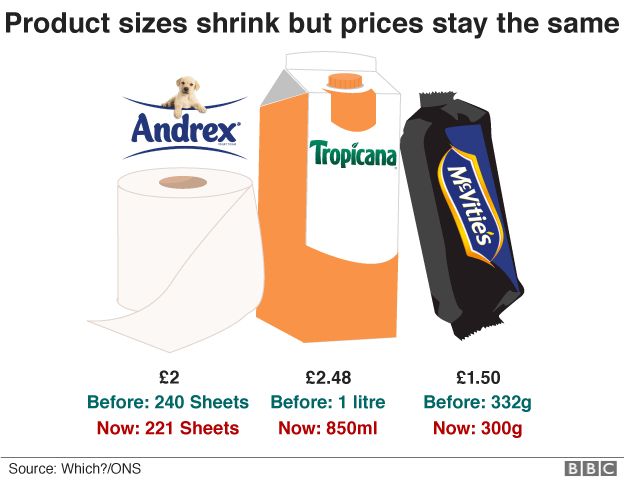
Yet, according to the UK Office of National Statistics, more than 600 items have actually increased in size during the past five years. This reflects the trend towards focusing consumers on value. 'More for the same price' sends a message to price-conscious shoppers that a product will deliver higher value than some competing items.
More shrinkflation is on the way as marketers cope with continued cost increases and ongoing currency swings that can affect what manufacturers pay for ingredients and what they receive in payment from wholesale buyers.
Shrinkflation is usually not publicised by the manufacturers...but government offices and media reporters take notice. Then consumers become aware, and have to decide whether to continue buying a favourite brand or product, or change behaviour and buy something else.
Monday, 25 September 2017
Competing technologies in the digital age
 |
| https://en.wikipedia.org/wiki/Video_Killed_the_Radio_Star |
Currently, vinyl sales in the UK market are 30% higher than at this time last year. Vinyl and other mature entertainment technologies have become popular enough in the digital age that eBay recently introduced a marketplace specifically for books, music, games and video.
Another product category affected by technology: postcards. Before the end of the 20th century, consumers were sending an estimated 20 million postcards every year. Now, however, competition from social media has resulted in barely 5 million postcards sent per year. Why pay for a postcard and postage, take time to write a message and pop it into the post for delivery days later--when you can post a photo or message immediately on Instagram, Pinterest, Facebook or another site? Postcard publisher J Salmon, founded in 1880, is therefore leaving the business.
Perhaps consumers will someday see postcards as unique communication vehicles and give them a go again, the way vinyl and cassettes have become newly popular. Meantime, marketers need to carefully monitor consumer behaviour trends and the impact on the business environment as competing technologies enter the marketplace.
Tuesday, 22 August 2017
Poundland's multiprice strategy

The multiprice strategy helps Poundland keep its brand promise to price-conscious customers. It also helps the retailer manage seasonal inventory. Rather than store out-of-season stock for nine months until the season rolls around again, Poundland is clearing merchandise by cutting the price, as many other stores do. The result: shelves are full of in-season, fresh merchandise at attractively low price points.
Poundland leverages social media for its price-driven promotions, with consistency in posts across platforms. More than 300,000 people have liked Poundland on Facebook, nearly 25,000 follow it on Instagram, and it has 80,000 Twitter followers (as well as a YouTube channel and a Pinterest page).
This updates the "Marketing in Practice" example in Chapter 7 of Essential Guide to Marketing Planning, 4th edn.
Monday, 19 June 2017
Beauty brands seek multichannel availability
Consumer behaviour is changing, and so beauty brands are changing their distribution strategies to be where consumers want to browse and buy. As department stores
consolidate and shoppers seek out specialty shops and online outlets,
brands like Nyx are opening their own UK stores for direct customer
contact. Nyx, for example, recently opened a flagship UK retail location with digital elements designed to appeal to Millennials.
 Beauty-sample subscription businesses like Birchbox give consumers more access to more new products. This is another channel for brands to reach consumers who like variety or want to test different items before becoming a loyal buyer of a particular brand/product.
Birchbox is, in fact, considering a UK store as another channel to supplement its online-only business model. 'Physical retail enhances the relationship with the brand, but it has to be profitable in their own right, it’s not just a marketing activity for us', says cofounder Katia Beauchamp. If Birchbox opens a store, the brands it distributes gain yet another channel of access to retail customers.
Yet the Birchbox cofounder's question is very important for multichannel strategy: Will brick-and-mortar retail shops be profitable on their own? The answer depends, in part, on how consumers adapt their browsing and buying habits in a crowded multichannel marketing environment.
Beauty-sample subscription businesses like Birchbox give consumers more access to more new products. This is another channel for brands to reach consumers who like variety or want to test different items before becoming a loyal buyer of a particular brand/product.Birchbox is, in fact, considering a UK store as another channel to supplement its online-only business model. 'Physical retail enhances the relationship with the brand, but it has to be profitable in their own right, it’s not just a marketing activity for us', says cofounder Katia Beauchamp. If Birchbox opens a store, the brands it distributes gain yet another channel of access to retail customers.
Yet the Birchbox cofounder's question is very important for multichannel strategy: Will brick-and-mortar retail shops be profitable on their own? The answer depends, in part, on how consumers adapt their browsing and buying habits in a crowded multichannel marketing environment.
Sunday, 18 June 2017
UK legacy grocery retailers continue to evolve
 |
| Sainsbury strapline |
Why? Changing consumer behaviour and evolving industry dynamics.
 |
| Nisa logo |
- Sainsbury is expected to buy Nisa convenience shops, a 'family' of 2,900 'independent grocers' that serve local neighbourhood shoppers.
- Tesco announced the acquisition of wholesale food firm Booker, a deal that is currently being evaluated by regulatory officials and may result in industry changes.
So grocery retailing is increasingly global even as the industry adjusts to low-price, no-frills competition and the growing popularity of online shopping via Amazon and others.
Wednesday, 14 June 2017
Ad blockers and consumer behaviour
If you're among the 22% of UK consumers using an ad blocker, you already know that some content-heavy sites (like The Guardian) will allow you to see what they publish but will also request (not require) that you turn off the ad blocker or pay.
And you know that some sites will block you for using an ad blocker--requiring you to turn it off when viewing their pages. If the ad blocker remains on, the content will not load.
Now Google is going to release its own Chrome-based ad blocking software in 2018. The idea is to give consumers more control over ads that are particularly annoying or that don't fit Google's guidelines for some other reason. Why? Because 'it's far too common that people encounter annoying, intrusive ads on the web - like the kind that blare music unexpectedly, or force you to wait 10 seconds before you can see the content on the page', says a Google exec.
Google will also allow content providers to either require that consumers turn off their blockers for those sites or levy a fee for viewing the content.
Consumers who want to access content will have to change their behaviour. Already, content sites are educating visitors that content costs money, one way or the other, and turning off the ad blocker allows a site to continue receiving advertising revenue without any direct payment from the consumer.
Will the new Chrome ad blocker change consumer behaviour and increase the number of UK users? The answer may depend, in part, on whether the blocker comes preinstalled and in place. We'll have to wait a little longer for the details.
And you know that some sites will block you for using an ad blocker--requiring you to turn it off when viewing their pages. If the ad blocker remains on, the content will not load.
Now Google is going to release its own Chrome-based ad blocking software in 2018. The idea is to give consumers more control over ads that are particularly annoying or that don't fit Google's guidelines for some other reason. Why? Because 'it's far too common that people encounter annoying, intrusive ads on the web - like the kind that blare music unexpectedly, or force you to wait 10 seconds before you can see the content on the page', says a Google exec.
Google will also allow content providers to either require that consumers turn off their blockers for those sites or levy a fee for viewing the content.
Consumers who want to access content will have to change their behaviour. Already, content sites are educating visitors that content costs money, one way or the other, and turning off the ad blocker allows a site to continue receiving advertising revenue without any direct payment from the consumer.
Will the new Chrome ad blocker change consumer behaviour and increase the number of UK users? The answer may depend, in part, on whether the blocker comes preinstalled and in place. We'll have to wait a little longer for the details.
Wednesday, 7 June 2017
Sustainability Marketing: Fashion Helps Save the Planet

Stella McCartney, who was involved in the Adidas designs, has also partnered with Parley for the Oceans on a new limited-edition backpack made from recycled ocean waste. This product is one of many that will incorporate a new fibre made from ocean waste plastics.
Other fashion marketers are saving the planet as well. ASOS, Tesco, Nike and H&M are some of the brands that will be using only sustainably sourced cotton by 2025. All over the world, fashion marketers are looking at sustainability issues and ways to reduce the stress on natural resources.
How much value do consumers see in buying fashions marketed with sustainability in mind? From the perspective of consumer behaviour, are the ethical issues of sustainability marketing compelling enough to motivate purchasing?
Saturday, 13 May 2017
Plan for brand power on social media

Notice how international this brand ranking is? All of these brands operate across national borders. Tesco has business operations in Central Europe and Asia, not just the UK.
But the important point about this most-loved brand ranking is how these brands are perceived among UK consumers. And clearly, they have favourable perceptions. Brand love enhances the brand power of these firms and may reinforce brand loyalty. The marketing plans of these five 'most loved' firms surely include detailed initiatives for social media interactions with customers.
Of course, many brands are increasingly savvy about social media. A brand can be smaller and more local and still be clever and engaging on social media.
For instance, take a look at the brands Hubspot says are 14 of the 'best brands on Instagram'. Brands that understand consumer behaviour can maintain customer interest and loyalty by planning to interact with their fans via all types of social media.
Subscribe to:
Posts (Atom)