In 2007, after years of study, Tesco crossed the pond to open its first Fresh & Easy neighborhood grocery store in California. The UK-based supermarket powerhouse has since opened more than 150 stores in California, Nevada and Arizona, sunbelt states that were growing rapidly and had strong economies--until the recent recession.
Tesco's plan to offer fresh produce at low prices seemed the perfect combination for the US market. However, Fresh & Easy ran into fierce competition from long-established supermarkets and from discounters-with-attitude (such as Trader Joe's). The recession didn't help, either.
Having lost millions of pounds on Fresh & Easy, Tesco made some changes to gain sales momentum. For example, the chain originally planned no advertising--it prefers to communicate directly with customers via Twitter, blogging, YouTube, Flickr and the Web. Instead, it reportedly has begun an advertising campaign to increase brand awareness and preference.
Tesco's chief executive now expects Fresh & Easy to turn a profit by the end of 2013. On the other hand, management of the US conglomerate Berkshire Hathaway, which owns 3% of Tesco, thinks that Fresh & Easy has more work to do if the chain is to succeed in the intensely competitive US market. It must increase revenue, attract more customers and reinforce loyalty. What does the future hold for Fresh & Easy?
Wednesday, 4 May 2011
Sunday, 1 May 2011
The royal wedding, social media and consumer behaviour
Even as huge crowds lined the streets of London to participate in last week's wedding of the decade, even larger crowds were airing their views minute by minute via social media. Social media sites absolutely buzzed with wedding news for days, a great example of how this technology is affecting consumer behaviour.
When Mashable tracked social-media mentions of the wedding, it found that tweeters, in particular, were posting many more comments than Facebook users and bloggers. This makes sense, given how short a tweet can be, and the fact that many people tweet on the go via mobile.
The Royal Wedding figured prominently on the royal family's Facebook page. The wedding had its own official Twitter hash tag (#rw2011) used by @ClarenceHouse, the official Twitter presence. And of course there's an official YouTube page for the royal wedding, complete with wedding book for online "guests" to sign.
Google celebrated with a special home-page doodle of a royal couple in horse-drawn carriage, acknowledging the world-wide interest in the Duke and Duchess of Cambridge. It added a wedding cake to its YouTube page, as well.
UK and US media contributed mightily to the social media buzz, with reporters live-blogging, tweeting and posting on Facebook journalism pages before, during and after the wedding. They invited members of the public to share their thoughts on media blogs/Facebook pages (as well as with their friends and others). Surprisingly, most of the wedding-related tweets were, in fact, from US commenters, although UK social media users were extremely active in sharing photos, memories and more.
Without a doubt, social media has emerged as a highly effective influence on the thoughts, feelings and actions of customers. Any marketer that doesn't engage brand fans through social media is missing an enormous opportunity.
When Mashable tracked social-media mentions of the wedding, it found that tweeters, in particular, were posting many more comments than Facebook users and bloggers. This makes sense, given how short a tweet can be, and the fact that many people tweet on the go via mobile.
The Royal Wedding figured prominently on the royal family's Facebook page. The wedding had its own official Twitter hash tag (#rw2011) used by @ClarenceHouse, the official Twitter presence. And of course there's an official YouTube page for the royal wedding, complete with wedding book for online "guests" to sign.
Google celebrated with a special home-page doodle of a royal couple in horse-drawn carriage, acknowledging the world-wide interest in the Duke and Duchess of Cambridge. It added a wedding cake to its YouTube page, as well.
UK and US media contributed mightily to the social media buzz, with reporters live-blogging, tweeting and posting on Facebook journalism pages before, during and after the wedding. They invited members of the public to share their thoughts on media blogs/Facebook pages (as well as with their friends and others). Surprisingly, most of the wedding-related tweets were, in fact, from US commenters, although UK social media users were extremely active in sharing photos, memories and more.
Without a doubt, social media has emerged as a highly effective influence on the thoughts, feelings and actions of customers. Any marketer that doesn't engage brand fans through social media is missing an enormous opportunity.
Wednesday, 27 April 2011
Brands of the century
It's the 100th anniversary of the Chartered Institute of Marketing (Twitter: @CIMinfo), and to celebrate, The Marketer has compiled a listing of the top brands of the past century.
Can you guess the top brand?
Yes, it's HSBC, a brand as well known for its social responsibility as it is for its banking. Here are some of its adverts.
During the last 10 years, anyone flying through Heathrow or many of the world's other top airports could not miss the bank's bold red and white logo on jetways and interior ad spaces. This is a particularly high-profile communication campaign that reaches business decision-makers and consumers alike.
HSBC has unified its brand identity in the past decade and sets forth as its brand values:
Can you guess the top brand?
Yes, it's HSBC, a brand as well known for its social responsibility as it is for its banking. Here are some of its adverts.
During the last 10 years, anyone flying through Heathrow or many of the world's other top airports could not miss the bank's bold red and white logo on jetways and interior ad spaces. This is a particularly high-profile communication campaign that reaches business decision-makers and consumers alike.
HSBC has unified its brand identity in the past decade and sets forth as its brand values:
- Perceptive
- Progressive
- Responsive
- Respectful
- Fair
Monday, 25 April 2011
Can Made.com shake up the furniture industry?
Ning Li, the entrepreneur behind Made.com, started his UK-based online furniture retailing business because he saw an industry in need of shaking up. He tells The Telegraph:
Direct-to-consumer furniture sold online has a mixed history, however. During the dot-com boom of the late 1990s, a number of furniture retailing sites debuted with great fanfare. Within a few years, however, several of the biggest names (furniture.com and living.com, for instance) faced severe financial difficulties when the dot-com bubble burst. One reason was economic uncertainty, which caused buyers to pause.
Another reason was that many customers want to see furniture, sit in chairs, feel the fabric before they buy. Not every customer is willing to spend hundreds or thousands of pounds without actually seeing the furniture. Made.com offers a 7-day money-back guarantee, which takes much of the risk out of this kind of purchase.
The Internet is a well-established retail channel these days, so Made.com has a better opportunity to profit than entrepreneurial sites of a decade earlier. Can it shake up the furniture industry in a profitable way?
"I thought if I could find a way to connect customers directly with furniture makers, it could be a good business. There hasn't been much innovation in the furniture market since Ikea, and that was more than 50 years ago. Furniture was one of the few industries that the internet hadn't shaken up, and I wanted to change that."Made.com makes furniture to order in China and sells directly to the customer, eliminating intermediaries and their markup prices. In the early days of the Internet, this was called "disintermediation" because it cut out a layer or two of traditional channel partners and handed the savings to bargain-hunting buyers. Made.com makes this a virtue, adding real-time tracking so buyers can see exactly where their purchases are in the production/shipping process.
Direct-to-consumer furniture sold online has a mixed history, however. During the dot-com boom of the late 1990s, a number of furniture retailing sites debuted with great fanfare. Within a few years, however, several of the biggest names (furniture.com and living.com, for instance) faced severe financial difficulties when the dot-com bubble burst. One reason was economic uncertainty, which caused buyers to pause.
Another reason was that many customers want to see furniture, sit in chairs, feel the fabric before they buy. Not every customer is willing to spend hundreds or thousands of pounds without actually seeing the furniture. Made.com offers a 7-day money-back guarantee, which takes much of the risk out of this kind of purchase.
The Internet is a well-established retail channel these days, so Made.com has a better opportunity to profit than entrepreneurial sites of a decade earlier. Can it shake up the furniture industry in a profitable way?
Wednesday, 20 April 2011
Tata's Nano steers toward higher sales
Tata Motors made headlines in the auto world when it introduced its ultra-cheap, ultra-small Nano car in its home market of India. As discussed in Chapter 6 of my Essential Guide to Marketing Planning, the car serves as basic transportation, replacing two-wheeled transport for many buyers. Initial response was highly positive, and the entire first-year production run was sold out in advance.
Sales have slowed since then, partly because of global recession, partly because of safety concerns, and partly due to increased competition. To boost buying, Tata has focused on safety, introduced a longer warranty to reassure buyers, and begun offering financing to help buyers afford the Nano.
As the world recovers from recession, these measures have definitely helped to drive higher demand for the Nano.
Tata is also learning from its experience with the Ace mini-truck, which has become quite popular in India. Now Tata is considering doing for the Nano what it did for the Ace: Opening dedicated dealerships in smaller towns just for the Nano.
Despite the many challenges, can Tata use its Nano to significantly accelerate sales and profits in the future?
Sales have slowed since then, partly because of global recession, partly because of safety concerns, and partly due to increased competition. To boost buying, Tata has focused on safety, introduced a longer warranty to reassure buyers, and begun offering financing to help buyers afford the Nano.
As the world recovers from recession, these measures have definitely helped to drive higher demand for the Nano.
Tata is also learning from its experience with the Ace mini-truck, which has become quite popular in India. Now Tata is considering doing for the Nano what it did for the Ace: Opening dedicated dealerships in smaller towns just for the Nano.
Despite the many challenges, can Tata use its Nano to significantly accelerate sales and profits in the future?
Tuesday, 19 April 2011
Coca-Cola celebrates 125 years
Happy anniversary, Coca-Cola. The iconic soft-drink firm is celebrating with special cans designed by James Jarvis.
Plus the company has released a new "retro" anniversary advert (created by McCann ad agencies) that builds on the nostalgia, accompanied by outdoor posters and other tactics to remind loyal customers of their favourite soda's special celebration.
Coca-Cola is featuring a retrospective of its logos linked from its UK home page. The US-based soft drink made its first appearance in Great Britain in 1900, but wasn't distributed widely until 1920, when it appeared on store shelves of Selfridge's and in other selected locations. Today the bright red can is recognised and sold around the world. When you can identify a brand by a color or the shape of the letters, that's good long-term marketing.
Plus the company has released a new "retro" anniversary advert (created by McCann ad agencies) that builds on the nostalgia, accompanied by outdoor posters and other tactics to remind loyal customers of their favourite soda's special celebration.
Coca-Cola is featuring a retrospective of its logos linked from its UK home page. The US-based soft drink made its first appearance in Great Britain in 1900, but wasn't distributed widely until 1920, when it appeared on store shelves of Selfridge's and in other selected locations. Today the bright red can is recognised and sold around the world. When you can identify a brand by a color or the shape of the letters, that's good long-term marketing.
Wednesday, 13 April 2011
Japan and the Global Supply Chain
Last month's terrible earthquake, tsunami, and nuclear disaster in Japan caused untold human misery (and will have unknown health and social repercussions for years to come). It also ruptured the supply chain for local and global marketers, affecting their ability to acquire parts and materials and to produce goods for domestic and international consumption.
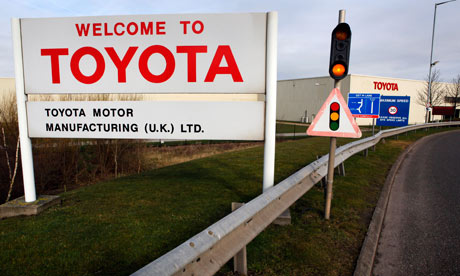
For example, Toyota's UK plants are temporarily shut because they can't get sufficient parts from Japan to continue production. Nissan and Ford have slowed or halted production at some factories, due to parts shortages. Manufacturers of other products that use Japan-made computer chips are worried about disruptions, as well.
Chip factories in Japan are working hard to bring production back to normal, but it will simply take time. As Japanese business inches towards normalcy, the economy will slowly improve and connections with the global supply chain will improve, too.
For example, Toyota's UK plants are temporarily shut because they can't get sufficient parts from Japan to continue production. Nissan and Ford have slowed or halted production at some factories, due to parts shortages. Manufacturers of other products that use Japan-made computer chips are worried about disruptions, as well.
Chip factories in Japan are working hard to bring production back to normal, but it will simply take time. As Japanese business inches towards normalcy, the economy will slowly improve and connections with the global supply chain will improve, too.
Tuesday, 12 April 2011
High street shopping at your fingertips
Calling all retailers: Smart phones are so popular that retailers are introducing apps to reinforce brand image and, more importantly, help customers browse, comment, compare and buy via mobile.
Here are a few of the many apps offered by UK retailers:
- House of Fraser has a gift finder app to help shoppers select that perfect gift for someone special.
- Argos has an iPhone app (above) to inform users of price cuts, store hours and directions, product reviews and more.
- Debenhams has an app for iPhones, an app for Android mobiles and an app for Nokia mobiles.
- TopShop has its own iPhone app to promote new fashions, provide directions to every TopShop and more.
Thursday, 7 April 2011
Looking back at the future of shopping
Technology has been the "future of shopping" for years now. What did experts predict? And how many of these predictions are now reality? A quick sampling from past predictions:
- Personal shopping assistants. These were described (in 2004) as tablet computers (yes, like iPads!) that shoppers would use to find their way around stores, tabulate purchases and speed up checkout. A variation (discussed in 2007) was in-store kiosks, like the Hewlett-Packard prototype above, that would print coupons, shopping lists, etc. Some grocery chains have tried these technologies . . . but now mobiles may be the real shopping assistants of the future, with QR codes providing detailed info for shopping decisions anywhere, at any time.
- Hyper-local buying. Before the recent economic turmoil, before petrol's skyrocketing price, Forum for the Future (with Tesco and Unilever) imagined scenarios (in 2007) in which high oil prices would prompt shoppers to buy food from nearby sources or grow produce themselves. Going green would be a necessity, and the main grocery chains would consolidate their market shares. Some of this has happened, in fact.
- Social media shopping. Facebook, m-commerce, YouTube, and e-mail retail promotions (in 2009) were growing rapidly and would change the way consumers shop. This scenario is actually in full swing today, of course.
Monday, 4 April 2011
Cultural influences on marketing: Teen proms
Although US-style proms aren't new to some UK neighborhoods, they're gaining in popularity, thanks in large part to US TV imports such as Glee and Hollywood movies such as the High School Musical series.
Holiday Inn is profiting from this prom craze, as are many other marketers with prom-related goods and services (think flowers, dresses, tuxedos, limos for hire and more). Below, Fashion Factory's prom offerings.
As noted in Chapter 3 of my Essential Guide to Marketing Planning, teens make up a subculture of their own. Trends in teen fashion and behavior can sweep the world in a short time, given the shared taste in entertainment (including music), clothing, soft drinks and so on. Proms have a long tradition in the US and once they're established in the UK, new generations of teens will look forward to their own end-of-school parties too. Is the prom here to stay?
Holiday Inn is profiting from this prom craze, as are many other marketers with prom-related goods and services (think flowers, dresses, tuxedos, limos for hire and more). Below, Fashion Factory's prom offerings.
As noted in Chapter 3 of my Essential Guide to Marketing Planning, teens make up a subculture of their own. Trends in teen fashion and behavior can sweep the world in a short time, given the shared taste in entertainment (including music), clothing, soft drinks and so on. Proms have a long tradition in the US and once they're established in the UK, new generations of teens will look forward to their own end-of-school parties too. Is the prom here to stay?
Subscribe to:
Posts (Atom)