Showing posts with label privacy. Show all posts

Friday, 20 June 2014

Latest smartphone feature: kill switch

Smartphone theft is a global problem, as the BBC reports, and growing worse year by year.

However, since Apple added a kill switch to its iPhone and iPad operating systems in September, 2013, fewer of its mobile devices have been stolen. Why? Because once owners activate the kill switch, the device becomes useless (except for its parts). Thieves can't get at personal data or use any apps or features, which protects the customer's privacy and makes thieves less apt to steal mobiles they can't easily convert to cash.

The Mercury News in Silicon Valley reports:
In the first five months of [2014], thefts of Apple devices fell by 17 percent in New York City while thefts of Samsung devices -- without a switch -- increased 51 percent from the same period a year earlier.
The pattern has been similar in other areas: Theft of Apple devices in London dropped by 24 percent after the kill switch was added, even as theft of Samsung mobiles increased.

Samsung added a kill switch earlier in 2014. Now, feeling competitive and legislative pressure, Microsoft and Google will add a kill switch to their Windows and Android mobile operating systems. As a result, more than 90 percent of new smartphones will be protected--if customers activate the kill switch mechanisms.

In other words, even with all the fancy apps and features available on sophisticated smartphones, the one that may be the most practical is the kill switch, if it can save customers from the aggravation and inconvenience of losing their devices to thieves.

Friday, 9 May 2014

Tracking versus privacy

The well-known management guru Peter Drucker always said that the purpose of business is to create and keep a customer. To do this, marketers must know what consumers think, feel and do--so they can use marketing to influence customer behaviour. Marketers know that customers are using the Internet and mobile devices as they shop or browse. Not surprisingly, marketers are also using technology to influence customer behaviour and satisfy customers.

For instance, Virgin Atlantic is piloting the use of iBeacon (an Apple mobile technology) to track its passengers in Heathrow and provide assistance as needed (or even before). Passengers might receive special offers as they walk through a retail area, for instance, or their boarding pass might pop up as the approach the gate. Many other marketers are exploring the use of beacon technology to reach customers when and where behaviour can be influenced.

Technology to track how many people pass its doors and how many enter, where they walk in the store and how long they pause in front of a display, is increasingly on retailers' shopping lists.

For privacy reasons, however, many consumers want the ability to be notified of tracking and opt out of tracking. A number of tech firms that provide tracking capabilities are allowing opt-out capabilities. How can marketers find the proper balance of tracking and privacy?

Monday, 13 January 2014

Shoppers + Tracking = Better In-Store Experience?

Will shopper tracking benefit customers as much as retailers? Although online retailers have long been able to track their customers page by page, click by click, store retailers generally lack the kind of comprehensive technology needed to unobtrusively monitor shoppers' movements and behaviour from entrance through the aisles to the exit.

Retail stores are keen to compete with online rivals by giving shoppers a better experience--meaning the right service at the right time, the right price, and the right merchandise where and when wanted. Many stores have data warehouses filled with customer details captured from transactions and loyalty-card schemes, but less specific information about the in-store behaviour of individual customers.

This will be the decade of shopper tracking in stores, experts say. The French Connection began using Wi-Fi to track shoppers via their mobile phones last year, for example. The upscale specialty store Nordstrom installed in-store tracking in 2012, counting the number of people entering and exiting its stores by following the Wi-Fi signals on their mobiles. Understanding footfall patterns helps stores plan employees' schedules and merchandise display possibilities.

To its credit, Nordstrom posted signs informing shoppers of the tracking system, explained that turning off Wi-Fi would allow shoppers to opt out of tracking and used aggregated data rather than individually-identifiable data for shopper analyses. But after a public outcry about invasion of privacy, the retailer was forced to stop tracking shoppers. 

Now Apple is promoting its iBeacon technology for shopper tracking. The system allows in-store sensors to detect iPhones in the area and offer those shoppers customised deals such as vouchers or free samples. Shoppers might be reminded to visit aisle 2 for the greeting cards on their shopping list, or rely on iBeacon to alert the store to prepare preordered merchandise for pickup when the shopper arrives.
Other shopper tracking systems include eye-tracking to determine where shoppers look as they push trolleys through the store. Procter & Gamble is using eye-tracking to gauge the appeal of product displays in stores, for instance.

The key to shopper acceptance will be providing a better in-store experience. If shoppers don't perceive any benefit in being tracked, they may object or turn off their Wi-Fi signals or buy from other stores. And if consumers become more concerned about being tracked when their mobiles are seeking out Wi-Fi signals, regulators may step in to force more prominent disclosure of tracking or limits.

Tuesday, 26 November 2013

Retailing 2014: Customer-driven, tech-driven

What's ahead for retailing in the coming year? The trends can be summed up in two phrases: tech-driven and customer-driven.
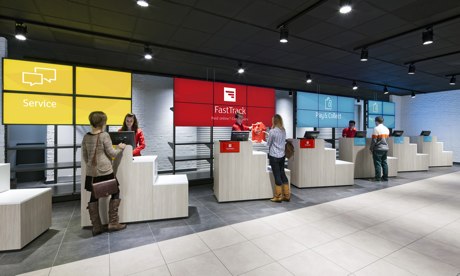
Argos is one example of the customer-driven trend in retailing. In showcase stores, it's finally doing away with those laminated catalogues and tiny pencils and substituting iPads and super-speedy service. FastTrack, shown above, is the retailer's new service that promises to retrieve merchandise ordered on the website within 60 seconds of the customer entering the store. The idea is to make shopping more convenient at every point, from ordering to picking up to paying. Instead of looking at a catalogue, shoppers can browse via iPad kiosks and speak with live employees. Watch for several of these new stores to open around London before Christmas.

Burberry is another example, because of its multichannel marketing. Customers like choices--buy online? buy in a store? order online and pick up in a store? get more info? see what other customers have to say?--and Burberry lets the customer choose. With 16.7 million FB likes, Burberry has a lot of social conversations going. Incoming chief executive Christopher Bailey will build on Burberry's success and creativity to keep the brand at the forefront of multichannel marketing.

Amazon is, of course, a good example of the tech-driven trend. No detail is too small for the giant of online retailing. It files for thousands of patents every year, covering innovations as seemingly small as being able to churn out boxes in the proper size and shape for the endless array of merchandise it sells. It has just launched Amazon Coins, a proprietary virtual currency that Kindle users can use to buy apps or make in-app purchases.

Traditional retailers are using tech to make apparel fitting more convenient and more precise; to give customers access to exclusive content; and to better understand customer behavior. Privacy concerns are definitely an issue for customer-tracking systems (such as those that track shoppers via their mobile signals), but this trend will certainly accelerate in 2014.

Friday, 13 September 2013

Shopper tracking: Who's watching and why?

Retailers want to know who's in their stores, what they look at, how long they stay, which aisles they visit and which marketing techniques are likely to result in buying behaviour.

Some retailers are trying to track shoppers throughout the buying decision process, to learn about underlying needs and preferences as well as to improve offerings and service before, during and after the sale.

For example:
  • Waitrose is considering using the GPS in a customer's mobile to track the distance to its UK "click and collect" locations. By the time the customer arrives at the Waitrose store, having clicked to order groceries earlier, the sacks will be ready to be picked up, saving time and effort at the end of the buying process.
  • A Toronto supermarket installed RFID (radio frequency identification) tags on its trolleys as a test, to where shoppers went in the store, how long they lingered in front of displays and be able to compare actual product purchases to time spent in front of product displays. In the future, the grocery chain might make point-of-sale offers to loyalty customers based on where in the store they are standing.
  • American Apparel stores needed to plan staffing for its busiest hours. With cameras mounted above entranceways in US stores, it counted footfall hour by hour and used the data to be sure it had sufficient salespeople available when shoppers were browsing and buying--resulting in higher sales.
  • Synqera, in Russia, uses cameras in its checkout areas to analyse shoppers' facial expressions and tailor point-of-sale offers to the mood and behaviour of the moment.
  • Some US malls have been tracking shoppers via their mobiles. Reaction is mixed. The marketers want to better understand their shoppers' behaviour. But some shoppers object to this for privacy reasons. 
Privacy concerns may, in the end, be a major challenge, because some customers are uncomfortable about having their movements and moods tracked. In the interest of transparency, disclosure is vital to be sure shoppers know they're being tracked and have a way to opt out--or opt in, if they want special offers for those who have registered.

Friday, 20 July 2012

Freemium pays--but what about privacy?

According to a Guardian analysis, 68% of the top 100 UK Android apps are free--actually, freemium, meaning the initial game or function is free but upgrades or extra elements carry a fee. In addition to ad revenue, these apps make money when consumers pay for higher levels or better characters/equipment/functionality.

Another study indicates that tablet computer users largely prefer free to fee apps. These users do make purchases via apps or within apps, but they don't want to pay for the app itself.

As consumers continue to adopt free or freemium apps for any and every purpose, advertisers and ad networks are finding new ways to attract app users' attention and collect users' data. Google does explain how its AdMob for apps network operates and how consumers can adjust their ad preferences, by the way.

The Economist writes that a growing number of ads delivered by apps are making 'aggressive' moves such as creating new icons that display ads when clicked (see table above, from mobile-security firm Lookout). Users don't expect ads to appear in those places and are surprised--not pleasantly--when they click and discover a commercial message.

Just as bad, users may not be aware of what type of information an ad network is collecting and how it will be used. And with Facebook intensifying its focus on apps and ads, consumers can expect to see more ad messages in the months ahead, with privacy continuing to be a concern.

Thursday, 26 January 2012

Google's controversial privacy changes

From March 1, Google will be putting all its data about users of Gmail, Google search, Blogger, YouTube, and other services together in one database, analysing it . . . and based on the results, serve up a simpler, better user experience. Read all about the changes here.


In the past, Google had separate privacy policies for each service. Now, by applying a single, uniform policy across services, and merging all it knows about you into one database, the company says it can personalize your Google experiences to make them more relevant to your needs.

Critics are unhappy because it's not possible for anyone to opt out. If you sign in, you're identified across all the Google services, and your data will be collected, whether you like it or not. Gmail may be convenient, but it will be less private because Google will use what it finds in your messages plus what it sees you watching on YouTube or writing on Blogger to present you with targeted ads.

You may, as Google points out, get more precise information when you search, because Google knows so much about you. And there are likely to be other benefits that will emerge as people learn to use the new system. Still, the privacy aspect is quite controversial.

Wednesday, 1 June 2011

The cookie rule and e-privacy

The European Union's Internet privacy directive affecting cookies is now in effect, but UK regulators are delaying implementation for a year.

The directive, intended to protect consumer privacy, requires that Internet users be informed of why each Web site wants to store individual info via cookies. Users will have to give their consent for cookies to be stored on their computers.

Neither customer-requested cookies (such as those indicating a paid subscription) nor necessary cookies (such as those that are needed when customers click to put a product into an online shopping basket) are covered by the directive.

Exactly how to accomplish the purpose of improving e-privacy without hurting the user's online experience isn't entirely clear, however. Should a site provide the information via pop-ups, which many users find irritating and intrusive? Should it request that users indicate their preferences when they sign up? Not surprisingly, companies are confused about how to proceed.

Meanwhile, browse the YourOnlineChoices UK site to learn more about browser settings for cookies (see left), Internet tracking and related issues.

Friday, 25 March 2011

Tablet Computers: Privacy vs Convenience

Tablet computers--iPads and competing tablets--are so light and convenient that shopkeepers in Estonia are using them to show YouTube product demonstrations and tally customers' purchases. Restaurant owners in Tokyo are testing iPad-based menus that allow customers to order with a touch (below). Small and medium-sized businesses are adopting tablets, as well. In hospitals, iPads are making the rounds with physicians.

But will the rush for convenience overwhelm the need for securing private data such as credit card numbers, customer details, and proprietary business information?

Tablet malware is a small but growing problem, for example. And a Harris Interactive poll shows that nearly half of the tablet users in the study are sending sensitive data via tablets.

UK and European regulators have established strict rules for data storage and protection. But they can't force every tablet user to input a strong password and they can't secure every wireless connection. Marketers should consider the privacy angle very carefully before they begin relying on a tablet for business functions.

Friday, 13 August 2010

RFID, marketing and privacy

A few years ago, when the RFID (Radio Frequency Identification) tag was a new idea for tracking products in warehouses, toting tolls and taking store inventory, the cost per tag was high and consumers knew little about this technology.

Today, the price per tag is much lower, which means RFID can be a cost-efficient way to handle many marketing functions. As the price of RFID tags and readers drop, RFID will become commonplace in stores, factories, airports and other public places.

The Finnish furniture manufacturer Martela, for example, adds RFID tags in hidden areas of its products (see left). As part of its full service to business customers, Martela then returns to the customers' facilities every year to inventory the furniture and identify broken or worn-out items to be replaced. Thanks to RFID, this is a speedy process that saves business customers time and money--and gives Martela a competitive advantage over other suppliers.

Privacy concerns remain, however. Consumers don't want RFID tracking their movements or use of individual products. Security is another issue: because RFID tags communicate via radio signals, they might be intercepted and/or blocked.

Walmart, for instance, has added RFID tags to many clothing items in its US stores. Although the retailer plans to "turn off" the RFID when clothing is purchased, privacy advocates worry that some tags will be missed or that the tags will be used to link individual purchasers to specific items and transactions, raising the threat of identity theft.

Stay tuned for more on the future of RFID and marketing.