Showing posts with label Starbucks. Show all posts

Friday, 16 December 2016

Easy marketing £1 coffee

EasyCoffee is a growing franchised coffee chain under the Easy brand umbrella, soon to open dozens of new branches around the UK. The top brand attribute for Easy is (no surprise) value (£1 for a regular -sized coffee or tea). You know, Easy as in easyJet, the high-profile Easy-branded budget airline.

Here's the EasyGroup mission:
To manage and extend Europe's leading value brand to more products and services, whilst creating real wealth for all stakeholders.
Businesses or other organisations can have an EasyCoffee vending machine (above) on their premises to offer employee value-priced branded coffee. In other words, EasyCoffee's distribution strategy goes beyond consumer-oriented retailing into B2B marketing.

Which is a good thing, because competition in the retail side of coffee shops is intense, given the strong brands trying to increase market share (Starbucks, Costa and so on). Not to mention competition from other food service brands that make coffee a signature element in their outreach to certain customer segments (such as McDonald's with its McCafe coffees).

Tuesday, 28 June 2016

Marketing Starbucks in China

Continuing a look at global brands in China, this entry is about Starbucks, the US-based coffee shop company that has made lattes and espressos part of daily life all over the world.

Starbucks just opened a spacious flagship cafe in the new Shanghai Disney resort. This isn't the first Starbucks connected with a Disney resort, but it is the first of this ultra-modern design...with more than 100 employees to serve thousands of customers every day. The company says this will be the busiest Starbucks on the planet.

China is an attractive market for Starbucks because coffee consumption is still relatively low compared with consumption in other areas--which means a lot of growth potential as consumers adopt the 'coffee culture'. Starbucks already has 2000 cafes in China and plans to open 2500 new cafes over the course of 5 years.

To reinforce its brand image and provide an upmarket consumption and sampling experience, Starbucks plans a new Roastery and Reserve Tasting Room for Shanghai. Modeled on the tasting room near the company's headquarters in Seattle, this Shanghai location will demonstrate the roasting process and offer samples of various coffees and flavours.

Will consumers in China pay the luxury price for a luxury coffee often enough for Starbucks to profit handsomely from its investment? 

Monday, 22 September 2014

Coffee marketing: Convenience vs status

Who prices a single cup of coffee at £11? Actually, the price is 1,998 yen, and the marketer is Starbucks in Japan. The coffee is made from special Geisha beans (really!) that are grown in Panama. Starbucks was able to buy a quantity of these specialty beans and is offering the coffee in its Tokyo-area restaurants.

Starbucks has tweeted about these specialty beans in the past. It is also promoting the expansion of installations of its special high-end brewing system, Clover, used for the expensive 'reserve' coffees it serves in selected stores.

The pricing strategy for Geisha coffee is in stark contrast to the popularity of 100-yen coffee available at the ubiquitous convenience stores all around the cities. In fact, there is a price war brewing among convenience stores that want to attract coffee buyers.

Convenience and low price are two key motivations for purchase--but status can be just as powerful in many situations, as this example of product pricing illustrates.


Tuesday, 29 January 2013

Coffee culture heats up

The Italian coffee company Lavazza will open dozens of Lavazza Espression coffee shops around London in the coming years, part of its intense focus on the UK market.

Italian-style coffee has been trendy in the UK for some time, with Whitbread's Costa operating 1,300 shops, Starbucks operating 760 shops and Caffe Nero operating 400 shops. Add it all up, and one expert says these three chains hold a combined 52% of the UK coffee-shop market. These chains revived the UK coffee culture and helped educate consumers about great tasting espresso, capuccino and other hot (and cold) coffees that have become favourites.

Even so, if the market share numbers are correct, and coffee consumption continues to increase as strongly as in previous years, there's opportunity for innovation by independent shops and small chains that emphasise high quality.

The Independent recently listed the 50 best UK coffee shops, including indies like Allpress Espresso, Caravan and 6/8 Kafe, highlighting friendly service, superior coffee, special events and comfortable cafe ambiance. After all the years of enjoying chain coffee, many consumers are seeking out different places and tastes, partly for the novelty and partly to be among the first to discover something new and different.

One fast-growing new entrant is Harris & Hoole (above), which has 10 coffee shops and multimillion-pound backing from Tesco. Although the Tesco investment has sparked some controversy, the founders of Harris & Hoole explain that they had difficulty obtaining funding and Tesco's money doesn't represent a controlling interest. Watch for more H&H shops popping up all over London and beyond--and for independents that make great coffee or offer great ambiance.


Thursday, 3 January 2013

Vietnam's new marketing vitality

Vietnam has new marketing vitality, thanks to ongoing economic growth and rising household buying power for a population of 90 million (see right).

Here are a few of the ways marketers are paying attention to Vietnam:
  • Starbucks will soon open its first coffee shop in Ho Chi Minh City, as part of the Seattle-based company's international expansion strategy.
  • Procter & Gamble markets many of its best-known products in Vietnam, including Gillette razors, Pampers disposable diapers and Pantene shampoo--in competition with Unilever and other multinationals.
  • E-commerce is growing in Vietnam, including daily deal sites, "Amazon-like" retailers and other online businesses.
  • Retailing is an industry undergoing expansion, with a mix of smaller stores and multi-city chain stores competing for shoppers.
  • Vietnam has had a thriving tourism business for years, drawing vacationers from Russia and China in particular. Among high-profile visitors, Facebook founder Mark Zuckerberg and friends spent Christmas 2011, in Vietnam.
  • HSBC Bank offers full-service banking in Vietnam and, with PriceWaterhouseCoopers, has developed a guide to doing business in the country.
  • Danish companies such as Mascot are profiting from B2B and consumer relationships in Vietnam.
  • Chevron is developing a gas pipeline project in Vietnam, only one example of the nation's infrastructure improvement initiative involving multinational corporations.


Thursday, 20 September 2012

New marketing moves by Starbucks

Want a Starbucks coffee first thing in the morning? Now the company is selling Verismo single-serve brewing machines. Just pop in a coffee pod, add water, press the button and have a hot latte in a few moments--without leaving your kitchen (or home office).

This is a multinational marketing effort, aimed at capturing a solid share of the fast-growing market for single-serve coffee made at home.

Like Nespresso, Starbucks will begin selling replacement coffee pods directly to consumers through its proprietary e-commerce website.

What if you're in a supermarket or a petrol station and you want to sip a Starbucks espresso? Look for Starbucks on the Go, vending machines being installed in stores, forecourts, airports and other places, featuring the company's Fairtrade espressos. Coming soon to a Starbucks near you: A new drive-through lane so you don't even have to park to order your favourite latte.

Wednesday, 12 September 2012

Coffee, Tea and Nespresso

Nespresso has been marketing premium single-serve coffeemakers and coffee capsules for decades--and brewing up high profits for parent company Nestlé.

Its posh positioning is reinforced by adverts featuring movie star George Clooney and branded boutiques where stylish coffee machines are the stars of the show. In fact, Nespresso recently announced it will build another factory to keep up with worldwide demand.

The single-serve coffee market has attracted a lot of competitors in recent years, however, and Nespresso is now busy defending its market share while launching new products to maintain revenue momentum.

Currently, Nespresso is introducing upmarket machines that brew one top-quality cup of tea at a time, for example. But competition may grow even more intense in the tea segment as Unilever thinks about opening a chain of trendy tea-machine boutiques.

In the core coffee market, Nespresso recently lost a legal battle in Germany to prevent competitors from selling capsules that fit Nespresso machines (but cost less than Nespresso's replacement capsules). Its patents were upheld by the European Patent Office, on the other hand. Meanwhile, Starbucks is launching its own single-serve coffeemaker and already makes replacement capsules to fit the Keurig machines that are popular in North America. What innovations will the market see next?

Monday, 28 November 2011

In search of a mobile payments standard

Starbucks thinks credit card companies, banks, telcos and handset makers are moving too slowly toward one unified standard for mobile payments via near field communications (NFC)--also known as contactless payments--where you simply wave your phone near the till or pay point and the transaction is completed.

Mobile payments are the new new thing. According to forecasts, NFC payments will be commonplace across the UK retail and restaurant marketplace by 2016. Given the huge number of smart phone mobiles in use, this is a possibility. However, consumers don't want to have to juggle multiple payment systems, nor do merchants. And so far, there's no agreement on one standard technology or processing programme. Security is another concern.

During the past year, a number of arrangements have been announced. Orange and Barclaycard, for example, have launched Quick Tap, making NFC payments possible at Subway, Pret a Manger and other retail establishments. Samsung and Visa are readying a deal in advance of the 2012 London Olympic Games.

Starbucks isn't waiting for one standard to be adopted by all parties. In the interim, it's launched its own mobile payment app for the iPhone. Although not NFC-based, the system has proven itself in the United States and will likely be enjoyed by Starbucks lovers around the UK because it speeds up transactions.

Will mobile payments follow the NFC standard? Or will another technology win out, the way VHS beat Betamax in the videocassette standards battle of the 1980s?

Thursday, 6 January 2011

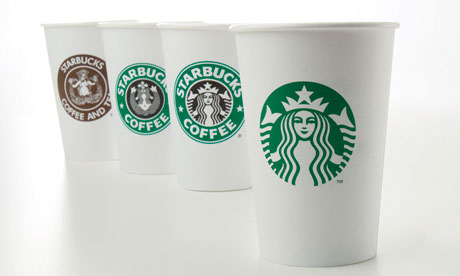
What about the new Starbucks logo?

Starbucks recently announced an updating of its seemingly ubiquitous green logo, which features the firm's mermaid "siren" with crown and long flowing hair. No more "Starbucks" name, no more references to "coffee." In fact, no words at all. Getting ready for brand/category extensions again? Trying to break free from its coffee roots?

As Starbucks prepares for its 40th anniversary celebration in March, its newly revised logo has some loyal customers--and some marketers--asking questions.

Although this isn't the first revamp of the logo, some people wonder whether Starbucks is wasting its money on the changeover to the new logo. The Guardian even has a poll asking readers this very question. When I checked today, sentiment was running 2-to-1 against the move. In other words, readers don't agree with Starbucks' investment in its updated logo.

Will Starbucks stay with the new logo or, like the Gap, will it revert to an older version? Let's see how vocal the opposition turns out to be.