The fast-growing 'sharing economy' includes firms like Airbnb (flats and homes) and Uber (car hires). Customers book what they need, when they need it, on demand, via app or the web. Convenient, easy, affordable and low-stress.
In America, electric scooters are already part of the sharing economy. Pioneering firms like Lime and Bird have put hundreds of lightweight, rechargeable scooters on the streets of major cities and on university campuses. Consumers unlock the scooters by logging into an app and paying about £1 to start. Operating fees depend on how long the ride continues, but the entire cost is usually much less than hiring a car or hailing a cab.
Scooters don't pollute, and they don't take up much space on streets or in car parks. Riding is fun and easy after a bit of trial and error. More scooters could mean less traffic and congestion in cities and on campuses. So why aren't UK cities encouraging scooters and the sharing economy?
Currently, UK law doesn't allow motorized scooters on paved streets/public roads. And based on the US experience, which has been both positive and negative, UK municipalities may be wary of consumers weaving in and out of traffic, riding on sidewalks and/or leaving scooters on the side of the street.
Now US-based Bird is among those seeking permission to operate in the UK. Its first test is a limited pilot programme on one private path near Bird's London offices. Will UK regulators change the rules to allow scooter-sharing services to operate?
Showing posts with label pricing. Show all posts
Showing posts with label pricing. Show all posts
Monday, 19 November 2018
Wednesday, 10 October 2018
How Tesco competes with deep-discount retailers
Tesco has a new weapon in its battle with deep-discount retail chains Lidl and Aldi.
It just opened two discount-price stores in a new chain it calls Jack, for Tesco's founder, Sir Jack Cohen. Short name, easy to remember, limited assortment, low prices, local merchandise. And the store openings coincide with Tesco's celebration of 100 years of low prices.
Most of the products will be branded own-label, but some will be well-known global brands like Coca-Cola. To reinforce the British origin of local merchandise, and the chain's British heritage, Jack signage features the Union Jack.
Tesco's CEO says the target market is 'economically challenged [consumers] that need a bargain and the affluent shopper that wants a bargain'. Adding a 'treasure hunt' element, the centre aisle of each Jack's store displays WIGIG promotions--bargain products that will go quickly, so 'when it's gone, it's gone'.
Lidl and Aldi have challenged Tesco and other full-service supermarkets in recent years, attracting price-conscious consumers willing to buy what they want at low, low prices in a no-frills retail atmosphere.
A few months ago, Tesco closed its Tesco Direct business, which sold non-food products directly to consumers. That business had been operating for nearly 12 years but was not yet profitable. Will Jack's enable Tesco to compete effectively in a highly pressured retail environment--and be profitable at the same time?
It just opened two discount-price stores in a new chain it calls Jack, for Tesco's founder, Sir Jack Cohen. Short name, easy to remember, limited assortment, low prices, local merchandise. And the store openings coincide with Tesco's celebration of 100 years of low prices.
Most of the products will be branded own-label, but some will be well-known global brands like Coca-Cola. To reinforce the British origin of local merchandise, and the chain's British heritage, Jack signage features the Union Jack.
Tesco's CEO says the target market is 'economically challenged [consumers] that need a bargain and the affluent shopper that wants a bargain'. Adding a 'treasure hunt' element, the centre aisle of each Jack's store displays WIGIG promotions--bargain products that will go quickly, so 'when it's gone, it's gone'.
Lidl and Aldi have challenged Tesco and other full-service supermarkets in recent years, attracting price-conscious consumers willing to buy what they want at low, low prices in a no-frills retail atmosphere.
A few months ago, Tesco closed its Tesco Direct business, which sold non-food products directly to consumers. That business had been operating for nearly 12 years but was not yet profitable. Will Jack's enable Tesco to compete effectively in a highly pressured retail environment--and be profitable at the same time?

Thursday, 19 July 2018
Bargains Draw Buyers on Amazon Prime Day
Once again, Amazon Prime Day has broken all records for merchandise sales. Eager shoppers clicked or swiped to buy more merchandise on 16 July than on Black Friday or CyberMonday, two "shopping holidays" that lead into Christmas buying season. Small businesses were among the big winners, promoting discounts to their customers via the Amazon retail platform.
Although Amazon generally puts special emphasis on electronics on Prime Day, Drapers reports that the retailer sold 287k clothing items during its shopping holiday--many of these from the company's private brand collections. Amazon has been more aggressively promoting its private brands in recent years, with product launches scheduled during Prime Day in 2018.
One of the year's most popular appliances sold out--the Instant Pot. But, not surprisingly, Amazon's own Echo Dot speaker was the biggest seller of all on Prime Day, along with its own Fire Stick TV device.
Although Amazon generally puts special emphasis on electronics on Prime Day, Drapers reports that the retailer sold 287k clothing items during its shopping holiday--many of these from the company's private brand collections. Amazon has been more aggressively promoting its private brands in recent years, with product launches scheduled during Prime Day in 2018.
One of the year's most popular appliances sold out--the Instant Pot. But, not surprisingly, Amazon's own Echo Dot speaker was the biggest seller of all on Prime Day, along with its own Fire Stick TV device.
Monday, 2 October 2017
Pricing and shrinkflation
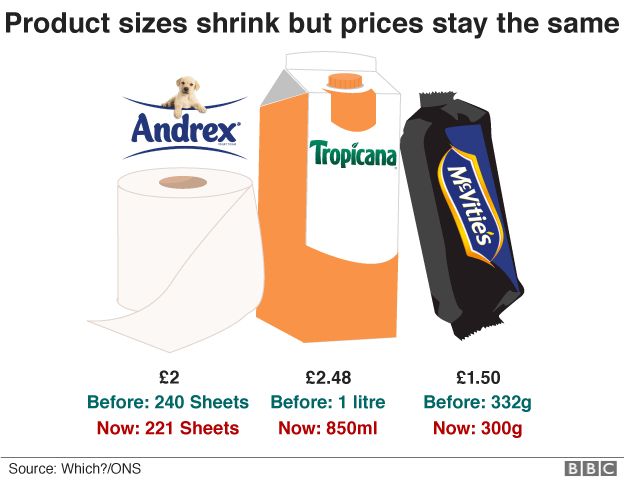
Yet, according to the UK Office of National Statistics, more than 600 items have actually increased in size during the past five years. This reflects the trend towards focusing consumers on value. 'More for the same price' sends a message to price-conscious shoppers that a product will deliver higher value than some competing items.
More shrinkflation is on the way as marketers cope with continued cost increases and ongoing currency swings that can affect what manufacturers pay for ingredients and what they receive in payment from wholesale buyers.
Shrinkflation is usually not publicised by the manufacturers...but government offices and media reporters take notice. Then consumers become aware, and have to decide whether to continue buying a favourite brand or product, or change behaviour and buy something else.
Tuesday, 22 August 2017
Poundland's multiprice strategy

The multiprice strategy helps Poundland keep its brand promise to price-conscious customers. It also helps the retailer manage seasonal inventory. Rather than store out-of-season stock for nine months until the season rolls around again, Poundland is clearing merchandise by cutting the price, as many other stores do. The result: shelves are full of in-season, fresh merchandise at attractively low price points.
Poundland leverages social media for its price-driven promotions, with consistency in posts across platforms. More than 300,000 people have liked Poundland on Facebook, nearly 25,000 follow it on Instagram, and it has 80,000 Twitter followers (as well as a YouTube channel and a Pinterest page).
This updates the "Marketing in Practice" example in Chapter 7 of Essential Guide to Marketing Planning, 4th edn.
Friday, 11 August 2017
Inside Uniqlo's Marketing Plan

Expanding beyond its home base of Japan, Uniqlo has a growing audience of brand fans in the UK and Europe, China, and the US. Many of Uniqlo's products are fashion basics, although it also launches new style collections seasonally. The company markets own-brand merchandise, and controls the design and production functions as well as controlling the retail outlets. This allows it to move quickly to ride the wave of a strong trend, for flexibility in adjusting the marketing plan as needed.
One recent innovation is the introduction of #UniqloToGo, vending machines dispensing t-shirts and light outerwear in US airports. The idea is to appeal to people passing through airports who need an extra shirt or another jacket to wear to or at their destination. It's not just convenient, it's also a way to increase brand awareness and capture extra sales. The prices are moderate, which encourages impulse purchasing.
This, plus pop-up stores in major cities, allows Uniqlo wider reach and more flexibility in executing its marketing plan.
NOTE: This post updates the Marketing in Practice box in Chapter 8 of Essential Guide to Marketing Planning, 4e
Monday, 7 August 2017
Top UK consumer brands of 2017
SuperBrands has released its list of the top consumer brands for this year, as determined by UK consumers.
Here are the top 5, along with a bit of news about each of these leading consumer brands.
5. Gillette - Gillette is facing competition from UK newcomer Harry's, which offers a subscription-based alternative to buying razor blades at retail. Backed by Procter & Gamble, Gillete's traditional strengths are positive brand recognition and product innovation.
4. Andrex - The well-known toilet-tissue brand is celebrating its 75th anniversary with nostalgia-laden marketing. Andrex enjoys high market share and has slightly shrunk its rolls to cut costs and fund product investments.
3. Rolex - Reinforcing its brand's luxury positioning, Rolex sponsors special events like the Rolex Fastnet yacht race and the Rolex Grand Prix at CHIO Aachen showjumping competition. These special events keep the brand top-of-mind in the target market.
2. LEGO - The recent Bricklive special event in Belfast offered LEGO fans the opportunity to build and to watch others build creatively. More than 10,000 brand fans showed up, some to build and many to enjoy seeing the process and the finished results--reinforcing loyalty and engaging fans.
1. British Airways - As part of a trend toward entertaining passengers (and the public), BA recently released a funny safety video starring celebs like Gordon Ramsay, 'Mister Bean' (Rowan Atkinson) and Gillian Anderson. The airline's CEO says he wants passengers to watch the safety video from start to finish. It's also a positive branding association.
Here are the top 5, along with a bit of news about each of these leading consumer brands.
5. Gillette - Gillette is facing competition from UK newcomer Harry's, which offers a subscription-based alternative to buying razor blades at retail. Backed by Procter & Gamble, Gillete's traditional strengths are positive brand recognition and product innovation.
4. Andrex - The well-known toilet-tissue brand is celebrating its 75th anniversary with nostalgia-laden marketing. Andrex enjoys high market share and has slightly shrunk its rolls to cut costs and fund product investments.
3. Rolex - Reinforcing its brand's luxury positioning, Rolex sponsors special events like the Rolex Fastnet yacht race and the Rolex Grand Prix at CHIO Aachen showjumping competition. These special events keep the brand top-of-mind in the target market.
2. LEGO - The recent Bricklive special event in Belfast offered LEGO fans the opportunity to build and to watch others build creatively. More than 10,000 brand fans showed up, some to build and many to enjoy seeing the process and the finished results--reinforcing loyalty and engaging fans.
1. British Airways - As part of a trend toward entertaining passengers (and the public), BA recently released a funny safety video starring celebs like Gordon Ramsay, 'Mister Bean' (Rowan Atkinson) and Gillian Anderson. The airline's CEO says he wants passengers to watch the safety video from start to finish. It's also a positive branding association.
Wednesday, 12 July 2017
The future of fixed pricing in UK food stores

The idea is to effectively manage supply and demand, avoiding queues during busy periods and spreading demand during the day.
Well, surge pricing is not exactly what's happening, at least not yet. Thanks to electronic price tags on shelves, however, food stores have the technical ability to vary prices during the day.
For example, Marks & Spencer last year tested discounting sandwiches in the morning to encourage early buying and alleviate crowds at lunchtime.
Surge pricing could be in the works for petrol, again as a way to manage supply and demand on busy days.
Still, fixed pricing is not going to disappear from food retailers, at least not for a long time. Customers will vote with their wallets if they don't like what a retailer is doing. And no store wants to lose loyal customers over a pence or a pound.
Monday, 10 July 2017
Specsavers focuses on differentiation
 Specsavers differentiates itself from other providers of spectacles by focusing on two key points of difference: (1) affordable pricing and (2) stylish frames.
The company, which partners with local optician professionals in the UK and Australia, as well as in Europe, has some 2,000 retail locations. With buying power like that, Specsavers can offer a variety of fashion frames at popular prices. It is also expanding into the niche of prescription safety glasses through a licensing deal with JCB.
The company seeks efficiency of operations to keep costs and prices low. For instance, it is streamlining its information technology arrangements and outsourcing to the cloud. It is also applying the latest manufacturing technology to the products it sells--including sustainable energy to keep Specsavers green.
Among the marketing techniques Specsavers uses is social media marketing on Facebook and beyond. The #LoveGlasses hashtag highlights images and posts that relate to its style credentials, all part of the marketing plan based on Specsavers' positioning of affordability and fashion.
This post updates content in Chapter 4 of Essential Guide to Marketing Planning, 4th edn.
Wednesday, 31 May 2017
Ryanair adds share, profits and partners

By adding more jets and cutting fares to attract passengers, the no-frills airline has successfully boosted market share while forcing competitors to respond.
Even as Brexit proceeds, Ryanair is preparing for the future through partnerships with European airlines. The plan is to allow passengers to book longer-haul travel through Ryanair and connections with its partners, including Air Europa, Aer Lingus and Norwegian Air.
Ryanair's long-term goal is to be flying 200 million passengers yearly by 2024. Currently, the airline projects it will fly 130 million passengers in the next 12 months--with lower prices and higher profits.
This post updates the Ryanair case in Chapter 3 of my Essential Guide to Marketing Planning, 4th edn.
Sunday, 19 March 2017
Poundland's multi-price strategy

Updating the 'Marketing in practice' box on p. 135 of my new Essential guide to marketing planning, Poundland has expanded its pricing and product mix beyond the traditional £ 1 unit price. Now owned by Steinhoff International, the discount retailer has a variety of price-oriented straplines, including: 'Big brands cost less'.
In stores and online, Poundland now sells many items for more than £1--with the vast majority of merchandise selling for less than £10. Above, the website shows branded items selling for 'only £2 each'.
The product mix includes more clothing than ever, thanks to a 'shop within a shop' arrangement with the Steinhoff-owned brand Pep & Co. Pep's managing director says: 'The combination of Pep&Co’s design and style credentials - with pricing that’s amazing - will help create a brand new option that helps mums on a budget'.
Having Pep stores within Poundland should increase footfall and bring shoppers back for fashions as well as everyday household goods like laundry detergent. How will Poundland's reputation for low prices be influenced by this multi-price strategy?
Wednesday, 1 March 2017
Tesco's core purpose, over time
Tesco has published its core purpose (also known as the mission statement) on its corporate website for years. Over time, the core purpose has changed slightly to a tighter focus on what, specifically, Tesco aspires to do for its customers.

In 2010, Tesco's mission statement (shown above, retrieved from the Internet Archive's Wayback Machine), was 'to create value for customers to earn their lifetime value'.

In 2014, Tesco's mission statement (shown above, again from the Wayback Machine), was to 'make what matters better, together'.
 In 2017, Tesco's mission statement (shown above, from today's website), was 'serving Britain's shoppers a little better every day'.
In my opinion the 2017 mission statement is stronger than the earlier versions. Why?
Take a look at Checklist #1 in my Essential Guide to Marketing Planning for questions to use in evaluating any mission statement, including Tesco's. For example, one question is: 'Who will the organisation focus on?'
Tesco's 2014 core purpose was less specific on this point than its 2017 core purpose, which clearly states 'Britain's shoppers'. In other words, it defines a particular group of customers in a particular market. The statement also mentions that Tesco will be 'a little better every day'.
This provides clear strategic direction for decision-makers (and reflects Tesco's shift away from operating stores in other nations). The clarity helps the grocery retailer's turnaround efforts, which depend on careful pricing and on consistent customer service, to battle intense competition.

In 2010, Tesco's mission statement (shown above, retrieved from the Internet Archive's Wayback Machine), was 'to create value for customers to earn their lifetime value'.

In 2014, Tesco's mission statement (shown above, again from the Wayback Machine), was to 'make what matters better, together'.

In my opinion the 2017 mission statement is stronger than the earlier versions. Why?
Take a look at Checklist #1 in my Essential Guide to Marketing Planning for questions to use in evaluating any mission statement, including Tesco's. For example, one question is: 'Who will the organisation focus on?'
Tesco's 2014 core purpose was less specific on this point than its 2017 core purpose, which clearly states 'Britain's shoppers'. In other words, it defines a particular group of customers in a particular market. The statement also mentions that Tesco will be 'a little better every day'.
This provides clear strategic direction for decision-makers (and reflects Tesco's shift away from operating stores in other nations). The clarity helps the grocery retailer's turnaround efforts, which depend on careful pricing and on consistent customer service, to battle intense competition.
Friday, 20 January 2017
Aldi, Lidl and the grocery price war
 Aldi and Lidl, two German-based discount supermarkets, are gaining UK market share through a seemingly never-ending price war against the local grocery retailers that once dominated the industry.
Consumer behaviour suggests that cash-strapped shoppers aren't completely returning to pre-recession buying patterns but continuing to seek out bargains and stretch their pounds in certain product categories.
Today, Aldi and Lidl are so well-known that these grocery names topped You.Gov's recent BrandIndex, exceeding the brand ranking of the BBC, John Lewis and other leading brands.
Lidl's newest strapline is Big on quality, Lidl on price, calling attention to its competitive strengths. For several years, Lidl has steadily increased its market share, and 2016 was its best UK holiday trading period ever.
Aldi is promoting its pay packages for staff, showing that employees make more than the minimum wage and putting pressure on rivals to increase pay as well--adding to the goodwill its brand enjoys. Like Lidl, Aldi's 2016 holiday trading period was its best ever in the UK, with higher market share as a result.
How will Tesco, Morrison's, Sainsbury's and John Lewis fight back in 2017?
Sunday, 15 January 2017
Maltesers, Braille and shrinkflation

Model Maltesers were used to spell out, in Braille, this message at one London bus shelter: 'Caught a really fast bus once, turns out it was a fire engine'.
Maltesers has a long-running ad theme #LookontheLightSide and this bus-shelter ad is part of the inclusiveness campaign as well as celebrating World Braille Day. More than 1.5 million people like the Maltesers Facebook page, where this photo was posted.
Meanwhile, Mars is reacting to higher commodities costs by shrinking some of its products. Malteser 'sharing' packages will contain 15% less than today but sell for today's price.
What Mars has done by reducing the contents of the Malteser package is part of a trend dubbed 'shrinkflation'. Mars competitor Mondelez recently changed the shape of its Toblerone chocolate so it contains less chocolate but sells for the same price as before, to avoid increasing the retail price.
Other chocolate marketers are also deciding between reducing the amount of product and raising the price. Because so many consumers are so price sensitive, shrinking the product may be more acceptable to buyers than increasing prices...for now.
Sunday, 1 January 2017
Mind the gender price gap
PRICING: SAME FOR MEN AND WOMEN?
This review has reassured us that for Boots own brands the two reported examples, Boots disposable razors and Botanics eye roll-on, are indeed exceptional cases which do not completely meet our principles and we are taking action to correct these prices.Now Tesco has also changed its pricing so razors cost the same for men as for women. It said: '...following an internal review and discussions with our suppliers, we have acted on concerns about the difference in price of our female and male disposable twin-blade razors, in line with our commitment to ensure consistently low, simple and affordable pricing.'
In 2017, more retailers are likely to follow this model and eliminate the gender price gap (sometimes known as the pink tax) so that functionally equivalent products are priced the same, regardless of whether the target market is male or female. But this same pricing trend is not as widespread among hair stylists. How many other product categories will move toward gender-neutral pricing in 2017?
Monday, 7 November 2016
Competing with Aldi
A former exec who helped set up Aldi in Australia explains the retailer's strategy: '. . . the deal between the supplier and Aldi is; first Aldi will take a larger pack size, often a pack size that is exclusive to Aldi so some economy is represented here and that Aldi does not embarrass other bigger retail customers . . . of the brand with its selling price'.
Now Aldi's head in Australia notes how the company's expansion has affected retail pricing: 'Our prices are always the lowest, so we have observed the market getting a little sharper in prices … at the same time as our competitors have been lowering prices, we have as well'. Aldi's expects to continue acquiring market share in Australia, aiming for as much as 15% of that market within a few years.
One way competitors are fighting back is by not only increasing their private brands but in some cases, by blurring the line between national brands and private brands. Woolworths in Australia recently relaunched some of its store private brands without highlighting the retailer's brand ownership on the front label. Products formerly branded prominently as 'Woolworth's Gold' now bear the brand 'Gold' on the front label, for example, with the Woolworth name on the back label.
Woolworth says it has been fine-tuning its Australian private brands: 'Over the last year we sought insights from our customers as we looked to enhance our range of products. Woolworths branded and non-branded ranges reflect our commitment to quality and value'.
Meanwhile, Aldi's low-price grocery rival in Germany, Lidl, is moving further into markets where Aldi has established itself--such as the US market. 'We are in the early stages of our preparation to launch in the U.S., and our focus right now is in our operations along the East Coast and opening our first stores no later than 2018', says a Lidl exec. Lidl competes against Aldi by opening larger stores and stocking a wider assortment of merchandise compared with Aldi.
Watch for price wars when Aldi targets a market--and watch for competing stores to slash prices or risk losing shoppers who follow the bargains.
Tuesday, 25 October 2016
Poundland's pricing strategy
 Poundland sells everything for £1. Or at least that was its traditional pricing strategy. In recent months, the retailer known for its one-price strategy has expanded the number of products sold at a higher price.
 From time to time, Poundland offered special deals over the one-pound price (see "Replay DVD" here). But recently, Poundland posted store signs announcing more value deals, meaning the sale of merchandise priced over the one-pound price.
Was the change in pricing strategy due to Brexit's impact on the pound? Poundland says Brexit is not to blame. The retailer is actually expanding its merchandise offerings: 'The rationale was to bring customers more value products than is possible at the £1 price point'.
In fact, Poundland is opening stores under the brand 'Poundland & More' to test the strategy of mixing £1 with a range of higher-priced value deals.
This post updates the Poundland example in the targeting and positioning section of Chapter 7 within my Essential Guide to Marketing Planning.
Friday, 14 October 2016
Product pricing and Brexit

As a result of Brexit, the value of the pound sterling has slumped, and Unilever is trying to increase the price of some products by an average of about 10% to compensate for the slump.
Inventory on Tesco's store shelves dwindled as the grocery giant fought Unilever over pricing. Media coverage of the battle raised the possibility that Tesco's shoppers might be unable to find beloved brands like Marmite and Ben & Jerry's.
Tesco resisted Unilever's price increase by emphasising its role as championing low prices on behalf of consumers. Unilever explained that its supply costs are increasing, profits are going to be affected and therefore product pricing must be adjusted.
After a 24-hour standoff, Tesco and Unilever announced that the dispute had been resolved and shelves would be full of the brands shoppers want.
Expect more announcements about wholesale pricing as other producers seek to counteract the slump of sterling by increasing prices, if possible.
Thursday, 23 June 2016
'Authentically Disney and distinctly Chinese'
 |
| From Walt Disney Company news |
The path from idea to approval to construction to opening was long and challenging. Disney originally proposed the theme park 20 years ago, but political and economic factors slowed progress.
The target market is the 330 million people who live within three hours of the park. Millions more may travel longer distances to visit, increasing domestic tourism and spreading awareness of the Disney brand throughout China.
As the head of Disney states: 'Shanghai Disneyland is authentically Disney and distinctly Chinese'.
Disney, whose characters are increasingly familiar to Chinese families, faces considerable competition from diverse theme parks already attracting crowds in China. Dalian Wanda Group is opening 10 entertainment complexes, with admission prices below those set by Disney. Other theme parks (such as Hello Kitty) are also competing for the middle class family's attention and money. How will Disney do in this super-competitive environment?
Wednesday, 20 April 2016
New tax on sugary sodas, new Coca-Cola Zero Sugar
 From 2018, sugary soft drinks will carry an extra tax, part of the UK's initiatives to combat obesity.
Now Coca-Cola is renaming its Zero soft drink, after learning that half of British consumers weren't aware the soda is sugar-free. Watch for the new cans on shelves this summer, part of the marketing strategy to give packaging a 'one brand' look featuring the famous red so strongly associated with Coke.
The rebrand will also include a reformulation so the soda tastes more like regular (non-zero-sugar) Coca-Cola.
Coca-Cola faces lower demand for its soft drinks among European and North American consumers. It is also examining its pricing policies in Asia, where price decreases have boosted sales.
Subscribe to:
Posts (Atom)