Showing posts with label value. Show all posts

Monday, 17 December 2018

Competitors as partners (and stakeholders)

Not only can competitors be key stakeholders (meaning your marketing performance may be influenced by rivals and influence the performance of rivals) - but in some cases, competitors can be key partners.

An entrepreneur recently explained when he considers it good business to partner with a competitor in strategic ways:

  • Partner to take advantage of opportunities for entering new markets - with co-developed products, for instance. Or to tap a new channel for distribution.
  • Partner to co-purchase raw materials used by both, at a lower price due to high-volume buying in combination.
  • Partner with complementary products or marketing, letting customers know about the complementary offerings and receiving customer referrals from the partner as well.
  • Partner to undertake activities that will achieve societal objectives.
Microsoft, the giant technology company, asked last year: 'Are we partners or competitors?' The answer: 'Yes, we are.'

Partners, whether competitors or non-competing vendors, are clearly stakeholders when it comes to each other's performance.

In this 2017 blog post, Microsoft wrote the following about working together with competitors as partners to provide customers with what they need and add value for all participants.
It’s not a we-win-you-lose sort of deal. In fact, it’s the opposite. Every time we come together with our partners for a solution, we open a new socket that creates value for everyone. We all need to work together and use transformative technology to help partners build successful ecosystems for customers.

Tuesday, 4 September 2018

Discount train travel builds customer base

Italo (nick-named the 'Ferrari train') was founded in 2012 as a high-speed, low-fare direct competitor to Trenitalia, Italy's state-controlled railway system. The combination of low fares and speedy, comfortable travel has attracted millions of loyal passengers and given Italo a profit margin of more than 30%.

Some of these customers used to ride Trenitalia's trains and some used to fly Ryanair and Easyjet between Rome and Milan. Now Italo is adding more trains and extending its coverage to new destinations as its discount pricing structure has helped it grow to the second-largest train system in Italy.

Four price levels allow passengers to choose the value they're willing to pay for. Italo even has a frequent-rider loyalty reward scheme and a cobranded American Express credit card that offers upgrades and other benefits.

Watch for discount train travel to become more of a competitive challenge for railway systems and no-frills airlines in other European nations, as well.

Friday, 10 August 2018

Private brands sell well

Private brands are owned and marketed by retailers and other channel members

Private brands traditionally sell well during periods of economic recession. That certainly was the case after the 2008 financial crash that led to a global financial downturn, when more expensive national and global brands saw price-conscious consumers switching to less-expensive private brands for many categories of purchases.

In fact, premium private brands have been part of the reason for consumers to switch away from other brands. These provide a 'halo effect' to help boost the image of all the private-brand products in the marketer's portfolio and make these products look more appealing in the eyes of consumers.

Private brands reportedly outperform national brands in four European nations, according to one source. They are strongest in the UK grocery market; research shows consumers consider the quality to be equal to that of national brands (and some consumers say the quality of private brands even exceeds that of national brands).

Many UK supermarket shoppers are admittedly looking for value. The rise of deep-discount grocery chains like Aldi and Lidl is due, in part, to the attractiveness of private brands that provide price-conscious consumers with quality alternatives to national brands.

This post updates private brand coverage in Chapter 6 of my Essential Guide to Marketing Planning, 4e.

Thursday, 23 November 2017

Primark keeps up the social media marketing momentum

Primark is gearing up for the holidays with all kinds of special merchandise and seasonal items. Its value fashion positioning is a distinct competitive advantage, offering both style and affordability. No wonder Primark's sales are up. And costs stay low because Primark doesn't splash out on flashy TV adverts. Instead, it concentrates on social media marketing, inexpensive and interactive.

A quick look at its social media accounts shows fashions for men, women, children, and home...giving brand fans more reasons to shop at their local Primark store more often.

Above, Primark's Twitter post about its Hogwarts merchandise for home and gifts. With 217k Twitter followers, Primark posts a constant stream of photos and promos to keep consumers excited about what's next.

Primark has an amazing 5.2m Facebook followers. In addition to merchandise promos, the company posts job openings to attract brand fans as employees. Who better to talk with shoppers than brand fans?

Fashion is a natural for Primark's Pinterest boards, which have 86k followers--many repinning Primark fashions for later review or to get hints for how to wear the latest accessories. Similarly, 5.2m people follow Primark's Instagram account. That's a big audience, and because they choose to follow Primark, it's clear that they're interested in the company, its products and its latest promotions.

And of course the company's Primania section of its website continues to attract user-contributed photos of Primark fashions in action, more than 15k photos in all. As 2017 winds down, Primark is well positioned for social media marketing momentum into the new year.

PS: This post, my 802nd post, updates the opening example in Essential Guide to Marketing Planning 4th edn. More posts are on the way!

Monday, 2 October 2017

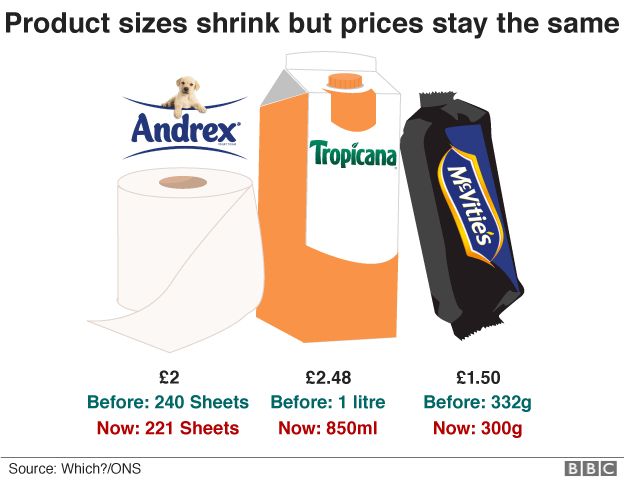
Pricing and shrinkflation

From foods to paper goods, more than 2,500 products have 'shrunk' whilst their retail prices have not decreased during the past five years. This shrinkflation reflects increased costs facing manufacturers, changes in foreign exchange rates after the Brexit vote and consumer resistance to paying higher prices. As a result of these environmental and internal forces, brands are reducing the size of some products without changing the prices.

Yet, according to the UK Office of National Statistics, more than 600 items have actually increased in size during the past five years. This reflects the trend towards focusing consumers on value. 'More for the same price' sends a message to price-conscious shoppers that a product will deliver higher value than some competing items.

More shrinkflation is on the way as marketers cope with continued cost increases and ongoing currency swings that can affect what manufacturers pay for ingredients and what they receive in payment from wholesale buyers.

Shrinkflation is usually not publicised by the manufacturers...but government offices and media reporters take notice. Then consumers become aware, and have to decide whether to continue buying a favourite brand or product, or change behaviour and buy something else.

Wednesday, 7 June 2017

Sustainability Marketing: Fashion Helps Save the Planet

Adidas has partnered with Parley for the Oceans to make and market shoes made from plastic ocean waste. The idea is to raise awareness of the need for clean oceans and recycle this waste in a productive way. Adidas has set a goal of selling one million shoes made from ocean waste by the end of 2017. 

Stella McCartney, who was involved in the Adidas designs, has also partnered with Parley for the Oceans on a new limited-edition backpack made from recycled ocean waste. This product is one of many that will incorporate a new fibre made from ocean waste plastics.

Other fashion marketers are saving the planet as well. ASOS, Tesco, Nike and H&M are some of the brands that will be using only sustainably sourced cotton by 2025. All over the world, fashion marketers are looking at sustainability issues and ways to reduce the stress on natural resources.

How much value do consumers see in buying fashions marketed with sustainability in mind? From the perspective of consumer behaviour, are the ethical issues of sustainability marketing compelling enough to motivate purchasing?

Friday, 16 December 2016

Easy marketing £1 coffee

EasyCoffee is a growing franchised coffee chain under the Easy brand umbrella, soon to open dozens of new branches around the UK. The top brand attribute for Easy is (no surprise) value (£1 for a regular -sized coffee or tea). You know, Easy as in easyJet, the high-profile Easy-branded budget airline.

Here's the EasyGroup mission:
To manage and extend Europe's leading value brand to more products and services, whilst creating real wealth for all stakeholders.
Businesses or other organisations can have an EasyCoffee vending machine (above) on their premises to offer employee value-priced branded coffee. In other words, EasyCoffee's distribution strategy goes beyond consumer-oriented retailing into B2B marketing.

Which is a good thing, because competition in the retail side of coffee shops is intense, given the strong brands trying to increase market share (Starbucks, Costa and so on). Not to mention competition from other food service brands that make coffee a signature element in their outreach to certain customer segments (such as McDonald's with its McCafe coffees).

Monday, 8 February 2016

Entrepreneurs give marketing advice

Startups often have big ideas but little money, so marketing is vital to survival and growth.

Here are quotes from entrepreneurs about their marketing ideas and insights.
  • 'My service isn’t for everyone, it is for those who appreciate it for what it is'. Melissa Curley, founder of SocialBee, which puts on afternoon tea events for clients, large and small. Her marketing insight is that the target market is not everyone, only people who understand the benefits and value and are willing to pay for her service. 
  • 'Look for collaboration and you will find opportunities to grow'. Aaron Jones, founder of Fikay Fashion, an ethical clothing company that puts profits towards reducing poverty. His insight is that marketers can leverage the resources and ideas of partners to become bigger--a good idea for businesses of all sizes. 
  • 'Having a pet pig is what I’m known for, it’s what people I meet always want to know about and I’d like to think my business has some of the best qualities of pigs - being smart, sociable and down-to-earth.' Why Katy Pollard named her business Listening Pig Communications is an interesting example of how to stimulate conversation about you and your offering. She didn't brand her service 'pig' but instead added words that would convey more about what her business does.
  • 'Usually the original has the greatest value, and will be sought out, and this is the thought, as original creators, that we must cling on to'. Gary Lancet created the Bookchair, a bookholder that would reduce neck strain. Then he began to worry about competitors copying his unique design. So his marketing insight is to protect the innovation but also remember that first-mover advantage has meaning to customers.

Wednesday, 25 March 2015

What do businesses need to create value?

Mitsubishi Heavy Industries--which began as a shipbuilding firm and is now a global manufacturer of transportation equipment, energy equipment and other industrial products--included this chart in its recent annual report to indicate the inputs used to create value.

What is particularly interesting is that Mitsubishi Heavy Industries mentions five inputs, not the traditional four identified by Michael Porter in 1985.  

Social relationship capital is Mitsubishi's "extra" input that addresses stakeholder relations so vital to today's competitive, global business environment, as shown in this comparison.

Porter's inputs:
  • Procurement--obtaining raw materials and money and other resources for the firm.
  • Human resources management--attracting, training and retaining managers and employees for the firm.
  • Technological development--creating or acquiring the technological know-how and equipment/services to transform resources into finished goods or services.
  • Infrastructure--the internal organization of departments and functions (such as finance, legal, etc) to support the firm's operations.
Mitsubishi's inputs:
  • Financial capital--money (assets, cash, debt and equity) to fund every aspect of the firm's planning and operations.
  • Manufactured capital--buildings and investments in equipment and infrastructure needed to enable the firm to conduct business.
  • Intellectual capital--patents and licenses, intellectual property of all types and knowledge needed to conduct business and in the future.
  • Human capital--employees and managers plus partners, suppliers and distributors that have the core competencies to help the business achieve its goals.
  • Social relationship capital--relationships with stakeholders and with the natural environment. (This set of inputs is not directly mentioned in Michael Porter's value chain, but its importance cannot be understated in contemporary business.)

Friday, 16 May 2014

McDonald's UK joins the twittersphere


Now in the twittersphere: McDonald's UK, where hash browns have been more popular than hashtags--until this week. McD's UK Twitter account has posted more than 50 tweets and attracted more than 500 followers in only three days. 
In addition to mouth-watering product photos, McD's UK is tweeting for Throwback Thursdays and--of course--following McD's Twitter accounts for Europe and elsewhere around the globe.

Two years ago, McDonald's US took a wrong turn with its Twitter strategy by inviting consumers to post tweets about favourite McDonald's experiences and products with the hashtag #McDStories. Instead, consumers posted negative comments, forcing the company to end that social media campaign. Recently, McDonald's appointed Ronald McDonald as one of its social media spokescharacters. 

McDonald's UK has been one of the multinational's bright spots in a crowded and competitive fast-food marketplace. Looking ahead, the chief exec of McD's UK plans to continue focusing on value and responding to what customers need and want: quality food and more menu choices.
 

Wednesday, 14 May 2014

Are You Using Porter's Five Forces Model?

Whether you're writing a marketing plan for a startup business or an existing organisation ready to enter new markets, you'll need to analyse the competitive situation in the industry.

One way to look at industry competition is through the lens of Professor Michael Porter's Five Forces model, which asks five strategic questions:
  1. How much bargaining power do buyers have? If there are only a few buyers, the business is likely to feel downward pressure on pricing. How can you make your offering stand out and add value that buyers will pay for? What role can good customer service play in your competitive situation?
  2. How much bargaining power do suppliers have? The more power suppliers have, the higher costs are likely to be. Keep this in mind as you plan your resource allocation and your profit-and-loss potential.
  3. How many substitutes are available for your offering? If there are many available substitutes for your good or service, competition will be more intense. And when buyers have many substitutes to choose from, that can negatively impact the marketer's ability to increase sales and maintain profitable pricing.
  4. What is the likelihood of new entrants coming into the industry? When many new entrants join the market, price competition intensifies and existing competitors may have profit problems. However, if there are few barriers to entry, build your marketing plan on promising opportunities that can be exploited with your unique strengths and capabilities. Also plan to build your brand into a barrier to entry.
  5. How much rivalry exists in the industry? Investigate the existing competitive situation to determine whether a market or segment is overly competitive--which can lead to price wars and other profit-sapping challenges.
Despite the constant change in the marketing environment, a careful competitive analysis will help you plan for innovatively pursuing opportunities and deflecting threats. Don't forget to include competitiveness when assessing which market segments to enter and what order.

Saturday, 9 February 2013

What's in store for private brands?

Private brands continue to sell well as bargain-hunting buyers seek out savings, not just in groceries but also in other categories. Already, grocery-store brands account for 45% of all UK supermarket sales. Looking ahead, one survey found that shoppers will increase their purchases of private brands by 22% during 2013.

Not surprisingly, stores are putting marketing power behind their private brands, because promotions add visibility and highlight the value benefits.
  • Tesco reintroduced its range of private-brand baby products as 'Tesco Loves Baby'. The idea is to encourage shopper loyalty among new parents. Think about the extra revenue and profits if new parents adopt Tesco brands for baby's early years, and buy extras while in the store. Plus the parents club will provide input to help Tesco improve its products.
  • Waitrose's website features its 'essential' range of 1,500 products, everything from pet food and pasta to coffee and crisps. The retailer describes its private brand this way: 'At the heart of our essential range is the belief that you shouldn’t have to compromise your standards, even on the everyday items you depend on'. (Waitrose has 93,000 Facebook likes.)
  • Morrisons is launching a new private brand of children's clothing and 'essentials' clothing for everyone. Margins on such products tend to be better than the margins on food, so this move is expected to help the bottom line if customers buy and clothing revenue is strong.
  • Asda was a pioneer of private brand fashions in its stores--its George brand appears on everything from baby clothes and blazers to shoes and socks. The George Style blog keeps brand fans updated on the latest styles. Of course George has more than 120,000 Facebook likes.

Wednesday, 27 June 2012

"How to" adds value to a brand

Many brands post free "how to" guides to help customers learn new skills or do a better job of buying and using products. Maybe you'll buy now, maybe you won't. The real added value is that the firm or brand becomes a trusted expert that you, the customer, can rely on, which is smart marketing for the long term.

No password or purchase is required, just a few clicks will bring you to a how-to site that teaches you something new and gives you a positive attitude toward the sponsor.

A few examples from different industries:
  • Want to learn how to pack clothing to make the most of space in your suitcase and avoid crushing everything into a wrinkled mess? Louis Vuitton's Art of Packing guide demonstrates how to go about this, step by step. 
  • Tesco can show you how to cook everything from lemon curd to sushi. Just click to see videos and tips, or search for recipes rated by consumer reviewers on a scale of 1 to 6 stars. There's even a food glossary for handy reference.
  • Dixons wants to teach you tips for buying appliances and electronics so you'll be happy with your purchase. You'll learn how to decipher computer jargon, choose the right size TV or pick a washing machine that fits your family's needs.