Blockchain is best known as the secure technology driving crytocurrencies such as bitcoin. Because of its security and the speed/accuracy of exchanging data, blockchain is increasingly being considered by retail marketers worldwide.
One key function of blockchain is to identify the supply-chain provenance of a product and track its movement through the distribution network. This is extremely important as retailers source products from around the world.
Carrefour, the French hypermarket retailer, is planning to implement blockchain for fresh foods such as tomatoes and chickens. This will enable the retailer to trace back to the source any possible problems.
Consumers will be reassured that Carrefour can quickly and accurately identify where fresh foods come from--and have confidence about the source. With 33,000 stores in 12 nations, blockchain will be a plus for Carrefour's ability to manage its fresh foods supply chain.
'The key thing for us as Carrefour is to be able to say when there is a crisis that we have the blockchain technology, so we are able to trace products and tell the story of the products', says the retailer's Secretary General.
Showing posts with label grocery retailing. Show all posts
Showing posts with label grocery retailing. Show all posts
Wednesday, 24 October 2018
Wednesday, 10 October 2018
How Tesco competes with deep-discount retailers
Tesco has a new weapon in its battle with deep-discount retail chains Lidl and Aldi.
It just opened two discount-price stores in a new chain it calls Jack, for Tesco's founder, Sir Jack Cohen. Short name, easy to remember, limited assortment, low prices, local merchandise. And the store openings coincide with Tesco's celebration of 100 years of low prices.
Most of the products will be branded own-label, but some will be well-known global brands like Coca-Cola. To reinforce the British origin of local merchandise, and the chain's British heritage, Jack signage features the Union Jack.
Tesco's CEO says the target market is 'economically challenged [consumers] that need a bargain and the affluent shopper that wants a bargain'. Adding a 'treasure hunt' element, the centre aisle of each Jack's store displays WIGIG promotions--bargain products that will go quickly, so 'when it's gone, it's gone'.
Lidl and Aldi have challenged Tesco and other full-service supermarkets in recent years, attracting price-conscious consumers willing to buy what they want at low, low prices in a no-frills retail atmosphere.
A few months ago, Tesco closed its Tesco Direct business, which sold non-food products directly to consumers. That business had been operating for nearly 12 years but was not yet profitable. Will Jack's enable Tesco to compete effectively in a highly pressured retail environment--and be profitable at the same time?
It just opened two discount-price stores in a new chain it calls Jack, for Tesco's founder, Sir Jack Cohen. Short name, easy to remember, limited assortment, low prices, local merchandise. And the store openings coincide with Tesco's celebration of 100 years of low prices.
Most of the products will be branded own-label, but some will be well-known global brands like Coca-Cola. To reinforce the British origin of local merchandise, and the chain's British heritage, Jack signage features the Union Jack.
Tesco's CEO says the target market is 'economically challenged [consumers] that need a bargain and the affluent shopper that wants a bargain'. Adding a 'treasure hunt' element, the centre aisle of each Jack's store displays WIGIG promotions--bargain products that will go quickly, so 'when it's gone, it's gone'.
Lidl and Aldi have challenged Tesco and other full-service supermarkets in recent years, attracting price-conscious consumers willing to buy what they want at low, low prices in a no-frills retail atmosphere.
A few months ago, Tesco closed its Tesco Direct business, which sold non-food products directly to consumers. That business had been operating for nearly 12 years but was not yet profitable. Will Jack's enable Tesco to compete effectively in a highly pressured retail environment--and be profitable at the same time?

Friday, 10 August 2018
Private brands sell well
Private brands are owned and marketed by retailers and other channel members
In fact, premium private brands have been part of the reason for consumers to switch away from other brands. These provide a 'halo effect' to help boost the image of all the private-brand products in the marketer's portfolio and make these products look more appealing in the eyes of consumers.
Private brands reportedly outperform national brands in four European nations, according to one source. They are strongest in the UK grocery market; research shows consumers consider the quality to be equal to that of national brands (and some consumers say the quality of private brands even exceeds that of national brands).
Many UK supermarket shoppers are admittedly looking for value. The rise of deep-discount grocery chains like Aldi and Lidl is due, in part, to the attractiveness of private brands that provide price-conscious consumers with quality alternatives to national brands.
This post updates private brand coverage in Chapter 6 of my Essential Guide to Marketing Planning, 4e.
Monday, 30 April 2018
Marketing consequences of merging Sainsbury's and ASDA

Sainsbury's would manage the new entity, with Walmart as a shareholder and partner.
One marketing consequence is the ability for the combined company to pay less for goods and services purchased in larger volume. This will, in turn, reduce costs and therefore allow for lower prices--a key element in this competitive industry.
So far, Sainsbury's says it will slash prices by 10% and will not be closing any stores after the merger is complete. UK regulators may require the sale of some stores to rivals, which would be another marketing consequence of the deal. The marketing environment for all UK retailers could change as a result.
Finally, how will consumers react? Will the merger change consumer behaviour? We'll have to wait and see.
Monday, 16 April 2018
Grocery retailers battle for UK market share
Aldi and Lidl, both based in Germany, have been steadily capturing market share in UK grocery retailing. Recent numbers show that Aldi has increased its market share from 3.9% at the start of 2014 to 7.3% at the start of 2018. Lidl, meanwhile, grew market share from 3.1% in early 2014 to 5.3% in early 2018.
From the perspective of traditional UK supermarkets like Tesco and Waitrose, the battle for market share has another challenge: pressure on profit margins. Aldi and Lidl are deep-discount grocers with no-frills stores. Not so for Tesco and Waitrose, which are full-service grocers. To be sure consumers can see the value in shopping at a full-service store, price promotions are often highlighted--and that cuts into margins.
In fact, price is a key element in consumers' perceptions of a store. Not long ago, Aldi overtook Waitrose as the favourite supermarket of UK consumers who were asked about satisfaction. Affordable prices would naturally be important to satisfaction.
Meanwhile, UK supermarkets will continue to face pressure from the deep discounters as Aldi and Lidl both plan to expand their store networks. At the same time, traditional supermarkets are slowing their store openings to maintain cost control. Will online grocery shopping be the competitive edge for traditional supermarkets? Possibly, as a growing number of UK shoppers try or continue buying food and household products without going into a store. Consumer behaviour is changing, and grocery retailers are learning to adapt so they can compete more effectively.
From the perspective of traditional UK supermarkets like Tesco and Waitrose, the battle for market share has another challenge: pressure on profit margins. Aldi and Lidl are deep-discount grocers with no-frills stores. Not so for Tesco and Waitrose, which are full-service grocers. To be sure consumers can see the value in shopping at a full-service store, price promotions are often highlighted--and that cuts into margins.
In fact, price is a key element in consumers' perceptions of a store. Not long ago, Aldi overtook Waitrose as the favourite supermarket of UK consumers who were asked about satisfaction. Affordable prices would naturally be important to satisfaction.
Meanwhile, UK supermarkets will continue to face pressure from the deep discounters as Aldi and Lidl both plan to expand their store networks. At the same time, traditional supermarkets are slowing their store openings to maintain cost control. Will online grocery shopping be the competitive edge for traditional supermarkets? Possibly, as a growing number of UK shoppers try or continue buying food and household products without going into a store. Consumer behaviour is changing, and grocery retailers are learning to adapt so they can compete more effectively.
Thursday, 1 February 2018
Marks and Spencer and legacy retailing

Online, M&S is enjoying growth increases--but results are not as strong as some analysts had hoped.
Competition from other legacy retailers, as well as competition from online merchants, is causing M&S to make changes to its offline strategy. One issue the retailer is addressing is how many stores it really needs. M&S is planning to close up to 30 of its brick-and-mortar stores in the near future. 'Stores will always be an integral part of our customer experience, alongside M&S.com, but we have to ensure we have the right offer in the right locations', says a company exec.
Looking at the international retail presence, M&S is selling its Hong Kong and Macau retail business as part of its change in strategy. The new owner will retain the M&S brand on store signage as part of the deal.
To keep sales and profits growing, M&S had planned to open dozens of new food stores in its Simply Food chain. But now, after food sales did not meet performance expectations during the key yearend holiday period of 2017, the company is opening fewer stores than originally planned. The company stated that 'headwinds facing our food business have intensified as competitors have encroached on some of our space with the rapid growth of convenience'.
Thursday, 28 December 2017
Trend: Online businesses opening physical locations

Trendy Products, which sells furniture online, has opened a 'digital concept showroom' in Cardiff. Trendy is, in fact, on trend, as more e-businesses add physical locations to allow customers to see and experience products, chat with salespeople, access digital catalogues and then make buying decisions.
Trendy has been in business for a decade, building a strong customer base. Now it plans to open more showrooms, expanding beyond digital to reach consumers who want to experience the product and consult with designers before they buy.
One reason for this trend is the availability of good retail locations. Many years of dismal economic growth and cautious consumer spending pushed a large number of stores into administration. Competition from online businesses has also caused retailers and other businesses to shutter some branches that weren't doing well. The result: vacancies in desirable shopping areas. And thanks to good space availability, some retail businesses are actually doing better.
Amazon, the pioneering e-tailer, arranged for space in sections of existing US retail stores for the 2017 holiday season. It owns the Whole Foods Market grocery chain, where it set up displays and sold products. But it also opened some mall stores and rented space in other department stores, enabling shoppers to see and trial Kindles and other products.

Alibaba, China's online retail giant, is adding a physical presence in key cities through partnerships and through, well, giant vending machines.
Each consumer-friendly Alibaba automated location (like the concept shown here) will sell Ford automobiles, starting with a test drive offered to consumers who qualify with sufficient credit to complete the purchase.
Thursday, 19 October 2017
Saying goodbye to the 'round pound'

Banks will continue to accept the old round pound for deposit. Yet consumers also want to be able to spend what they have. That's why Aldi, Poundland, Tesco and other retailers are continuing to accept the old pound coins for days or weeks after the official deadline.
In addition, the BBC Children in Need charity fund is promoting a Round Pound Countdown, urging consumers to donate their coins via the Post Office, Boots, Greggs, Cineworld or Welcome Break locations prior to Appeal Day on 17th November.
Even trolley token key rings have been redesigned with the new pound in mind...as grocery retailers scramble to modify their equipment so trolleys will accept the 12-sided pound.
So goodbye, round pound, hello new £1 coin.
Monday, 18 September 2017
Private brands remain strong
|
| M&S wines have won awards |
Traditionally, consumers switched to private brands to save money, and then switched back to manufacturers' brands once they felt less anxiety over economic circumstances.
Consumer behaviour these days indicates that despite economic recovery and consumers feeling more confident about spending, private brands continue to sell well. Private brands are helping Lidl--the deep-discount grocery chain--gain market share against traditional UK supermarkets like Tesco, just as they are helping Aldi.
In fact, customers who can afford to buy manufacturers' brands often choose to buy private brands because they want both value and quality. At Marks & Spencer, for example, the store's brand of wine has won numerous awards, reassuring buyers that the quality is good, not just the price. The newest trend is toward premium private brands, reflecting the dual interest in value and quality.
This post updates the private brand discussion in Chapter 6 of Essential Guide to Marketing Planning 4e.
Wednesday, 12 July 2017
The future of fixed pricing in UK food stores
The idea is to effectively manage supply and demand, avoiding queues during busy periods and spreading demand during the day.
Well, surge pricing is not exactly what's happening, at least not yet. Thanks to electronic price tags on shelves, however, food stores have the technical ability to vary prices during the day.
For example, Marks & Spencer last year tested discounting sandwiches in the morning to encourage early buying and alleviate crowds at lunchtime.
Surge pricing could be in the works for petrol, again as a way to manage supply and demand on busy days.
Still, fixed pricing is not going to disappear from food retailers, at least not for a long time. Customers will vote with their wallets if they don't like what a retailer is doing. And no store wants to lose loyal customers over a pence or a pound.
Sunday, 18 June 2017
UK legacy grocery retailers continue to evolve
 |
| Sainsbury strapline |
Why? Changing consumer behaviour and evolving industry dynamics.
 |
| Nisa logo |
- Sainsbury is expected to buy Nisa convenience shops, a 'family' of 2,900 'independent grocers' that serve local neighbourhood shoppers.
- Tesco announced the acquisition of wholesale food firm Booker, a deal that is currently being evaluated by regulatory officials and may result in industry changes.
So grocery retailing is increasingly global even as the industry adjusts to low-price, no-frills competition and the growing popularity of online shopping via Amazon and others.
Wednesday, 10 May 2017
Who likes self-serve checkouts?

Instead, the new self-serve checkouts frustrated some of Sainsbury's shoppers, because the staffless tills don't allow for weighing of fresh merchandise or for shoppers who bring reusable sacks.
Lidl's staffless self-serve checkouts in Maldon aren't pleasing customers, either.
Of course shoppers want to complete transactions quickly and conveniently. One study found that customers dislike waiting, and will tolerate a queue time of only 6 minutes. Understanding consumer behaviour is important if retailers are to compete effectively and provide what shoppers want, in the way shoppers prefer to be served.
For retailers, however, self-serve checkouts mean lower costs. No doubt that's behind the trend toward more self service. Australia's Woolworths recently announced the installation of more self-serve checkouts at a number of its downtown locations.
Rival Coles is testing new limits to speed up self-serve transactions for the convenience of all. 'Coles is trialling a 12-item limit on self-scanning checkouts in a small number of stores as part of our ongoing commitment to improve customer service', the Australian retailer has announced. This may also be a way to combat shopper theft at self-serve checkouts.
Wednesday, 1 March 2017
Tesco's core purpose, over time
Tesco has published its core purpose (also known as the mission statement) on its corporate website for years. Over time, the core purpose has changed slightly to a tighter focus on what, specifically, Tesco aspires to do for its customers.

In 2010, Tesco's mission statement (shown above, retrieved from the Internet Archive's Wayback Machine), was 'to create value for customers to earn their lifetime value'.

In 2014, Tesco's mission statement (shown above, again from the Wayback Machine), was to 'make what matters better, together'.
 In 2017, Tesco's mission statement (shown above, from today's website), was 'serving Britain's shoppers a little better every day'.
In my opinion the 2017 mission statement is stronger than the earlier versions. Why?
Take a look at Checklist #1 in my Essential Guide to Marketing Planning for questions to use in evaluating any mission statement, including Tesco's. For example, one question is: 'Who will the organisation focus on?'
Tesco's 2014 core purpose was less specific on this point than its 2017 core purpose, which clearly states 'Britain's shoppers'. In other words, it defines a particular group of customers in a particular market. The statement also mentions that Tesco will be 'a little better every day'.
This provides clear strategic direction for decision-makers (and reflects Tesco's shift away from operating stores in other nations). The clarity helps the grocery retailer's turnaround efforts, which depend on careful pricing and on consistent customer service, to battle intense competition.

In 2010, Tesco's mission statement (shown above, retrieved from the Internet Archive's Wayback Machine), was 'to create value for customers to earn their lifetime value'.

In 2014, Tesco's mission statement (shown above, again from the Wayback Machine), was to 'make what matters better, together'.

In my opinion the 2017 mission statement is stronger than the earlier versions. Why?
Take a look at Checklist #1 in my Essential Guide to Marketing Planning for questions to use in evaluating any mission statement, including Tesco's. For example, one question is: 'Who will the organisation focus on?'
Tesco's 2014 core purpose was less specific on this point than its 2017 core purpose, which clearly states 'Britain's shoppers'. In other words, it defines a particular group of customers in a particular market. The statement also mentions that Tesco will be 'a little better every day'.
This provides clear strategic direction for decision-makers (and reflects Tesco's shift away from operating stores in other nations). The clarity helps the grocery retailer's turnaround efforts, which depend on careful pricing and on consistent customer service, to battle intense competition.
Friday, 20 January 2017
Aldi, Lidl and the grocery price war
 Aldi and Lidl, two German-based discount supermarkets, are gaining UK market share through a seemingly never-ending price war against the local grocery retailers that once dominated the industry.
Consumer behaviour suggests that cash-strapped shoppers aren't completely returning to pre-recession buying patterns but continuing to seek out bargains and stretch their pounds in certain product categories.
Today, Aldi and Lidl are so well-known that these grocery names topped You.Gov's recent BrandIndex, exceeding the brand ranking of the BBC, John Lewis and other leading brands.
Lidl's newest strapline is Big on quality, Lidl on price, calling attention to its competitive strengths. For several years, Lidl has steadily increased its market share, and 2016 was its best UK holiday trading period ever.
Aldi is promoting its pay packages for staff, showing that employees make more than the minimum wage and putting pressure on rivals to increase pay as well--adding to the goodwill its brand enjoys. Like Lidl, Aldi's 2016 holiday trading period was its best ever in the UK, with higher market share as a result.
How will Tesco, Morrison's, Sainsbury's and John Lewis fight back in 2017?
Wednesday, 11 January 2017
Consumer behaviour and the 'big night in'

Rather than splashing out on a restaurant meal and cinema tickets, many consumers are making plans to enjoy food and entertainment at home. Pizza, anyone? New Year's Eve was a 'big night in' this year for consumers in Wales, research shows.
Targeting this occasion, Sainsbury's and other marketers, offer snacks, drinks and more. Above, Sainsbury's online store, with a 'big night in' page offering 'easy cook' meals, snack foods, DVDs and video on demand. Poundland wants to attract shoppers interested in snacks for a big night in, whether the entertainment is a movie or a sleepover.
'Big night in' is influencing multiple marketing elements. For example, snack products are increasingly packaged in larger sizes for family sharing. 'Generally, the packaging is bold and often piggy-backs a cinematic theme as families try to create a movie going experience without actually leaving home', says one packaging expert.
Thursday, 8 December 2016
Is Amazon Go the future of grocery shopping?

What makes this a unique concept is -- as shown above in a still from Amazon's video introduction -- shoppers don't queue to pay at the till. No, seriously, their purchases are tallied on a smartphone app and recorded as they leave the store. Amazon charges the payment method on file for each customer and sends an electronic receipt.
Obviously, only shoppers with smartphones can shop at Amazon Go. But given the mature nature of the smartphone market, this is not much of a barrier. And given the high brand awareness that Amazon enjoys, consumers are likely to at least give this store a go if one opens nearby. Because, it seems, there are some products that simply can't be sold online and some shoppers who simply won't buy groceries online (consumer behaviour in action).
Behind the scenes is Amazon's technology, sensing when a product is lifted from a shelf (and if the product is returned to a shelf). Amazon is a master of inventory management, and with time it will learn what sells and doesn't sell in each store location. No cashiers, an enormous cost savings. And the opportunity to serve the same shopper again and again because groceries are a frequently-purchased product category. Is this the future of grocery shopping?
Monday, 7 November 2016
Competing with Aldi
A former exec who helped set up Aldi in Australia explains the retailer's strategy: '. . . the deal between the supplier and Aldi is; first Aldi will take a larger pack size, often a pack size that is exclusive to Aldi so some economy is represented here and that Aldi does not embarrass other bigger retail customers . . . of the brand with its selling price'.
Now Aldi's head in Australia notes how the company's expansion has affected retail pricing: 'Our prices are always the lowest, so we have observed the market getting a little sharper in prices … at the same time as our competitors have been lowering prices, we have as well'. Aldi's expects to continue acquiring market share in Australia, aiming for as much as 15% of that market within a few years.
One way competitors are fighting back is by not only increasing their private brands but in some cases, by blurring the line between national brands and private brands. Woolworths in Australia recently relaunched some of its store private brands without highlighting the retailer's brand ownership on the front label. Products formerly branded prominently as 'Woolworth's Gold' now bear the brand 'Gold' on the front label, for example, with the Woolworth name on the back label.
Woolworth says it has been fine-tuning its Australian private brands: 'Over the last year we sought insights from our customers as we looked to enhance our range of products. Woolworths branded and non-branded ranges reflect our commitment to quality and value'.
Meanwhile, Aldi's low-price grocery rival in Germany, Lidl, is moving further into markets where Aldi has established itself--such as the US market. 'We are in the early stages of our preparation to launch in the U.S., and our focus right now is in our operations along the East Coast and opening our first stores no later than 2018', says a Lidl exec. Lidl competes against Aldi by opening larger stores and stocking a wider assortment of merchandise compared with Aldi.
Watch for price wars when Aldi targets a market--and watch for competing stores to slash prices or risk losing shoppers who follow the bargains.
Friday, 14 October 2016
Product pricing and Brexit

As a result of Brexit, the value of the pound sterling has slumped, and Unilever is trying to increase the price of some products by an average of about 10% to compensate for the slump.
Inventory on Tesco's store shelves dwindled as the grocery giant fought Unilever over pricing. Media coverage of the battle raised the possibility that Tesco's shoppers might be unable to find beloved brands like Marmite and Ben & Jerry's.
Tesco resisted Unilever's price increase by emphasising its role as championing low prices on behalf of consumers. Unilever explained that its supply costs are increasing, profits are going to be affected and therefore product pricing must be adjusted.
After a 24-hour standoff, Tesco and Unilever announced that the dispute had been resolved and shelves would be full of the brands shoppers want.
Expect more announcements about wholesale pricing as other producers seek to counteract the slump of sterling by increasing prices, if possible.
Tuesday, 2 August 2016
Same-day delivery: marketing battleground for retailers

Amazon is offering same-day grocery delivery in London (in partnership with Morrisons for certain private brands). Whether delivered by drone in the future, as shown above, or not, Amazon Fresh promises Prime members that orders placed before the cutoff time will be at the customer's door by evening.
Rivals Aldi and Lidl are feeling the challenge of Brexit's impact on currency fluctuations. Because both Aldi and Lidl source many products from EU suppliers, the UK stores have to deal with higher costs when the pound sterling is low--and higher costs cut into already thin profit margins. For Sainsbury's and other UK-based retailers, however, this may present an opportunity to press price war advantages.
Meanwhile, speedy delivery is a niche being explored by startups such as Convibo, which offers one-hour delivery of grocery orders from London retailers such as Whole Foods and Waitrose. How much demand exists for one-hour delivery, compared with same-day delivery, is unclear--but this startup is a good example of distribution in general and service in particular as key points of differentiation.
Monday, 20 June 2016
Do online stores need a physical presence?
Many online stores have, since their first days, been digital only, without a physical presence on the high street or in the shopping centre.
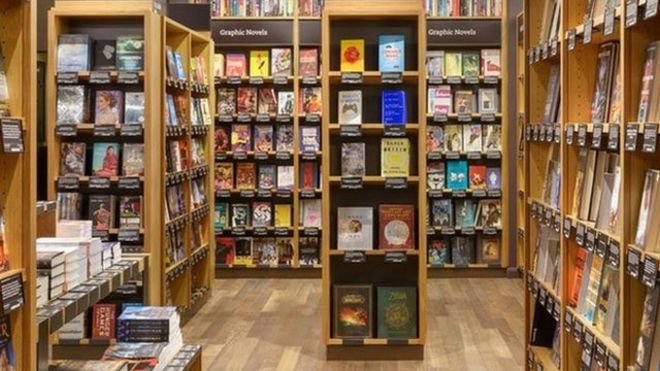
The obvious example is Amazon, which pioneered online-only retailing and is making a major marketing effort in the UK to sell groceries online. But in the US, Amazon is currently experimenting with book stores in two locations, and planning additional book stores in the future.
Amazon can learn a lot about shoppers by observing how they browse, what catches their attention in the store, what sells well in a store compared with online only, and so forth. It can also experiment with covers, shelf placement, pricing, adjacencies and other details.
In Canada, several online-only retailers are opening physical stores. The goal is to provide a physical space in which to express the brand image and showcase branded products. Indochino, which originally marketed online-only bespoke men's wear, now generates half of its turnover from the physical stores it operates.
Even brands that sell through other retailers are opening their own branded stores. Upmarket outerwear company Canada Goose, well known for its goose-down jackets and other apparel, is opening its own stores in New York and Toronto.
As the global economy improves, will more online-only retailers become multichannel?
The obvious example is Amazon, which pioneered online-only retailing and is making a major marketing effort in the UK to sell groceries online. But in the US, Amazon is currently experimenting with book stores in two locations, and planning additional book stores in the future.
Amazon can learn a lot about shoppers by observing how they browse, what catches their attention in the store, what sells well in a store compared with online only, and so forth. It can also experiment with covers, shelf placement, pricing, adjacencies and other details.
In Canada, several online-only retailers are opening physical stores. The goal is to provide a physical space in which to express the brand image and showcase branded products. Indochino, which originally marketed online-only bespoke men's wear, now generates half of its turnover from the physical stores it operates.
Even brands that sell through other retailers are opening their own branded stores. Upmarket outerwear company Canada Goose, well known for its goose-down jackets and other apparel, is opening its own stores in New York and Toronto.
As the global economy improves, will more online-only retailers become multichannel?
Subscribe to:
Posts (Atom)