Some product decisions have long time frames and extremely costly consequences. Aircraft manufacturers therefore spend considerable time studying the marketing environment to project future trends in travel and demand, before they develop and introduce a new jet.
Airbus spent billions to develop its double-decker A380 jumbo jet, betting that airlines would be ferrying large numbers of passengers from major hub to major hub. It was test-flown in 2007, receiving much publicity for its spacious interior and the amenities that could be added (such as on-board showers and luxurious first-class suites).
Airbus received some big orders from Emirates, among other airlines. In fact, Emirates is by far the largest buyer of A380s. But when Emirates cut the number of A380s in its latest order, and other orders slowed down, Airbus decided to discontinue this product after 2021. In fact, the 2020 coronavirus pandemic that brought international air travel to record-low levels seems to be accelerating the move away from A380s.
Competitor Boeing based its product decisions on a different forecast for the travel environment, believing that passengers would want to travel from point to point rather than hub to hub. It put the emphasis on nimbleness and fuel efficiency, rather than on having a high number of passengers being carried per flight. And that's attracted more buyers than the Airbus A380.
Now Boeing's original 747 jumbo jet is transitioning to a cargo carrier, extending the life cycle of this aging product. In addition, Boeing is still marketing its 777 and 787 jets to airline customers--and looking ahead with forecasts for the future of travel as it plans future product introductions.
Showing posts with label marketing environment. Show all posts
Showing posts with label marketing environment. Show all posts
Monday, 18 February 2019
Wednesday, 12 December 2018
Tracking trends via Google search results
What were some key UK trends in 2018?
Google recently published a list of the most frequently-used search terms amongst UK users. It's not a surprise that many people searched for Meghan Markle, given the hoopla over the royal wedding this year. I was surprised that her name was not at the TOP of the search list. It was #2, followed by the royal wedding.*
At #4 was searches for Black Panther, the blockbuster movie.
At the very top of the list, at #1, was the World Cup. Football fever!
To see the trends globally and country, by country, go to the page Google's Year in Search and select a place.
Globally, for example, Google says the #1 search was . . . World Cup.
Even in the United States, World Cup was the #1 search during 2018.
For historical comparison, you can also select a different year. No individual country results are available for 2001, but globally, the top search term was Nokia, followed by Sony, BMW, Palm (remember that brand? It was a personal digital assistant back in the day) and Adobe.
Fun and an interesting look back on trends from the past.
*Expect Meghan Markle and Prince Harry and the royal baby to trend very high in 2019 search results, right?
Google recently published a list of the most frequently-used search terms amongst UK users. It's not a surprise that many people searched for Meghan Markle, given the hoopla over the royal wedding this year. I was surprised that her name was not at the TOP of the search list. It was #2, followed by the royal wedding.*
At #4 was searches for Black Panther, the blockbuster movie.
At the very top of the list, at #1, was the World Cup. Football fever!
To see the trends globally and country, by country, go to the page Google's Year in Search and select a place.
Globally, for example, Google says the #1 search was . . . World Cup.
Even in the United States, World Cup was the #1 search during 2018.
For historical comparison, you can also select a different year. No individual country results are available for 2001, but globally, the top search term was Nokia, followed by Sony, BMW, Palm (remember that brand? It was a personal digital assistant back in the day) and Adobe.
Fun and an interesting look back on trends from the past.
*Expect Meghan Markle and Prince Harry and the royal baby to trend very high in 2019 search results, right?

Wednesday, 23 May 2018
Beverage marketing evolves

Another reason for the proliferation of product extensions and brand extensions is consumers' desire for healthy, nutritious beverages. At the same time, beverage marketers are responding to governmental efforts to encourage healthier lifestyles.
In the UK, there is now a levy on high-added-sugar drinks. Beverages that are made of 100% fruit or vegetables will not be subject to this levy. Ireland and South Africa are also taxing high-sugar beverage products. Individual US cities are similarly taxing high-sugar soft drinks, all part of the effort to encourage healthy eating.
In this UK marketing environment, Britvic has experienced strong demand for its no- and low-sugar soft drinks. Barr is also experiencing strong demand for its low-sugar and no-sugar soft drinks. Watch for more product introductions as beverage marketers compete for the attention of consumers during the high-demand summer months.
Sunday, 1 April 2018
Happy 9th Blogiversary (Not April Fool)

Unquestionably, competitors are truly stakeholders of any marketing organisation, from the smallest single-person operation to multinational giants. Remember, stakeholder is defined as 'a group or individual that has an interest in or can potentially affect the marketer's performance and activities'. Surely competitors qualify because they have the ability to begin or escalate price wars, influence market share and marketing trends, influence customers and suppliers and so on.
An academic paper found six good reasons to include competitors as stakeholders. McKinsey has noted that organisations must try to anticipate competitors' strategies so they can plan ahead to deflect challenges.
At times, a marketer may want to collaborate with competitors on issues of mutual interest, such as industry standards or sustainability projects. Not on pricing--such collusion is illegal in most nations--but on larger issues that affect many stakeholders, including the public.
Wednesday, 7 February 2018
Marketing 'made in Britain'
SWOT: Focus on British heritage as a strength
In today's global economy, brands are looking for a competitive edge that will attract the attention of customers near and far. From a SWOT perspective, that strength is often 'made in Britain', which provides an edge for British-based marketers. Grenson is a good example. The company communicates its British heritage when marketing its high quality shoes to local and international customers. Founded by William Green, the company modernised its name to Grenson in 1913, among the first brands legally registered in the UK.
With a long and proud tradition of producing quality shoes, Grenson only became active in wholesaling to major retailers like Harrods and Selfridges in 2011. Grenson launched its first branded overseas retail store in 2016, choosing a trendy neighborhood in lower New York City to influence consumer perceptions of its fashion credentials. Today, Grenson shoes are also stocked by online retailers like Mr Porter (the men's side of online merchant Net-a-Porter), amongst others.
Grenson updates its marketing plan as trends change, consumers change, the marketing environment changes and technology changes. One thing doesn't change: Grenson's brand is always mentioned in the context of its British heritage, keeping 'made in Britain' in the spotlight with every communication channel.
This is true of all Grenson's social media marketing activities: It's on Instagram (87k followers), Facebook (26k followers), Twitter (13.5k followers), Pinterest (2k followers) and Tumblr.
This example extends coverage of SWOT in Chapter 2 of my Essential Guide to Marketing Planning textbook.
Monday, 2 October 2017
Pricing and shrinkflation
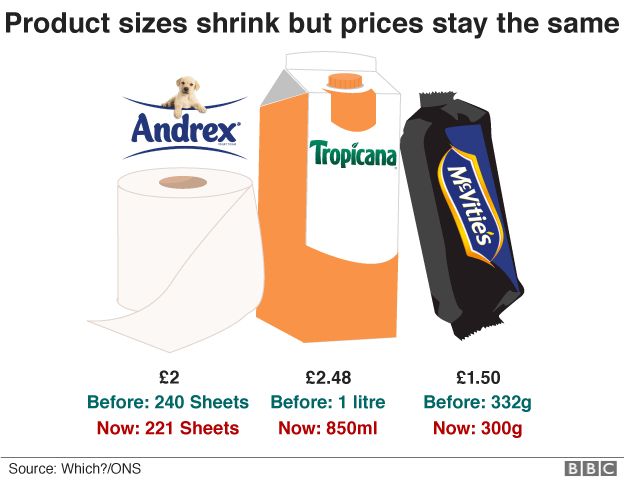
Yet, according to the UK Office of National Statistics, more than 600 items have actually increased in size during the past five years. This reflects the trend towards focusing consumers on value. 'More for the same price' sends a message to price-conscious shoppers that a product will deliver higher value than some competing items.
More shrinkflation is on the way as marketers cope with continued cost increases and ongoing currency swings that can affect what manufacturers pay for ingredients and what they receive in payment from wholesale buyers.
Shrinkflation is usually not publicised by the manufacturers...but government offices and media reporters take notice. Then consumers become aware, and have to decide whether to continue buying a favourite brand or product, or change behaviour and buy something else.
Friday, 1 September 2017
New regulations drive new auto marketing
The marketing environment can have a profound effect on brand and product marketing. Regulations governing car emissions are a good example.
From today, EU regulators have changed the rules on how car emissions will be measured, to prevent automakers from circumventing emissions limits. Most of all, the new rules are intended to improve air quality, for a greener future. In turn, these new rules are driving new vehicle marketing.
Now automakers are offering 'scrappage' schemes to encourage drivers to purchase new cars and 'scrap' or trade in older vehicles. Volkswagen is offering as much as £7,000 off to encourage UK buyers to turn in their old diesels (registered prior to 2010) and buy a new VW, Audi, Skoda or Seat model.

Ford is offering £2,000 off to UK buyers who exchange any brand of vehicle (model year 2010 or older) for a new Ford model. Kia and Renault are also offering the same amount for older models turned in when buying a new car in the UK. Toyota is offering up to £4,000 to encourage trade-ins of older cars by UK buyers.
Automakers are also designing new cars that will comply with emissions rules and appeal to environmentally-conscious buyers. Aston Martin has plans to have an all-hybrid product portfolio by 2020, and BMW will soon launch an all-electric version of its popular Mini.
However, the UK's ambitious plan to not allow sales of new diesel and petrol cars from 2040 will strain the infrastructure for electric cars, requiring significant investments in recharging stations, for example. Automakers will be watching the environment carefully as they plan for future product introductions and car promotions.
From today, EU regulators have changed the rules on how car emissions will be measured, to prevent automakers from circumventing emissions limits. Most of all, the new rules are intended to improve air quality, for a greener future. In turn, these new rules are driving new vehicle marketing.
Now automakers are offering 'scrappage' schemes to encourage drivers to purchase new cars and 'scrap' or trade in older vehicles. Volkswagen is offering as much as £7,000 off to encourage UK buyers to turn in their old diesels (registered prior to 2010) and buy a new VW, Audi, Skoda or Seat model.

Ford is offering £2,000 off to UK buyers who exchange any brand of vehicle (model year 2010 or older) for a new Ford model. Kia and Renault are also offering the same amount for older models turned in when buying a new car in the UK. Toyota is offering up to £4,000 to encourage trade-ins of older cars by UK buyers.
Automakers are also designing new cars that will comply with emissions rules and appeal to environmentally-conscious buyers. Aston Martin has plans to have an all-hybrid product portfolio by 2020, and BMW will soon launch an all-electric version of its popular Mini.
However, the UK's ambitious plan to not allow sales of new diesel and petrol cars from 2040 will strain the infrastructure for electric cars, requiring significant investments in recharging stations, for example. Automakers will be watching the environment carefully as they plan for future product introductions and car promotions.
Wednesday, 8 February 2017
Marketing with purpose: Think long term

P&G wants to demonstrate its leadership in sustainability marketing, and this packaging will soon be at in Carrefour stores across France. On the way are hundreds of millions of shampoo bottles made from recycled materials. P&G has also set aggressive multi-year targets for zero manufacturing waste. These and are other actions are building the firm's reputation for sustainability over the long term.
 Competitor Unilever has been publicising its sustainability marketing as well. Last month, the company announced ambitious goals for plastic product packaging that is recyclable, reusable or compostable. It is reassessing its products and packaging to reduce the environmental impact wherever possible (as in image shown at right).
In a recent survey conducted in five countries, Unilever found that one in five consumers said they decide to buy based on whether a product was made without harming the environment. Unilever also reported that sales of its brands linked to sustainability are growing much more quickly than non-sustainability brands in the corporate portfolio.
A recent opinion column in The Guardian noted that social activism sells, and brands are busy promoting their good deeds for business reasons. In other words, marketing with purpose is the hottest way to differentiate a brand and make consumers aware of what it stands for, in order to make a sale. Well, yes, but if marketing with purpose is insincere or inconsistent, consumers will soon find that out. P&G and Unilever are committed to marketing with purpose for the long term, with considerable financial and human resources devoted to their environmental protection endeavors.
Thursday, 23 June 2016
'Authentically Disney and distinctly Chinese'
 |
| From Walt Disney Company news |
The path from idea to approval to construction to opening was long and challenging. Disney originally proposed the theme park 20 years ago, but political and economic factors slowed progress.
The target market is the 330 million people who live within three hours of the park. Millions more may travel longer distances to visit, increasing domestic tourism and spreading awareness of the Disney brand throughout China.
As the head of Disney states: 'Shanghai Disneyland is authentically Disney and distinctly Chinese'.
Disney, whose characters are increasingly familiar to Chinese families, faces considerable competition from diverse theme parks already attracting crowds in China. Dalian Wanda Group is opening 10 entertainment complexes, with admission prices below those set by Disney. Other theme parks (such as Hello Kitty) are also competing for the middle class family's attention and money. How will Disney do in this super-competitive environment?
Tuesday, 19 January 2016
Unilever faces changes in consumer behaviour
 Butter is becoming more popular as consumers return to its taste and its natural ingredients. McDonald's, for instance, has experienced higher demand for its Egg McMuffin sandwich since switching from margerine to butter last year.
And this is only one of the changes in consumer behaviour that are challenging Unilever, which markets such spreads as I Can't Believe It's Not Butter, Stork and Flora.

Being a global corporation, Unilever has 400+ brands in markets on every continent. And it recently arranged to begin marketing again in Cuba, after an absence of several years. But the CEO sees a challenging year ahead as economics give consumers little reason to reach into their pockets and spend.
Monday, 18 January 2016
Chocolate demand is up but supplies are down

Even as the world's appetite for chocolate treats increases, the world's supply of cocoa beans is not keeping pace. In fact, chocolate supplies are declining. As crop yields drop, chocolate marketers like Mondelez are advising growers on how to improve. And, of course, lower supplies mean higher prices on the wholesale level, which often leads to higher prices on the retail level (and profit margin pressure).
Small marketers are seeing opportunity. One growing firm in South America wants to put the spotlight on its fine chocolates made not from beans grown in Africa, but in Ecuador.
Meanwhile, some of the biggest chocolatiers are innovating to appeal to choco-lovers worldwide and throughout the year. An ongoing challenge has been making fine chocolates that retain their properties and quality in hot conditions. For areas where air conditioning isn't widespread, or retail stores that aren't equipped to store chocolates in a cool place, Barry Callebaut is now marketing 'heat-resistant' chocolates.
In Japan, where chocolates are one of the favourite gifts on gift-giving occasions, Kit Kat has a new hand-crafted, gold-dusted bar for the status conscious consumers who are willing to pay more for a special product. Limited quantities only add to the scarcity and perceived value.
Tuesday, 18 August 2015
Marketing Brompton Bicycle

Brompton's bikes are differentiated by their sturdy frames and, more importantly, by how compact they become when folded for storage. The company has a cult following, with some customers chronicling their bike adventures on blogs or via other social media. (Brompton has more than 17,000 Twitter followers and 42,000 Facebook likes plus more than 7,000 Instagram followers.)
Brompton is growing rapidly to meet ever-higher demand for convenient transport in cities domestically and abroad (urban locations and consumer behaviour are clearly key to its market segmentation). This year, the firm projects unit sales of 50,000 in more than 40 nations, with only 20 percent of its output remaining in Britain. Asia and the United States are particular target markets with strong demand for commuting options such as folding bicycles.
By 2021, the company plans to double its output and is therefore relocating to a larger production facility next year. And it's also stretching its product line by planning for an electric version of its popular folding bike, to 'get rid of the sweat and Lycra' and make bike commuting less strenuous and more fun.
Thursday, 30 July 2015
Researching the marketing environment
DEVELOPING YOUR MARKETING PLAN
Every marketing plan begins with a review of the external trends and changes that affect the company, product, customers, buying trends and competition.To get a headstart on researching the marketing environment, try clicking on the links shown on my Marketing planning links page. Every link is regularly tested and updated as needed--plus new links are added as well.
Links are categorised according to:
- Preparing for marketing planning
- Analysing the marketing environment
- Researching consumer and business demographics
- Marketing ethics, social responsibility and sustainability
- Branding issues and ideas
- Marketing issues and ideas
- Marketing control and implementation
- Retailing and channel trends
Thursday, 14 May 2015
Merlin Entertainments' awesome, balanced portfolio
| From Merlin's 'About us' page |
Other attractions operated by Merlin include Madame Tussauds wax museums (where Star Wars exhibits are attracting attention ahead of the new movie), Gardaland theme parks, Alton Towers, the London Eye and Sea Life aquariums.
On the 'about us' page, Merlin sets out its marketing strategy:
To create a high growth, high return, family entertainment company based on strong brands and a portfolio that is naturally balanced against the impact of external factors.Merlin is smart to plan for balancing the portfolio 'against the impact of external factors' in the marketing environment. For instance, the weakness of the euro is expected to keep some European visitors from vacationing at UK destinations in 2015. Weather is also an uncontrollable factor.
By design, Merlin has assembled a portfolio that spans four continents and includes a variety of brands. At any one time, one brand (such as Legoland) might be in the media spotlight and therefore attract an awesome number of customers. Building on that interest, Legoland Water Park Dubai is in the works, among other enhancements to the portfolio.
Wednesday, 25 March 2015
What do businesses need to create value?

What is particularly interesting is that Mitsubishi Heavy Industries mentions five inputs, not the traditional four identified by Michael Porter in 1985.
Social relationship capital is Mitsubishi's "extra" input that addresses stakeholder relations so vital to today's competitive, global business environment, as shown in this comparison.
Porter's inputs:
- Procurement--obtaining raw materials and money and other resources for the firm.
- Human resources management--attracting, training and retaining managers and employees for the firm.
- Technological development--creating or acquiring the technological know-how and equipment/services to transform resources into finished goods or services.
- Infrastructure--the internal organization of departments and functions (such as finance, legal, etc) to support the firm's operations.
- Financial capital--money (assets, cash, debt and equity) to fund every aspect of the firm's planning and operations.
- Manufactured capital--buildings and investments in equipment and infrastructure needed to enable the firm to conduct business.
- Intellectual capital--patents and licenses, intellectual property of all types and knowledge needed to conduct business and in the future.
- Human capital--employees and managers plus partners, suppliers and distributors that have the core competencies to help the business achieve its goals.
- Social relationship capital--relationships with stakeholders and with the natural environment. (This set of inputs is not directly mentioned in Michael Porter's value chain, but its importance cannot be understated in contemporary business.)
Sunday, 8 March 2015
Competitors are definitely stakeholders
COMPETITORS ARE STAKEHOLDERS
- What one competitor--the most innovative or the strongest--does can affect the entire industry. This doesn't only apply to price wars (such as those in the UK grocery retailing industry). It's also a factor in the digital payments world, where Apple Pay has made a big impact in a short time. Or look at the smartwatch industry, which Apple is about to enter with a lot of promotional momentum. Having Apple as a competitor will force every business to be nimbler and better in order to survive.
- New or tiny competitors may be the most innovative. Ella's Kitchen, a 2014 winner of the new product award by The Grocer, is an example of a startup with a compelling value proposition: all-organic, tasty baby foods. The innovator attracted the eye of a larger company, which bought Ella's Kitchen and is using the brand to expand into new products and markets. Imagine what competitors think about the combination of Ella's Kitchen's innovative ideas and the financial strength of Hain Celestial.
- Competitive scandals can hurt the entire industry. The horsemeat scandal of 2013 caused some consumers to switch from supermarket meats to local butchers' meats. Frozen hamburgers didn't sell well for a time, either, although price promotions helped increase demand. Not every company was implicated, but all were affected by changes in consumer confidence and perceptions.
- Competitive pressure can encourage the industry to do more for people and the planet. Just look at the Fairtrade movement, which has improved the lives of many farmers and food producers and encouraged sustainability. When Cadbury Dairy Milk committed to Fairtrade cocoa in a big way, that put pressure on other mainstream chocolate marketers to show their Fairtrade support. Mars, another chocolate giant, is now embracing Fairtrade cocoa for its Mars Bars. Fairtrade fruit and vegetable and coffee products are widely sold in mainstream grocery stores, partly because of competitive pressure and partly because of consumer demand. One competitor that gets a lot of media coverage for social responsibility activities can be the catalyst for others wanting to follow suit.
Thursday, 4 December 2014
Changes in Nespresso's marketing environment

In recent years, however, Nespresso has faced increased competition as well as regulatory pressure in many markets. One reason is the high profitability of replacement single-serve coffee capsules. The way razors require replacement blades, Nespresso machines require replacement coffee capsules. That means opportunity for Nespresso and for rivals, who have been making capsules to fit Nespresso machines.
Following a legal battle in France, Nespresso will now share technical information about its machines so rivals can make completely compatible replacement capsules. It won't threaten to invalidate warranties if customers use rivals' capsules, either.
Thanks to years of carefully-crafted marketing, Nespresso has successfully encouraged millions of espresso-lovers to visit its boutiques or order online when they need replacement capsules. Price-conscious buyers are most likely to switch to rival capsules. The changes in its marketing environment are unlikely to woo away the most brand-loyal customers, "club" members who enjoy the coffee and the entire buying/consumption experience.
Nespresso says that half of its new club members are introduced to the brand by friends and family--among the most trusted word-of-mouth sources. Having George Clooney as the brand's spokesperson is another competitive advantage. In Japan, however, Nespresso has a new marketing gimmick: friendly robots equipped to converse with customers about their java preferences. Not only will the robots engage customers and prospects, they'll capture conversational content that Nespresso can analyse for clues to needs, behaviours and buying intentions.
Thursday, 9 October 2014
Why Retailers Run into Trouble

From Comet to Blockbuster, Phones4U and beyond, some UK retailers have run into trouble from a variety of challenges related to changes in the marketing environment, including:
Increasingly, retailers are looking to multichannel marketing as a key to attracting new customers and retaining existing customers who enjoy shopping via tablet or mobile, not just in a high-street store.
- Economic conditions
- New consumer tastes
- New shopper behavior
- Population shifts
- Industry consolidation
- Management issues
- Financial woes
- Technology
Friday, 3 October 2014
Updating the Lost Legends Luxury Chocolatier marketing plan

- Products and marketing by competitors such as the Grown Up Chocolate Company, Hotel Chocolat, Thorntons and Paul A Young. See what they're offering, the prices they charge, the markets they serve and the flavours they're introducing.
- The cocoa supply situation, supplier concerns and potential problems that might disrupt delivery of chocolate and other ingredients.
- UK chocolate consumption trends and implications for future demand.
- Social-cultural issues that affect consumption and brand loyalty, such as consumer preference for authenticity.
- Legal issues such as new food labelling requirements to indicate allergens.
- Technological issues such as 3D choco printing.
- Pricing trends and consumer reaction.
Thursday, 18 September 2014
Update on the Ferrari Train

NTV's stylish, modern trains introduced competition into an industry unaccustomed to rivalry. The company's long-term marketing goal is to carry 9 million passengers per year and capture as much as 25% of the market for high-speed rail service inside Italy.
However, NTV's Italo has not done as well as it had hoped in the first two years of operation. First, the European economy hasn't fully recovered from recession, which means fewer passengers in general and more intense competition for those who are willing to pay for high-speed train service. Second, NTV reportedly says that Trenitalia has set its prices at an unfairly low level. Third, Trenitalia is reportedly raising its operating network fees and the new, higher costs will further erode NTV's profit margins.
Although NTV is attracting passengers, it has lost about €156m in its initial two years of operation, and is looking at layoffs to cut costs. Achieving its market-share goal and becoming profitable will be extremely difficult unless NTV can overcome these challenges.
This post updates the case study about NTV Italo in chapter 7 of my Essential Guide to Marketing Planning.
Subscribe to:
Posts (Atom)