Sunday, 18 June 2017

UK legacy grocery retailers continue to evolve

Sainsbury strapline
As in the rest of the world, UK legacy retailers are buying specialised firms and sharpening their competitive positioning. 

Why? Changing consumer behaviour and evolving industry dynamics.

Nisa logo
With fierce price wars raging amongst UK grocery chains, and online competition growing, legacy retailers are looking for new marketing roads to customer loyalty and for supply chain efficiencies to help the bottom line. For example:
  • Sainsbury is expected to buy Nisa convenience shops, a 'family' of 2,900 'independent grocers' that serve local neighbourhood shoppers.
  • Tesco announced the acquisition of wholesale food firm Booker, a deal that is currently being evaluated by regulatory officials and may result in industry changes.
Meanwhile, US grocery retailers are responding to the news that Amazon has acquired Whole Foods Market, giving the online giant an instant brick-and-mortar distribution channel. In fact, UK and European grocery retailers may also be affected. And European deep-discount grocer Aldi is aggressively expanding across the US, adding to the pressure on legacy supermarkets--just as Lidl opens its US stores.

So grocery retailing is increasingly global even as the industry adjusts to low-price, no-frills competition and the growing popularity of online shopping via Amazon and others.

Wednesday, 14 June 2017

Ad blockers and consumer behaviour

If you're among the 22% of UK consumers using an ad blocker, you already know that some content-heavy sites (like The Guardian) will allow you to see what they publish but will also request (not require) that you turn off the ad blocker or pay.

And you know that some sites will block you for using an ad blocker--requiring you to turn it off when viewing their pages. If the ad blocker remains on, the content will not load.

Now Google is going to release its own Chrome-based ad blocking software in 2018. The idea is to give consumers more control over ads that are particularly annoying or that don't fit Google's guidelines for some other reason. Why? Because 'it's far too common that people encounter annoying, intrusive ads on the web - like the kind that blare music unexpectedly, or force you to wait 10 seconds before you can see the content on the page', says a Google exec.

Google will also allow content providers to either require that consumers turn off their blockers for those sites or levy a fee for viewing the content.

Consumers who want to access content will have to change their behaviour. Already, content sites are educating visitors that content costs money, one way or the other, and turning off the ad blocker allows a site to continue receiving advertising revenue without any direct payment from the consumer.

Will the new Chrome ad blocker change consumer behaviour and increase the number of UK users? The answer may depend, in part, on whether the blocker comes preinstalled and in place. We'll have to wait a little longer for the details.

Wednesday, 7 June 2017

Sustainability Marketing: Fashion Helps Save the Planet

Adidas has partnered with Parley for the Oceans to make and market shoes made from plastic ocean waste. The idea is to raise awareness of the need for clean oceans and recycle this waste in a productive way. Adidas has set a goal of selling one million shoes made from ocean waste by the end of 2017. 

Stella McCartney, who was involved in the Adidas designs, has also partnered with Parley for the Oceans on a new limited-edition backpack made from recycled ocean waste. This product is one of many that will incorporate a new fibre made from ocean waste plastics.

Other fashion marketers are saving the planet as well. ASOS, Tesco, Nike and H&M are some of the brands that will be using only sustainably sourced cotton by 2025. All over the world, fashion marketers are looking at sustainability issues and ways to reduce the stress on natural resources.

How much value do consumers see in buying fashions marketed with sustainability in mind? From the perspective of consumer behaviour, are the ethical issues of sustainability marketing compelling enough to motivate purchasing?

Wednesday, 31 May 2017

Ryanair adds share, profits and partners

Not every marketer can achieve both higher market share and higher profits, but Ryanair's marketing plan has accomplished these two key objectives through price cuts.

By adding more jets and cutting fares to attract passengers, the no-frills airline has successfully boosted market share while forcing competitors to respond.

Even as Brexit proceeds, Ryanair is preparing for the future through partnerships with European airlines. The plan is to allow passengers to book longer-haul travel through Ryanair and connections with its partners, including Air Europa, Aer Lingus and Norwegian Air.

Ryanair's long-term goal is to be flying 200 million passengers yearly by 2024. Currently, the airline projects it will fly 130 million passengers in the next 12 months--with lower prices and higher profits.

This post updates the Ryanair case in Chapter 3 of my Essential Guide to Marketing Planning, 4th edn.

Thursday, 18 May 2017

Luxury brands move toward omnichannel marketing

Luxury brands were, in many cases, late in adopting ecommerce strategies because of concerns about top-notch customer service, price competition and other issues. Now leading luxe brands are moving into cross-platform marketing to accommodate changes in consumer behaviour and buying preferences.

Consider LVMH, the €37.6 billion French-based group marketing top-quality, upmarket brands like Louis Vuitton, Bulgari, Tag Heuer and more than 65 other brands (soon to include Christian Dior Couture).

LVMH had a previous ecommerce venture, eLuxury, but eight years ago, during the great recession, the company closed the retail function and transformed the site into a digital fashion magazine.

Now LVMH is launching a new ecommerce venture. This new business (both online and app version) is 24 Sèvres, named for the firm's Paris street address. The business will go live in mid-June.

'Increasingly consumers want pictures over words', says LVMH's chief digital officer, Ian Rogers, mentioning the rapid rise of Instagram and Snapchat. Therefore, he says, 'if you look at our site, we lean far further toward visually-led merchandising than the more editorial skew of our competitors'.

Instead of brand-specific sites and apps, this new online retail platform will feature multiple LVMH brands--and some non-LVMH brands as well, with a visually innovative customer experience. Rogers says: 'There is . . . currently a major focus on omnichannel and experience, and we are moving from a mass culture to a mass of niches'.

Saturday, 13 May 2017

Plan for brand power on social media

Drum reports that on social media, a NetBase study found the above five brands are the most loved by UK consumers, based on sentiment analysis of comments.

Notice how international this brand ranking is? All of these brands operate across national borders. Tesco has business operations in Central Europe and Asia, not just the UK.

But the important point about this most-loved brand ranking is how these brands are perceived among UK consumers. And clearly, they have favourable perceptions. Brand love enhances the brand power of these firms and may reinforce brand loyalty. The marketing plans of these five 'most loved' firms surely include detailed initiatives for social media interactions with customers.

Of course, many brands are increasingly savvy about social media. A brand can be smaller and more local and still be clever and engaging on social media.

For instance, take a look at the brands Hubspot says are 14 of the 'best brands on Instagram'. Brands that understand consumer behaviour can maintain customer interest and loyalty by planning to interact with their fans via all types of social media.

Wednesday, 10 May 2017

Who likes self-serve checkouts?

Not consumers, judging by the reactions received by many grocery chains. Sainsbury's recently introduced card-only self-serve checkouts, to streamline the process of paying and leaving the store in this age of often cashless transactions.

Instead, the new self-serve checkouts frustrated some of Sainsbury's shoppers, because the staffless tills don't allow for weighing of fresh merchandise or for shoppers who bring reusable sacks.

Lidl's staffless self-serve checkouts in Maldon aren't pleasing customers, either.

Of course shoppers want to complete transactions quickly and conveniently. One study found that customers dislike waiting, and will tolerate a queue time of only 6 minutes. Understanding consumer behaviour is important if retailers are to compete effectively and provide what shoppers want, in the way shoppers prefer to be served.

For retailers, however, self-serve checkouts mean lower costs. No doubt that's behind the trend toward more self service. Australia's Woolworths recently announced the installation of more self-serve checkouts at a number of its downtown locations.

Rival Coles is testing new limits to speed up self-serve transactions for the convenience of all. 'Coles is trialling a 12-item limit on self-scanning checkouts in a small number of stores as part of our ongoing commitment to improve customer service', the Australian retailer has announced. This may also be a way to combat shopper theft at self-serve checkouts.

Saturday, 6 May 2017

Nike marathon results

2:00:25

This morning, Nike held a marathon with three elite runners, hoping to break the two hour barrier that has eluded athletes.

The results: Eliud Kipchoge completed the marathon distance in 2:00:25.

This unofficial marathon put the spotlight on individual performance and, of course, Nike's association with sports excellence. The company invested millions to develop shoes and plan the marathon with the goal of breaking the two hour mark.

Nike's social media posts helped fans follow the race every step of the way. Here is the tape and the Twitter post celebrating this accomplishment. 'The barrier just got that much closer' and #JustDoIt.

Meanwhile, Adidas has its own 'sub 2' marathon initiative, linked to its own shoe technology. Athletes will be the sports winners--and both Nike and Adidas are marketing winners in the never-ending race for revenues and profits.

Friday, 5 May 2017

Nike's marketing marathon

On Saturday, world-class athletes wearing special Nike shoes will attempt to do what has never been done--run a marathon in less than two hours. Nike has been promoting this effort for many months, identifying just the right elite athletes and selecting a track that is suited to setting this record.

The brand's lightweight shoes are a big part of this project, featuring technology that reduces effort, a salient functional benefit that even weekend athletes will appreciate. Even if none of the runners achieves the goal of 'breaking 2', Nike will be a winner for supporting the goal and celebrating sports performance (a key association for its brand, of course). In short, this marathon is also a marketing marathon.

Despite intense competition from Adidas, amongst other major brands, Nike enjoys strong brand loyalty and image. Yet Adidas has strengths that help it attract customers, including retro styled shoes favoured by many.

Nike UK has more than 400k followers on Twitter, where posts include promotions, 'where to buy', new product introductions and influencer images (think athletes). Nearly 200k followers watch the NikeWomen Pinterest account, and 450k followers check out Nike London's Instagram page. Nike UK has 28 million Facebook followers, many of whom also follow individual Nike sports accounts. Clearly, this is a brand with social media savvy, smart segmentation strategies and a good connection with its target markets.

Tuesday, 2 May 2017

Which is the future of banking?

What is the future of banking? One bank marketing exec points out: 'if banks want to stay relevant, financial marketers need to stop selling and start problem-solving'.

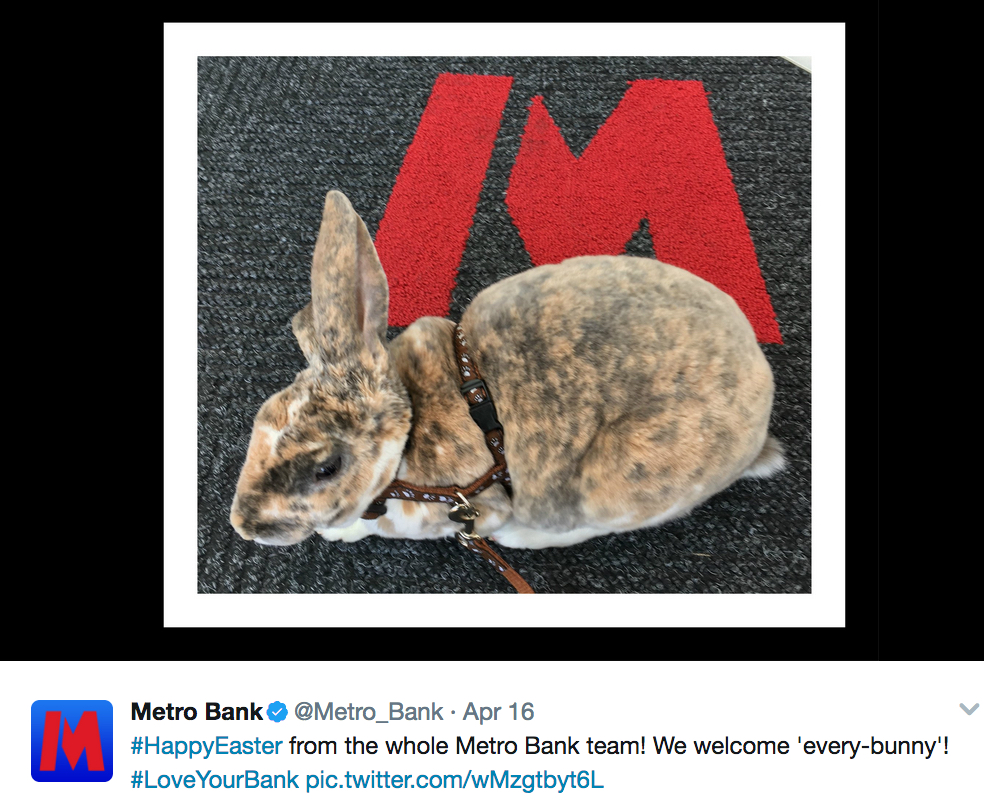
So is the future of banking personalised customer service, a problem for many? Convenient service in neighborhood branches ('stores') has been fueling Metro Bank's UK growth since 2010. Metro Bank is poised for full-year profitability and has attracted 1 million customers with 48 branches.

As a 'challenger bank', Metro Bank is targeting individuals and businesses who aren't satisfied with the established banks. To induce switching, Metro Bank keeps its branches open 7 days, with extended hours for evening transactions. The branches look more like cheerful retail stores than stuffy banks. And it's connecting with customers on social media: Metro Bank has 13k Twitter followers and 24k LinkedIn followers.

Or is the future of banking in technology, speeding transactions without face-to-face service? Between more sophisticated cash machines and smartphone banking functionality, do customers want or need to visit a branch these days? Customer behaviour is shifting as more people adopt on-the-go banking using apps. Pockit is a startup financial services firm that offers app-based transactions such as remittances.

Sometimes cash is needed for everyday transactions. NCR, which makes video-capable ATMs, notes that such automation is 'a bank in a box', ideal for locations where a bank wants to serve its local customers, with or without a branch.